
Official statement
Other statements from this video 8 ▾
- □ Le contenu de la page est-il vraiment le facteur de pertinence le plus important pour Google ?
- □ Google supprime-t-il vraiment les mots vides de vos requêtes ?
- □ Google élargit-il vraiment vos requêtes avec des synonymes automatiquement ?
- □ Comment la localisation de l'utilisateur transforme-t-elle réellement vos résultats de recherche ?
- □ Qualité de page vs qualité de site : laquelle pèse le plus dans l'algorithme Google ?
- □ L'unicité du contenu influence-t-elle vraiment le classement dans Google ?
- □ L'importance relative d'une page impacte-t-elle vraiment sa qualité selon Google ?
- □ Pourquoi Google affiche-t-il des fonctionnalités SERP différentes selon vos requêtes ?
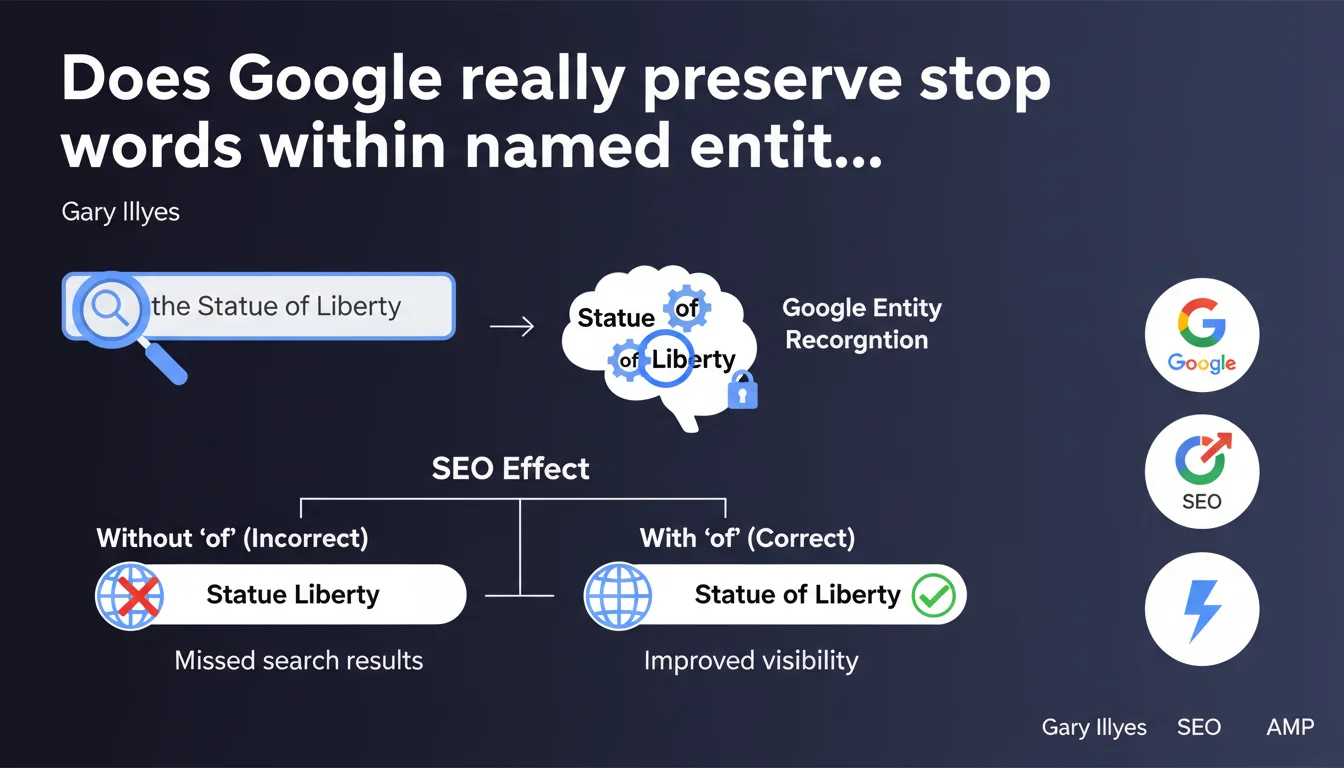
Google recognizes named entities in search queries and intentionally preserves the stop words that are an integral part of them. For 'the Statue of Liberty', the word 'of' is not removed because it belongs to the entity itself. This approach directly impacts query matching and search result relevance.
What you need to understand
What is a named entity for Google?
A named entity refers to a proper noun: a person, place, organization, work, or brand. Google does not treat these entities as a simple succession of keywords. The engine identifies their nature and preserves their syntactic integrity.
Concretely? Stop words (of, the, de, le...) are usually ignored in standard query processing. But when they are part of an entity, Google retains them. 'The Statue of Liberty' remains a complete semantic unit, 'of' included.
Why is this distinction important for SEO?
Because exact entity matching influences ranking. If your page uses 'Statue Liberty' instead of 'Statue of Liberty', Google understands the intent but the relevance signal differs. The absence of the preposition can reduce strict correspondence.
This logic extends to linguistic variations. Google adapts its processing by language: 'Tour de France' preserves 'de', while 'Tour France' is recognized but less precise.
What are the technical impacts of this recognition?
- Google maintains a knowledge base (Knowledge Graph) that catalogs entities and their canonical forms
- Semantic markup (Schema.org) strengthens this identification when properly implemented
- The query context helps resolve ambiguities: 'Paris' can refer to the French city or Paris Hilton depending on the rest of the query
- Link anchors containing complete entities transmit a stronger signal than truncated variants
SEO Expert opinion
Is this statement consistent with real-world observations?
Yes, largely. Tests show that Google favors exact entity matches in title tags and H1s. A page optimized for 'University of Oxford' typically outperforms 'University Oxford', even though both rankings may overlap.
But — and this is crucial — this rule doesn't operate in isolation. Domain authority, content depth, and user signals often weigh more heavily than a single syntactic comma. Don't overestimate this factor in isolation.
Where does this logic reach its limits?
On long-tail queries and natural variations. Users type 'statue liberty new york' or 'liberty statue', without respecting the canonical form. Google must balance strict recognition with semantic flexibility.
Another blind spot: emerging or niche entities. If your client launches 'The Future of AI Summit', Google will take time to catalog this entity. In the meantime, the engine treats it as a series of standard words. [To verify]: no public data on the average timeframe for integrating a new entity into the Knowledge Graph.
Should you systematically stick to the official form?
No. Readability and editorial flow come first. If 'the Rolling Stones' sounds better than 'Rolling Stones' in your sentence, keep it. But in high-weight SEO zones (title, H1, anchors), align yourself with the recognized form.
Practical impact and recommendations
How do you verify that your entities are correctly recognized?
Test your main entities in Google Search. If a Knowledge Panel appears, the entity is cataloged. If not, strengthen the signals: Schema.org markup for Organization, Person, or Place types as appropriate.
Analyze your Search Console data. Compare impressions/clicks for 'University of Cambridge' versus 'University Cambridge'. If the gap is significant, adjust your content toward the complete form.
What concrete optimizations should you apply?
- Audit your title tags: replace truncated entities with their canonical forms (check Wikipedia or the Knowledge Graph for the official form)
- Harmonize your internal anchors: 'the Museum of Modern Art' rather than 'Museum Modern Art', especially on strategic pages
- Implement Schema.org on pages mentioning key entities: Product, Event, Organization, Person with the 'name' property respecting the complete form
- In your editorial content, introduce the complete entity on first mention, then vary naturally (pronouns, short forms) to avoid heaviness
- Monitor featured snippets: Google often displays the canonical form there, which validates your choice
What should you do for local or emerging entities?
Create cross-platform consistency. If you manage 'The Green Coffee House' (a new café), ensure that Google My Business, directories, social media, and your website all use exactly the same name. This redundancy accelerates recognition.
Produce authoritative content. External articles citing your entity with its complete form strengthen Google's learning. Press releases, guest articles, interviews — every mention counts.
❓ Frequently Asked Questions
Google ignore-t-il toujours les mots vides hors entités ?
Doit-on inclure les articles définis dans les balises title pour toutes les entités ?
Les variations d'entités (pluriel, accents, majuscules) affectent-elles le ranking ?
Comment savoir si mon entité de marque est reconnue par Google ?
Les entités traduites doivent-elles conserver la structure de la langue source ?
🎥 From the same video 8
Other SEO insights extracted from this same Google Search Central video · published on 09/04/2024
🎥 Watch the full video on YouTube →
💬 Comments (0)
Be the first to comment.