
Official statement
What you need to understand
Why Does Google Encourage Taking Action During an Update?
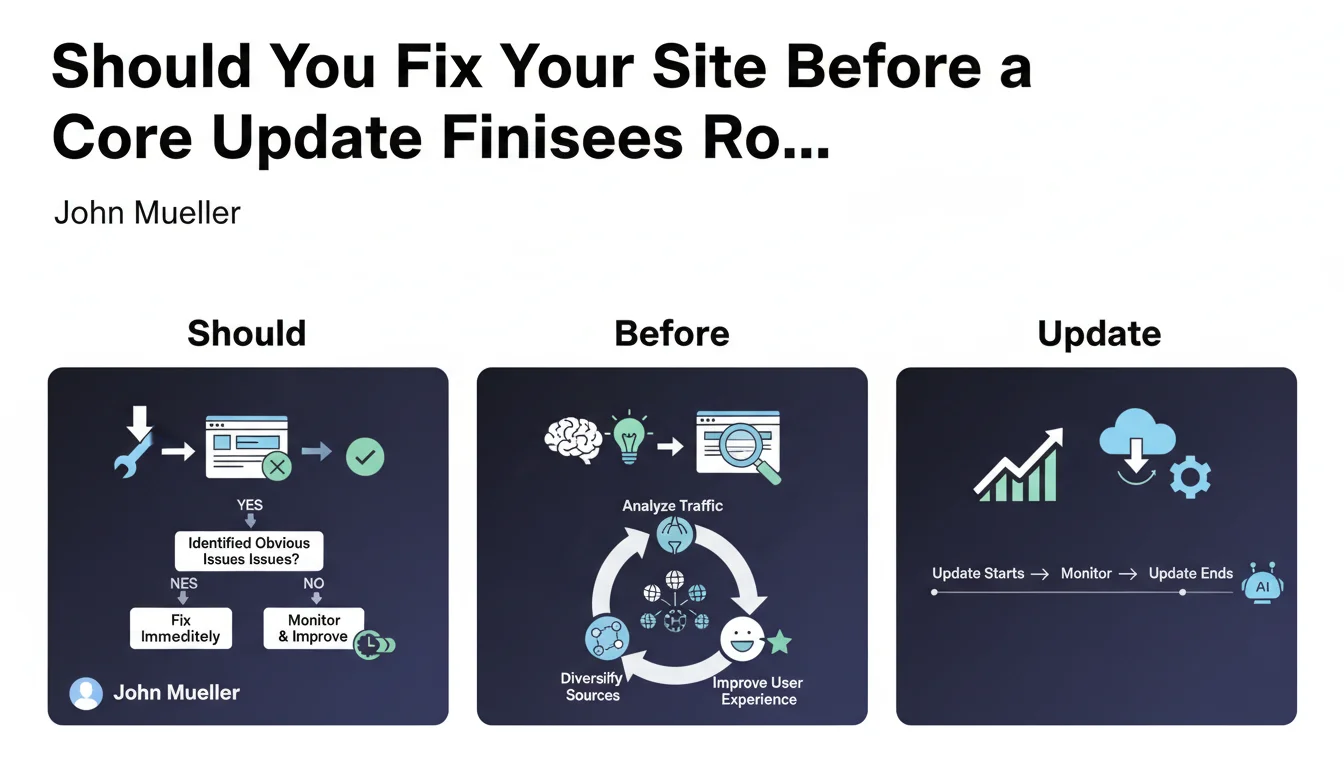
John Mueller's statement during the March 2024 Core Update challenges a widespread belief in the SEO community. Traditionally, many practitioners recommend waiting for an update to finish rolling out before intervening.
Mueller reverses this logic: if you identify obvious problems on your site, correcting them immediately can allow you to benefit from the improvement as soon as the rollout completes. Passive waiting could instead prolong an unfavorable situation.
What Does "Obvious Problems" Really Mean?
Google is referring to clear structural defects that harm user experience. This isn't about frantically modifying your content in response to every ranking fluctuation.
Obvious problems include: low-quality content, pages overloaded with ads, confusing navigation, excessive loading times, or massive duplicate content.
What's the Underlying Philosophy Behind This Recommendation?
Mueller emphasizes two fundamental principles: diversify your traffic sources and continuously improve your site for users rather than for algorithms.
This approach reflects Google's long-term vision: sites that survive updates are those that build real and lasting value for their visitors, independent of algorithmic fluctuations.
- Don't passively wait for a Core Update to finish if structural problems are identified
- Focus on obvious defects that harm user experience
- Prioritize continuous improvement over reactive optimization
- Diversify acquisition channels to reduce dependence on Google
- Build for users, not for algorithms
SEO Expert opinion
Is This Recommendation Consistent with Real-World Observations?
In my practice, I've observed contradictory results depending on context. Sites that corrected major issues during a Core Update have sometimes experienced spectacular recoveries, while others have suffered increased volatility.
The key lies in the nature of the corrections made. Structural and qualitative modifications (removing poor content, improving UX) generally yield better results than superficial tactical adjustments.
What Essential Nuances Should Be Added to This Advice?
Mueller's advice involves a calculated risk that isn't made explicit. During a Core Update, algorithmic signals fluctuate, and your corrections may be evaluated in an unstable context.
The distinction between "obvious problems" and "speculative optimizations" is crucial. If you have to ask yourself whether a problem is obvious, it's probably not obvious enough to warrant urgent intervention.
When Is It Better to Wait for Stabilization?
If your site is experiencing significant but temporary fluctuations, without any identifiable structural problem, waiting remains the most prudent strategy. Core Updates can last 2 to 4 weeks, during which the algorithm continuously reevaluates.
Similarly, if you're considering major changes in editorial positioning or technical redesign, it's better to wait for a stable period to precisely measure the impact of your actions.
Practical impact and recommendations
What Concrete Actions Should You Take During a Core Update?
First focus on an objective diagnosis of your site. Use Search Console data, Analytics, and user feedback to identify real problems, not assumptions.
Prioritize corrections that improve measurable user experience: loading speed, mobile usability, navigation clarity, visible content quality. These elements have an immediate and lasting impact.
- Analyze pages that have lost significantly in visibility (more than 30-40%)
- Identify common patterns: thin content, excessive advertising, degraded UX
- Remove or substantially enrich low-value content
- Improve Core Web Vitals on strategic pages
- Check for absence of cannibalization between similar pages
- Precisely document each modification for post-rollout analysis
What Mistakes Should You Absolutely Avoid During an Update?
Don't fall into the trap of frantic optimization. Modifying your content daily in reaction to fluctuations creates noise and prevents any reliable analysis of real impact.
Also avoid radical changes in editorial line or structure. A major redesign during a Core Update makes it impossible to identify the causes of your ranking variations.
Don't focus exclusively on Google. This is the ideal time to diversify your traffic sources: social networks, email marketing, partnerships, video SEO.
How Do You Implement a Continuous Improvement Strategy?
Rather than reacting to updates, establish a regular optimization schedule. Audit a portion of your site monthly and progressively improve overall quality.
Implement user-centered performance indicators: engagement time, adjusted bounce rate, conversions, qualitative feedback. These metrics are more stable than rankings and reflect your site's true value.
💬 Comments (0)
Be the first to comment.