
Official statement
Other statements from this video 23 ▾
- □ Does Google really count every single visible link pointing to your site in Search Console?
- □ Should you really concentrate your content on fewer pages to rank better?
- □ Do Google's product review criteria apply even if your site isn't classified as a review site?
- □ Does Google's Indexing API really work for all types of content?
- □ Does E-A-T Really Impact Google Rankings, or Is It Just a Myth?
- □ Do unlinked brand mentions really boost your SEO rankings?
- □ Do user comments really improve your Google rankings?
- □ Do premium SSL certificates really impact Google rankings?
- □ Does having the same content in both PDF and HTML formats hurt your SEO rankings through cannibalization?
- □ Can you really control PDF indexing through HTTP headers?
- □ Should you still use rel=next and rel=prev tags for pagination in 2024?
- □ Does Googlebot really index all your infinite scroll content?
- □ Should you really worry about the referrer page shown in Google Search Console?
- □ Should you really redirect the old sitemap with a 301 or submit the new one directly instead?
- □ Is a 97% crawl refresh rate actually a positive sign for your website's health?
- □ Does your server speed actually control how often Google crawls your site?
- □ Does Google really measure crawl speed and Core Web Vitals the same way — and why should you care?
- □ Does Google really slow down crawling after a hosting migration, and how long does it last?
- □ Is the crawl rate parameter really a ceiling rather than something Google will try to maximize?
- □ Can CTR really penalize the rest of your website?
- □ Is internal linking really the most critical factor for SEO success?
- □ Does internal linking really take effect instantly after Google recrawls your pages?
- □ Should you worry if Google isn't crawling all your pages?
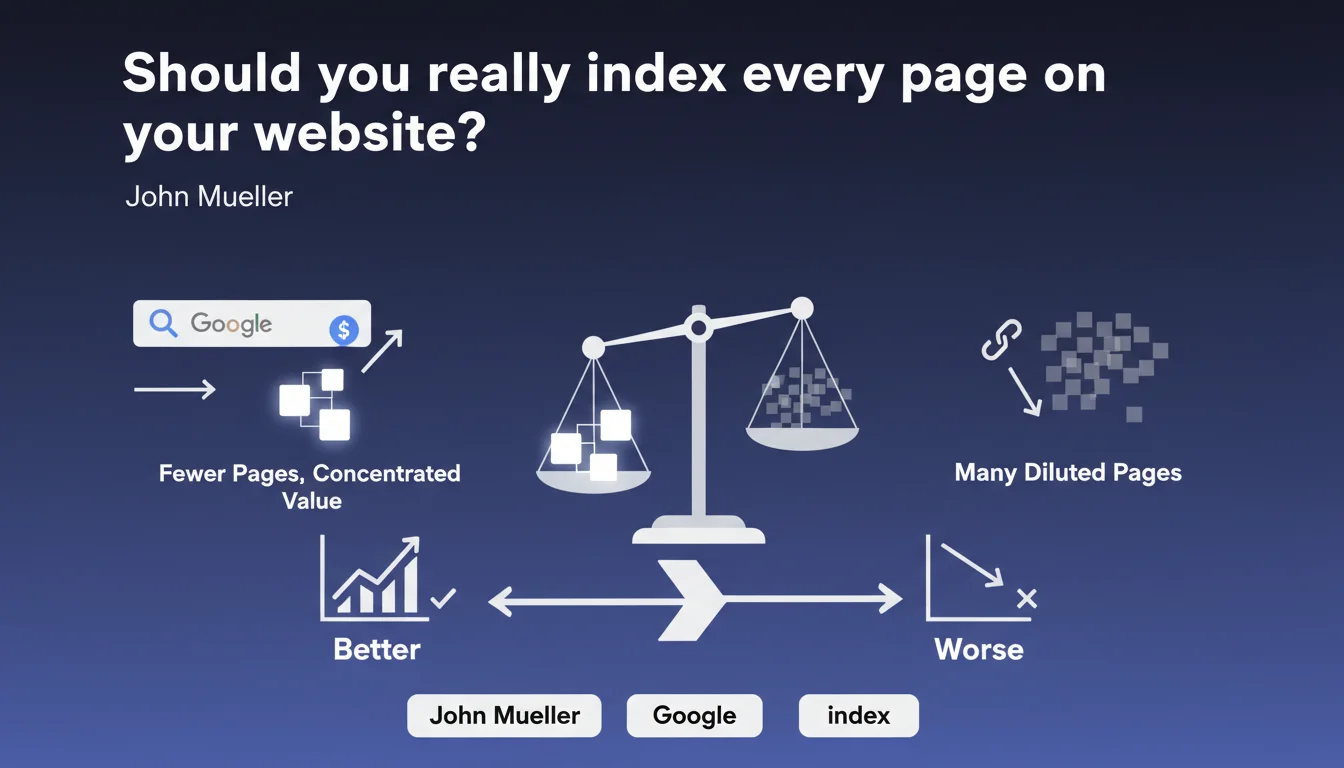
Google doesn't impose any ideal ratio between the total number of pages on a site and those that should be indexed. The preferred approach: concentrate value on fewer pages rather than dilute authority across excessive volume. Quality consistently trumps quantity when it comes to indexation.
What you need to understand
Why does Google refuse to give a precise ratio?
Google doesn't set a numerical rule because each site has unique architecture and different objectives. An e-commerce store with 50,000 products is nothing like a blog with 200 articles. Imposing a universal percentage would be absurd.
This position also reflects a technical reality: the algorithm evaluates the individual relevance of each page, not a global indexation score. The search engine doesn't need you to reach a threshold — it simply wants to find content that deserves to be ranked.
What does "fewer pages with more value" actually mean in practice?
The statement directly targets sites that artificially inflate their volume: pointless tag pages, nearly identical variations, auto-generated content with no real utility. This phenomenon dilutes crawl budget and scatters quality signals.
Concentrating value means merging redundant content, removing orphaned pages, deindexing what adds nothing to the user experience. Every indexed URL must justify its existence through a specific search intent.
Does this apply to all types of websites?
Not exactly. A news site can legitimately publish hundreds of pages per week. A local directory needs to index each business listing. The principle remains valid, but application varies depending on your editorial model.
The crucial nuance: even with high volume, each page must have an identifiable added value. It's not the absolute number that's problematic, it's the proportion of weak or duplicate content.
- Google sets no ratio of total pages / indexed pages
- Concentrating value on fewer pages outperforms spreading it across many
- Evaluation happens page by page, not at the site-wide level
- Business context dictates the legitimate volume of indexation
- Every indexed URL must respond to a specific search intent
SEO Expert opinion
Is this recommendation consistent with real-world observations?
Absolutely. Technical audits consistently show that sites that prune their index see their strategic pages perform better. Crawl budget concentrates on relevant URLs, quality signals no longer get dispersed.
However — and this is where Google remains vague — the definition of "concentrated value" remains subjective. [To be verified] because Google provides no measurable criteria for qualifying what deserves indexation. We're still navigating blind on this notion of "quality."
What gray areas remain in this statement?
Mueller carefully avoids discussing technical thresholds. From how many weak pages is the entire site penalized? What percentage of thin content triggers overall devaluation? Radio silence.
Another evasive point: treatment of very high-volume sites. A pure-play e-commerce player with 500,000 product references can't "concentrate value" like a brochure site. Google suggests a universal approach while constraints differ radically by sector.
In what cases does this rule not apply?
News sites and large editorial platforms can't play the minimalism card. Their model relies on freshness and volume. As long as each article covers a specific angle, mass indexation remains legitimate.
Same goes for comparison sites, directories, or marketplaces: their value comes precisely from comprehensiveness. Massive deindexation would kill their value proposition. Here, the challenge becomes fine-grained quality management rather than crude volume reduction.
Practical impact and recommendations
How do you identify pages that dilute your site's value?
Start by cross-referencing Search Console with your analytics tool. Extract indexed URLs generating zero clicks over 6 months, zero impressions, zero organic traffic. These are your first deindexation candidates.
Next examine technical pages: internal search results, parameterized filters, poorly managed pagination, tags without unique content. These URLs burn crawl budget without return. A well-calibrated robots.txt or noindex tags solve the problem.
What concrete actions should you take following this statement?
Launch a complete indexation audit: how many pages does Google have in its index vs how many do you actually want indexed? The gap often reveals massive leaks (archives, empty categories, duplicate content).
For each type of weak content, make a decision: improve, merge, redirect, or deindex. Orphaned pages disappear. Similar content consolidates via 301 redirects. Pointless variations get noindexed.
Strengthen retained pages: targeted internal linking, enriched content, on-page optimizations. If you cut your index in half, the remaining pages must become twice as powerful.
- Extract all indexed URLs via Search Console and exhaustive crawl
- Identify pages with zero traffic / zero impressions over 6+ months
- Spot duplicate or near-identical content to merge
- Block indexation of pages with no SEO value (filters, internal search)
- Consolidate weak content via 301 redirects to pillar pages
- Strengthen internal linking toward retained strategic pages
- Monitor indexation rate evolution and performance post-cleanup
❓ Frequently Asked Questions
Quel est le bon ratio de pages indexées pour un site e-commerce ?
Faut-il désindexer les anciennes pages de blog peu performantes ?
Comment Google mesure-t-il la « valeur concentrée » d'une page ?
Les pages en noindex consomment-elles toujours du crawl budget ?
Un site peut-il être pénalisé pour avoir trop de pages indexées ?
🎥 From the same video 23
Other SEO insights extracted from this same Google Search Central video · published on 18/02/2022
🎥 Watch the full video on YouTube →
💬 Comments (0)
Be the first to comment.