
Official statement
Other statements from this video 23 ▾
- □ Does Google really count every single visible link pointing to your site in Search Console?
- □ Should you really concentrate your content on fewer pages to rank better?
- □ Do Google's product review criteria apply even if your site isn't classified as a review site?
- □ Does Google's Indexing API really work for all types of content?
- □ Do unlinked brand mentions really boost your SEO rankings?
- □ Do user comments really improve your Google rankings?
- □ Do premium SSL certificates really impact Google rankings?
- □ Does having the same content in both PDF and HTML formats hurt your SEO rankings through cannibalization?
- □ Can you really control PDF indexing through HTTP headers?
- □ Should you still use rel=next and rel=prev tags for pagination in 2024?
- □ Does Googlebot really index all your infinite scroll content?
- □ Should you really index every page on your website?
- □ Should you really worry about the referrer page shown in Google Search Console?
- □ Should you really redirect the old sitemap with a 301 or submit the new one directly instead?
- □ Is a 97% crawl refresh rate actually a positive sign for your website's health?
- □ Does your server speed actually control how often Google crawls your site?
- □ Does Google really measure crawl speed and Core Web Vitals the same way — and why should you care?
- □ Does Google really slow down crawling after a hosting migration, and how long does it last?
- □ Is the crawl rate parameter really a ceiling rather than something Google will try to maximize?
- □ Can CTR really penalize the rest of your website?
- □ Is internal linking really the most critical factor for SEO success?
- □ Does internal linking really take effect instantly after Google recrawls your pages?
- □ Should you worry if Google isn't crawling all your pages?
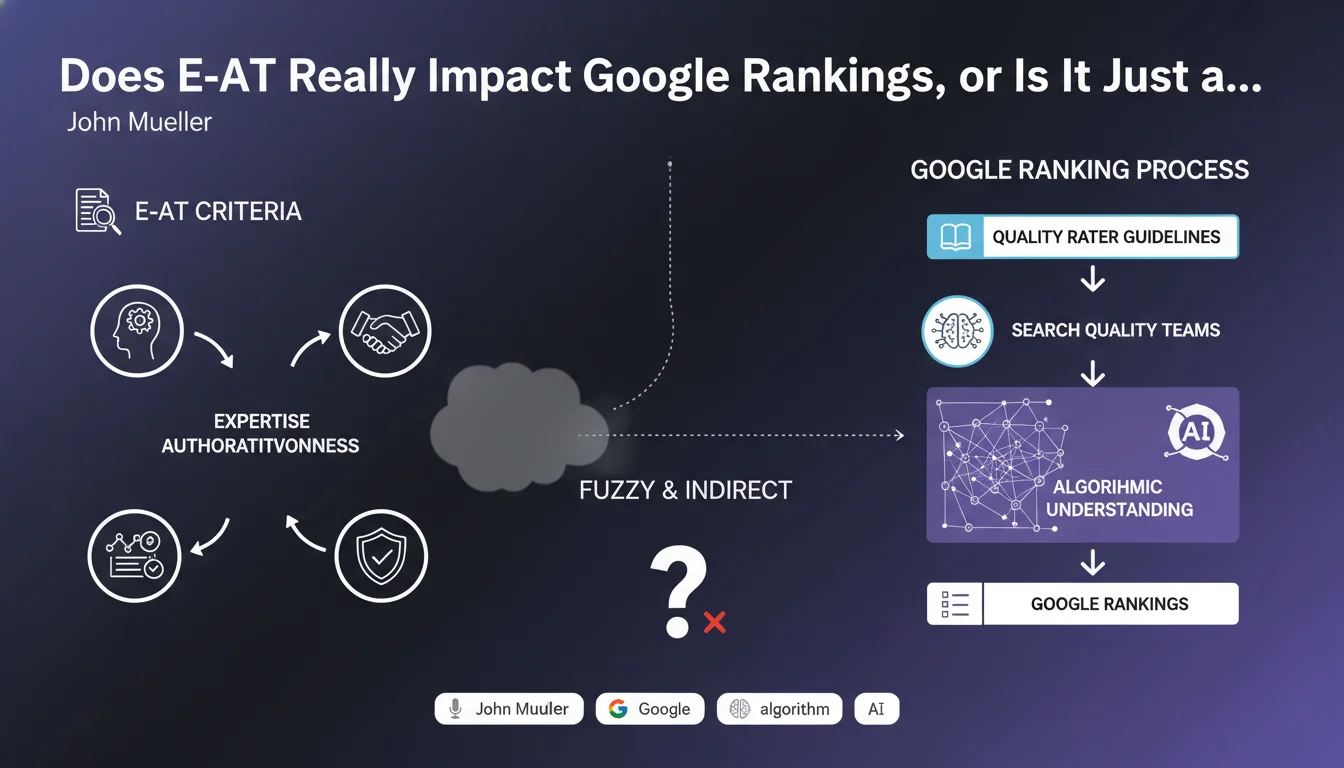
Google doesn't assign any direct E-A-T score to pages. Expertise-Authoritativeness-Trustworthiness criteria are used only by Quality Raters to manually evaluate search result quality. Search Quality teams attempt to translate these concepts into algorithmic signals, but the process remains unclear and indirect.
What you need to understand
Why does Google talk about E-A-T if no score actually exists?
E-A-T (Expertise, Authoritativeness, Trustworthiness) appears in the Quality Rater Guidelines, a document intended for human evaluators who rate the relevance of search results. These evaluators don't directly modify rankings — they provide data that helps Google improve its algorithms.
Mueller clarifies that there is no E-A-T metric you could measure with a tool. Google's teams seek to identify algorithmic signals that correlate with what Quality Raters judge as "high quality," but with no guarantee they fully achieve this.
What does "indirect influence" mean in concrete terms?
Algorithms attempt to detect observable characteristics that generally correspond to an expert, authoritative, or trustworthy site. This can include quality backlinks, content depth, author reputation, or even update frequency within an expertise domain.
The influence remains indirect because Google doesn't assign a global E-A-T score. It mobilizes dozens, even hundreds of signals to estimate whether a page deserves to rank for a sensitive query. The final result may appear consistent with E-A-T without this concept being hardcoded.
Why does this gray area persist?
Translating subjective notions like "trustworthiness" or "expertise" into measurable algorithms remains a massive technical challenge. Quality Raters judge in context — an expert recognized in one field can be completely ignorant in another. This human nuance is difficult to automate.
Google openly acknowledges this is a fuzzy domain. Rather than forcing a single score, Search Quality teams explore combinations of signals that statistically correlate with human judgments of quality.
- No E-A-T score is calculated or visible in ranking systems
- Quality Raters use E-A-T to manually evaluate search result quality
- Google attempts to convert these human evaluations into multiple algorithmic signals
- Influence remains indirect, composite, and difficult to isolate
- YMYL sectors (health, finance) are particularly sensitive to these criteria
SEO Expert opinion
Is this statement consistent with what we observe in practice?
Yes, largely. Sites that rank on YMYL (Your Money Your Life) queries often display strong credibility signals: identified authors with detailed bios, mentions in specialized press, backlinks from recognized institutions. These elements don't stem from an "E-A-T score" but from an accumulation of positive signals.
We also observe that Google values thematic consistency: a site that regularly publishes on a specific topic gains perceived authority, especially if other expert sources cite it. It remains indirect — no tool will tell you "your E-A-T is 7/10" — but the correlations are real.
[To verify]: some SEO tools promise to measure E-A-T with proprietary scores. These are approximations based on proxies (backlinks, brand mentions, etc.), not an official Google metric. Let's be honest: nobody outside Google knows exactly which signals weigh most heavily.
In which cases might this rule not apply?
On generic informational queries without critical stakes, E-A-T matters less. A cookie recipe doesn't require the same level of authority as a guide on cancer treatments. Google adjusts its requirements based on query sensitivity.
Similarly, a recent but ultra-specialized site can outrank an established competitor if its content is significantly more comprehensive and better sourced. Longevity helps, but it isn't enough — and that's good.
Should you really care if it's "fuzzy"?
Absolutely. The fact that Google doesn't reveal technical details doesn't invalidate its observed impact. Sites that neglect their perceived credibility struggle to rank on competitive or sensitive topics. Think of E-A-T as a guiding framework, not as a mechanical checklist.
The mistake would be to wait for a tool to give you a magic score before taking action. Focus on the fundamentals: identifiable authors, cited sources, demonstrated expertise, external reputation. These are signals Google can capture, even indirectly.
Practical impact and recommendations
What should you do concretely to strengthen E-A-T?
Start by identifying your authors. Every sensitive article should mention who wrote it, with a brief bio and links to their qualifications (LinkedIn, academic publications, professional profiles). Google can cross-reference this information to assess legitimacy.
Next, cite your sources. Content that references studies, recognized institutions, or domain experts gains credibility. Outbound links to established authorities don't "steal" your PageRank — they signal that you're part of a quality ecosystem.
Build your external reputation. Obtain mentions in specialized media, participate in conferences, publish opinion pieces on recognized platforms. These off-site signals strengthen your brand's or authors' perceived authority.
What mistakes should you absolutely avoid?
Don't publish under a pseudonym or "Editorial Team" on YMYL topics. Google looks for identifiable authors with verifiable expertise. An article signed by an unknown person will struggle to rank against content signed by a certified doctor.
Also avoid stuffing your content with technical jargon without clear structure. Expertise is shown through clarity and depth, not obscurity. A good expert explains without over-simplifying.
- Add a detailed bio for each author with links to professional profiles
- Systematically cite primary sources (studies, official data)
- Obtain backlinks from authoritative sites in your sector
- Clearly display your legal information, privacy policy, and contact details
- Regularly update sensitive content to reflect domain developments
- Remove or improve superficial content that dilutes your perceived authority
- Encourage brand mentions and external citations without links (brand signals)
How can you verify your site is progressing on these criteria?
Analyze your performance on YMYL queries specifically. If you're stalling on these terms despite good technical content, it's likely a signal of perceived authority deficit. Compare your competitors: do they have more visible authors, higher-quality backlinks, superior media presence?
Use tools like Ahrefs or Semrush to audit your link profile. But remember that quantity alone isn't enough — thematic diversity and referring domain authority matter more.
❓ Frequently Asked Questions
Peut-on mesurer l'E-A-T avec un outil SEO ?
L'E-A-T s'applique-t-il à tous les types de sites ?
Faut-il avoir un auteur expert pour chaque article ?
Les backlinks suffisent-ils à renforcer l'E-A-T ?
Google pénalise-t-il les sites avec un E-A-T faible ?
🎥 From the same video 23
Other SEO insights extracted from this same Google Search Central video · published on 18/02/2022
🎥 Watch the full video on YouTube →
💬 Comments (0)
Be the first to comment.