
Official statement
What you need to understand
What exactly is PageRank sculpting and why are we still talking about it?
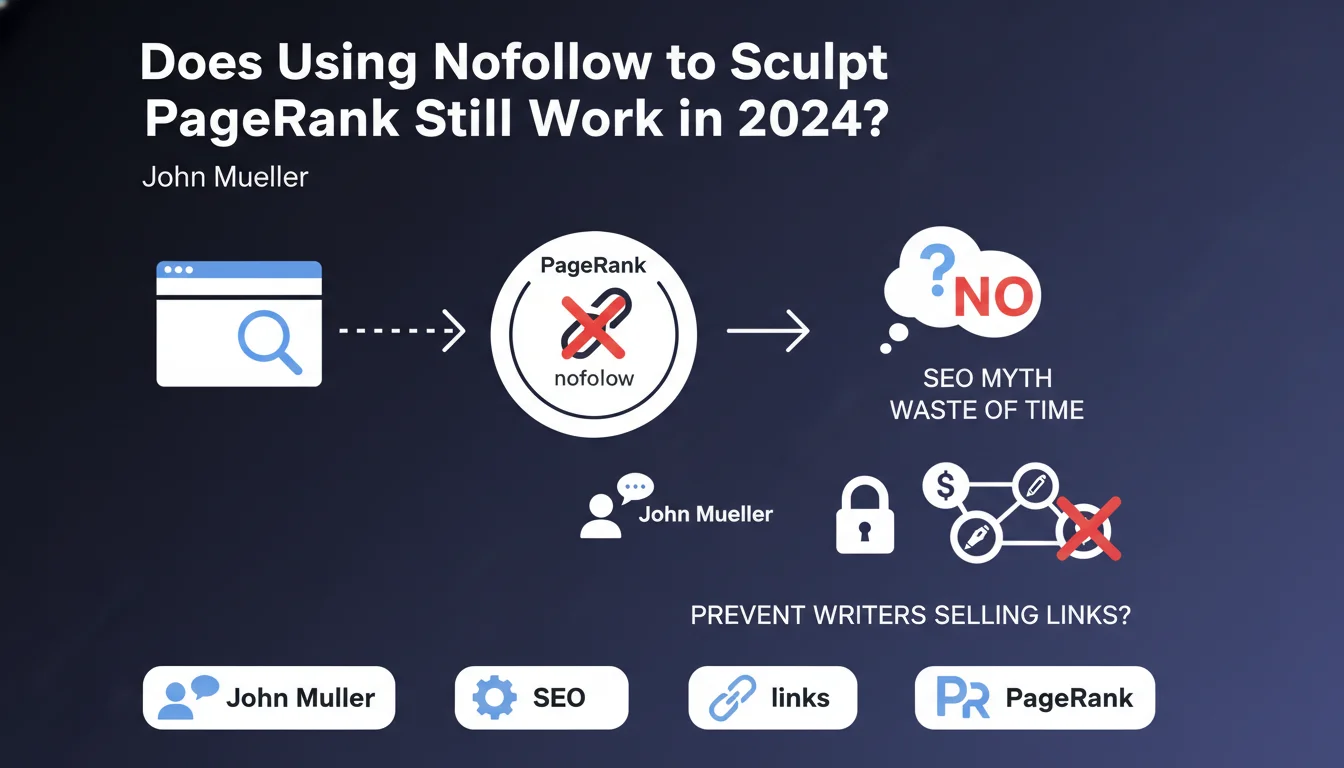
PageRank sculpting was a popular SEO technique in the 2000s. It consisted of placing nofollow attributes on certain internal links to concentrate link juice towards strategic pages.
Google officially ended this practice in 2009 by modifying how nofollow works. Yet some SEOs continue to believe they can manipulate PageRank distribution this way.
What does Google actually say about using nofollow internally?
According to Google engineers, adding a nofollow attribute to an internal link does not preserve the PageRank that would have been transmitted. This PageRank is simply lost in the overall calculation.
If page A has 10 points of PageRank and 5 outgoing links including 2 with nofollow, the 10 points are divided by 5 (not by 3). The nofollow links therefore receive 0, but the others don't receive more as a result.
Why do some sites continue to use nofollow extensively?
Google suspects that intensive use of nofollow on certain sites responds to commercial motivations. Owners sometimes seek to prevent their writers or contributors from placing undeclared sponsored links.
This practice reveals a lack of understanding of how the algorithm really works and a waste of time in SEO optimization.
- Nofollow does not preserve PageRank on the source page
- The PageRank that would have been transmitted is permanently lost in the calculation
- PageRank sculpting via nofollow has been ineffective since 2009
- Massive use of nofollow often reflects a misunderstanding of the algorithm
- Nofollow remains relevant for untrusted or sponsored external links
SEO Expert opinion
Is this statement consistent with what SEOs observe in the field?
Absolutely. Empirical tests conducted by the SEO community since 2009 confirm that PageRank sculpting via nofollow no longer works. Sites that have abandoned this practice have seen no loss in performance.
Some SEO tools nevertheless continue to suggest this optimization, creating persistent confusion. It's time to definitively abandon this obsolete technique that only consumes time and resources.
Are there exceptions where nofollow remains strategically relevant?
Nofollow retains its relevance for external links to sites whose content you don't want to vouch for. It also remains mandatory for all sponsored or advertising links according to Google's guidelines.
On the other hand, for internal linking, using nofollow provides no SEO benefit. It's better to focus on a coherent and natural link architecture.
What are the real techniques for optimizing PageRank distribution?
The best approach is to work on information architecture and crawl depth. Place your strategic pages at 3 clicks maximum from the homepage and create thematic hubs.
Contextual links in content transmit more value than navigation links. Favor intelligent internal linking based on semantics and user intent rather than obsolete mathematical calculations.
Practical impact and recommendations
What should you actually do with existing nofollow attributes?
Start with a complete audit of your internal links to identify all nofollow attributes present. Use tools like Screaming Frog or Semrush to extract this comprehensive list.
Systematically remove nofollow from strategic internal links pointing to your conversion pages or high-value content. Keep them only on untrusted external links.
- Perform a complete crawl of the site to identify all internal nofollow links
- Remove nofollow attributes from internal links to priority pages
- Check the configuration of CMS and plugins that automatically add nofollow
- Keep nofollow only for external links that are not controlled
- Add sponsored or ugc attributes according to the link context
How can you restructure your internal linking to maximize PageRank?
Identify your strategic pages (conversion, traffic, rankings) and ensure they receive links from your high PageRank pages. The homepage and highly-linked pages are your best allies.
Create semantic silos where pages on the same topic mutually reinforce each other. Prioritize quality and contextual relevance rather than quantity of links.
What common mistakes should you avoid in your internal linking strategy?
Don't fall into the trap of over-optimization by creating artificial link schemes. Google values naturalness and coherence for the user above all.
Also avoid neglecting anchor text which remains a strong signal. Vary your anchors while maintaining semantic coherence with the destination page.
💬 Comments (0)
Be the first to comment.