
Official statement
What you need to understand
What situation is presented in this Google statement?
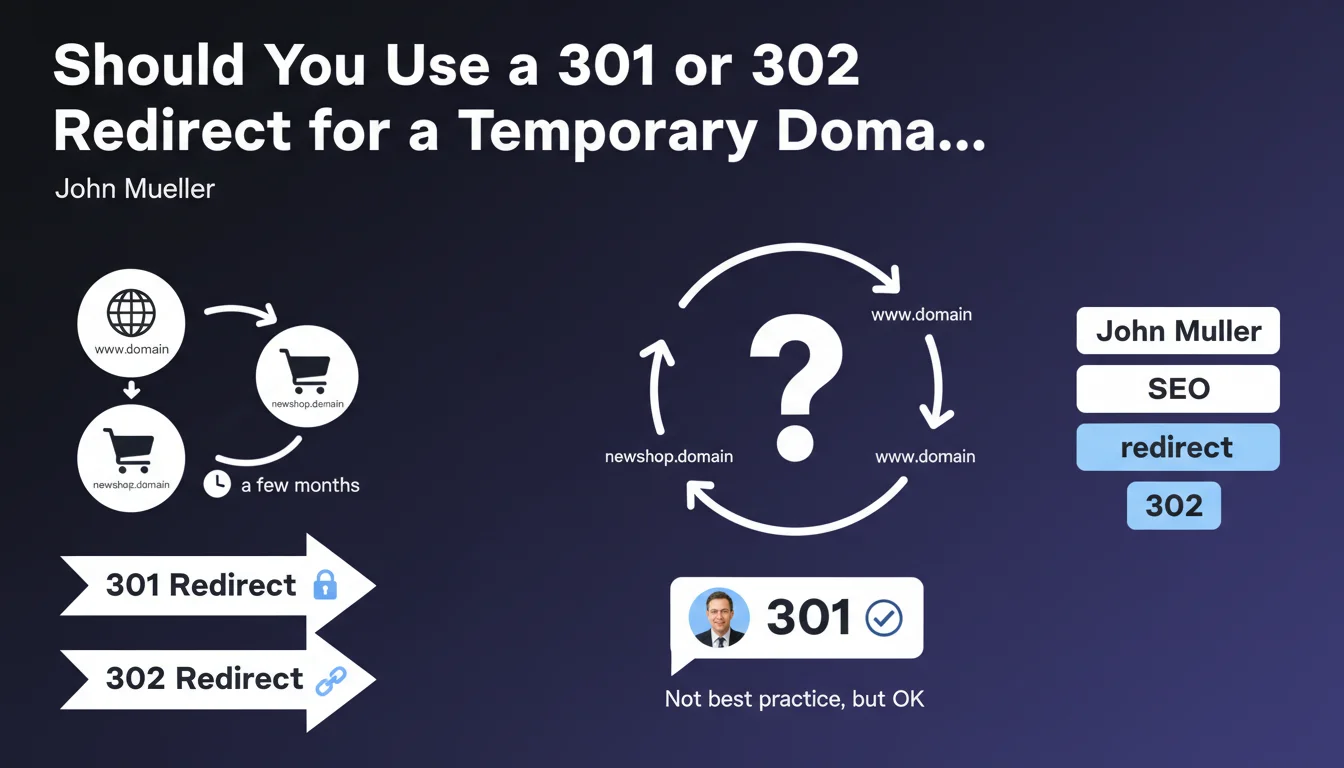
An SEO practitioner is faced with a particular case: they must temporarily migrate a site from www.domain to newshop.domain, then return to the old domain a few months later. This situation raises a legitimate question about the type of HTTP redirect to use.
Intuitively, one might think that a 302 redirect (temporary) would be appropriate since the change is temporary. Yet, John Mueller recommends using a 301 redirect (permanent), while acknowledging that this is not an ideal practice.
Why does Google recommend a 301 redirect in this case?
Google processes 301 redirects more reliably and consistently than 302 redirects. A permanent redirect ensures a complete transfer of PageRank and SEO signals to the new domain.
302 redirects can create ambiguity for search engines, which may hesitate between indexing the old or new URL. With a 301, Google clearly understands the intention to consolidate signals on the new destination.
What are the key takeaways from this recommendation?
- Use a 301 redirect even for a temporary domain change
- Do not use Google Search Console's change of address tool in this specific case
- Accept that this maneuver may cause short-term fluctuations
- Recovery of rankings is possible in the medium/long term according to Google
- Anticipate and consolidate your SEO strategy before, during, and after the migration
SEO Expert opinion
Is this recommendation consistent with what we observe in the field?
In practice, this statement confirms what many experts observe: Google handles 301 redirects better than 302s, even in atypical situations. Temporary redirects often create confusion in indexation.
However, the claim that it "won't cause problems in the medium/long term" deserves to be nuanced. In reality, each migration represents a significant SEO risk, and two successive migrations (round-trip) multiply these risks. High-authority sites generally fare better than more fragile sites.
What important nuances should be added to this recommendation?
The notion of "a few months" remains vague. If the change lasts less than 3 months, the risks are limited. Beyond 6 months, Google will likely have fully consolidated the new domain, making the return more problematic.
The advice not to use the change of address tool is crucial and often overlooked. This tool signals to Google a definitive change, which would be counterproductive for a temporary migration. You must absolutely avoid this mistake.
In what cases could this strategy fail?
Sites with low domain authority or few backlinks risk suffering significant losses during the first change, with no guarantee of recovery upon return. The double migration can exhaust their trust capital with Google.
If the return to the old domain occurs when Google has already deindexed the old URLs, recovery will be much longer and more uncertain. Timing is absolutely crucial in this delicate operation.
Practical impact and recommendations
How do you concretely implement this temporary migration?
Before the migration, make sure to document all your strategic URLs and their current performance. Create a precise mapping between old and new domains to ensure individual 301 redirects, not a global redirect.
During the phase on the new domain, maintain close monitoring of your rankings and organic traffic. Prepare the return in advance: never delete files from the old domain and keep technical control of both domains.
At the time of return, put 301 redirects back in place from the new domain to the old one. This double layer of redirects is not ideal, but necessary to avoid losing the signals acquired during the interim period.
What critical mistakes must you absolutely avoid?
Definitely do not use the change of address tool in Google Search Console, neither during the initial migration nor during the return. This tool signals a definitive change and would considerably complicate the rollback.
Do not let the temporary domain name expire after returning to the old domain. You must maintain control of the temporary domain and keep the redirects in place for at least 12 months to ensure a complete transition.
Avoid modifying the site architecture or internal linking during this period. Each additional change multiplies the variables and makes recovery more uncertain.
What checklist should you follow to secure this operation?
- Document the complete initial state: rankings, traffic, backlinks, strategic URLs
- Create a URL-by-URL mapping between old and new domains
- Implement individual 301 redirects (no global wildcard)
- Manually verify each important redirect
- DO NOT use the Search Console change of address tool
- Monitor rankings and indexation daily for 2 weeks
- Maintain technical control of both domains at all times
- Prepare the return plan from the start of the migration
- Upon return, implement 301s again from the new to the old domain
- Maintain redirects on the temporary domain for 12+ months
- Track the reindexation of the old domain via Search Console
💬 Comments (0)
Be the first to comment.