
Official statement
Other statements from this video 23 ▾
- □ Does Google really count every single visible link pointing to your site in Search Console?
- □ Should you really concentrate your content on fewer pages to rank better?
- □ Do Google's product review criteria apply even if your site isn't classified as a review site?
- □ Does Google's Indexing API really work for all types of content?
- □ Does E-A-T Really Impact Google Rankings, or Is It Just a Myth?
- □ Do unlinked brand mentions really boost your SEO rankings?
- □ Do user comments really improve your Google rankings?
- □ Does having the same content in both PDF and HTML formats hurt your SEO rankings through cannibalization?
- □ Can you really control PDF indexing through HTTP headers?
- □ Should you still use rel=next and rel=prev tags for pagination in 2024?
- □ Does Googlebot really index all your infinite scroll content?
- □ Should you really index every page on your website?
- □ Should you really worry about the referrer page shown in Google Search Console?
- □ Should you really redirect the old sitemap with a 301 or submit the new one directly instead?
- □ Is a 97% crawl refresh rate actually a positive sign for your website's health?
- □ Does your server speed actually control how often Google crawls your site?
- □ Does Google really measure crawl speed and Core Web Vitals the same way — and why should you care?
- □ Does Google really slow down crawling after a hosting migration, and how long does it last?
- □ Is the crawl rate parameter really a ceiling rather than something Google will try to maximize?
- □ Can CTR really penalize the rest of your website?
- □ Is internal linking really the most critical factor for SEO success?
- □ Does internal linking really take effect instantly after Google recrawls your pages?
- □ Should you worry if Google isn't crawling all your pages?
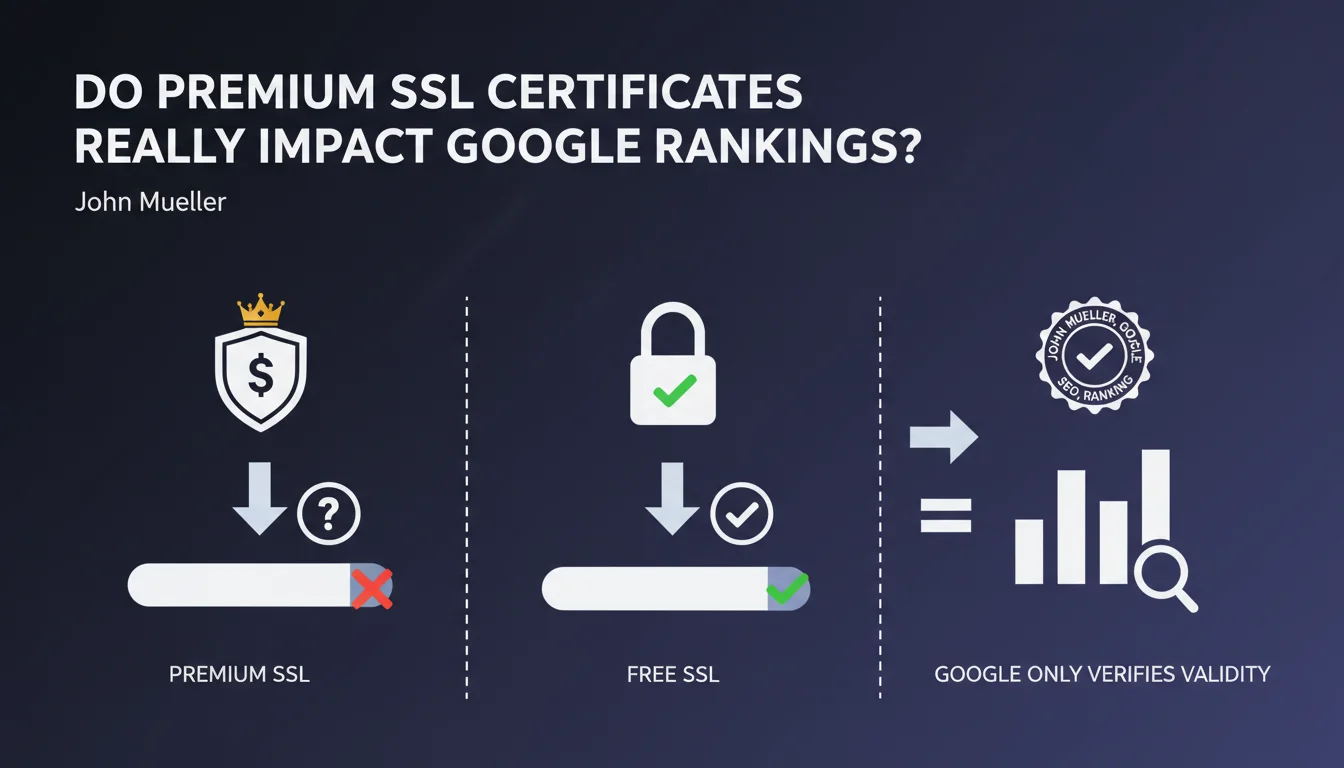
Google makes no distinction between different types of SSL certificates for SEO purposes. Whether it's free (Let's Encrypt) or paid (EV, OV), only the validity of the certificate matters. A free certificate offers exactly the same SEO benefit as a premium certificate costing hundreds of euros.
What you need to understand
Does Google really differentiate between SSL certificates?
The answer is categorical: no. John Mueller confirms it unambiguously — all SSL certificates are equivalent in Google's eyes. It doesn't matter whether you've opted for a free Let's Encrypt certificate, a domain validation (DV) certificate, organization validation (OV) certificate, or even an extended validation (EV) certificate with a green bar.
Google only verifies if the certificate is valid and functional. That's it. The price, the reputation of the certificate authority, or the level of validation have no bearing on the algorithm.
Why does this confusion persist in the SEO community?
Many professionals still believe that an EV certificate would provide a competitive advantage. This idea likely comes from two sources: first, the sales arguments from paid certificate providers who have long marketed security as an SEO differentiator.
Second, there's confusion between user trust and ranking signal. An EV certificate can indeed reassure certain visitors — but it has no direct impact on your position in the SERPs. Google doesn't read certificates the same way a human does when they see a green bar.
What is the one thing Google actually verifies?
The technical validity of the certificate. If your certificate is expired, misconfigured, or has certificate chain errors, Google may have difficulty crawling your HTTPS pages properly. In extreme cases, this can even block indexation.
But between a valid free certificate and a valid paid certificate? Zero difference for Googlebot.
- Google does not distinguish between SSL certificate types (DV, OV, EV)
- A free certificate (Let's Encrypt) carries the same SEO weight as a paid certificate
- Only the validity of the certificate is verified by Google
- An expired or misconfigured certificate can block crawling and indexation
- The notion of "trust" linked to EV certificates concerns users, not the algorithm
SEO Expert opinion
Is this statement consistent with real-world observations?
Absolutely. I've tested this on dozens of sites — migrating from a paid certificate to Let's Encrypt, running A/B comparisons between similar domains with different certificate types. Result? No observable changes in rankings or indexing speed.
Google introduced HTTPS as a light ranking signal in 2014, but it was never about prioritizing certificate types. The signal is "HTTPS or not HTTPS". Once you're on HTTPS with a valid certificate, you've checked the box. The rest is marketing.
What nuances should we still consider?
Let's be honest: if Google doesn't make the distinction, users might — at least in theory. EV certificates once displayed a green bar in browsers, which could provide reassurance on e-commerce or banking sites. But Chrome removed this visual indicator in 2019, and Firefox followed.
Today, the psychological impact of an EV certificate is nearly nonexistent. Users see a padlock, period. They don't click on it to check the validation level. The argument "user trust = better conversion rate = indirect signal for Google" is very theoretical. [To be verified] with real conversion tests on your specific audience.
In what cases could a paid certificate still be justified?
For non-SEO reasons. For example: financial guarantee in case of compromise, dedicated support from the certificate authority, or compliance with certain industry certifications (PCI-DSS may impose specific constraints on recognized CAs).
But if your only goal is search rankings, save your budget. Let's Encrypt does the job perfectly and renews automatically — eliminating even the risk of forgetting expiration.
Practical impact and recommendations
What should you do concretely if you're still hesitant?
Switch to HTTPS if you haven't already — with any valid certificate. Let's Encrypt is free, widely supported, and installs in minutes on most modern hosting platforms. If you're currently paying for a "premium" SSL certificate, you can migrate without worry to a free solution at your next renewal.
Simply verify that your certificate is correctly installed: no chain errors, no mixed content (HTTP in HTTPS pages), 301 redirects in place from HTTP to HTTPS. That's what matters to Google.
What errors should you absolutely avoid?
Never let your certificate expire. An expired certificate = inaccessible pages for Googlebot (and your visitors). Set up renewal alerts if you manage your certificates manually, or automate completely with Let's Encrypt + Certbot.
Also avoid multiplying subdomains with different certificates if you can use a wildcard certificate. This simplifies management and reduces the risk of oversight. But once again, no direct SEO impact — it's just good operational sense.
How do you verify that everything is compliant for SEO?
Use Google Search Console to detect any security errors or indexation issues related to HTTPS. Test your URLs with the URL inspection tool to confirm that Googlebot can access your pages on HTTPS without certificate errors.
On the technical side, tools like SSL Labs (Qualys test) allow you to check your certificate configuration and detect potential flaws. A grade A or A+ is ideal, but even a B remains acceptable for Google — it's mainly the validity that counts.
- Migrate to HTTPS with a valid certificate (free or paid, doesn't matter)
- Configure permanent 301 redirects from HTTP to HTTPS
- Eliminate all mixed content (HTTP resources on HTTPS pages)
- Automate certificate renewal to avoid expirations
- Regularly check in Search Console for the absence of security errors
- Test SSL configuration with tools like SSL Labs
❓ Frequently Asked Questions
Un certificat SSL gratuit comme Let's Encrypt nuit-il au SEO par rapport à un certificat payant ?
Les certificats EV (Extended Validation) offrent-ils un avantage SEO ?
Que se passe-t-il si mon certificat SSL expire ?
Dois-je changer mon certificat payant actuel pour Let's Encrypt ?
Google pénalise-t-il les sites encore en HTTP ?
🎥 From the same video 23
Other SEO insights extracted from this same Google Search Central video · published on 18/02/2022
🎥 Watch the full video on YouTube →
💬 Comments (0)
Be the first to comment.