
Official statement
Other statements from this video 23 ▾
- □ Should you really concentrate your content on fewer pages to rank better?
- □ Do Google's product review criteria apply even if your site isn't classified as a review site?
- □ Does Google's Indexing API really work for all types of content?
- □ Does E-A-T Really Impact Google Rankings, or Is It Just a Myth?
- □ Do unlinked brand mentions really boost your SEO rankings?
- □ Do user comments really improve your Google rankings?
- □ Do premium SSL certificates really impact Google rankings?
- □ Does having the same content in both PDF and HTML formats hurt your SEO rankings through cannibalization?
- □ Can you really control PDF indexing through HTTP headers?
- □ Should you still use rel=next and rel=prev tags for pagination in 2024?
- □ Does Googlebot really index all your infinite scroll content?
- □ Should you really index every page on your website?
- □ Should you really worry about the referrer page shown in Google Search Console?
- □ Should you really redirect the old sitemap with a 301 or submit the new one directly instead?
- □ Is a 97% crawl refresh rate actually a positive sign for your website's health?
- □ Does your server speed actually control how often Google crawls your site?
- □ Does Google really measure crawl speed and Core Web Vitals the same way — and why should you care?
- □ Does Google really slow down crawling after a hosting migration, and how long does it last?
- □ Is the crawl rate parameter really a ceiling rather than something Google will try to maximize?
- □ Can CTR really penalize the rest of your website?
- □ Is internal linking really the most critical factor for SEO success?
- □ Does internal linking really take effect instantly after Google recrawls your pages?
- □ Should you worry if Google isn't crawling all your pages?
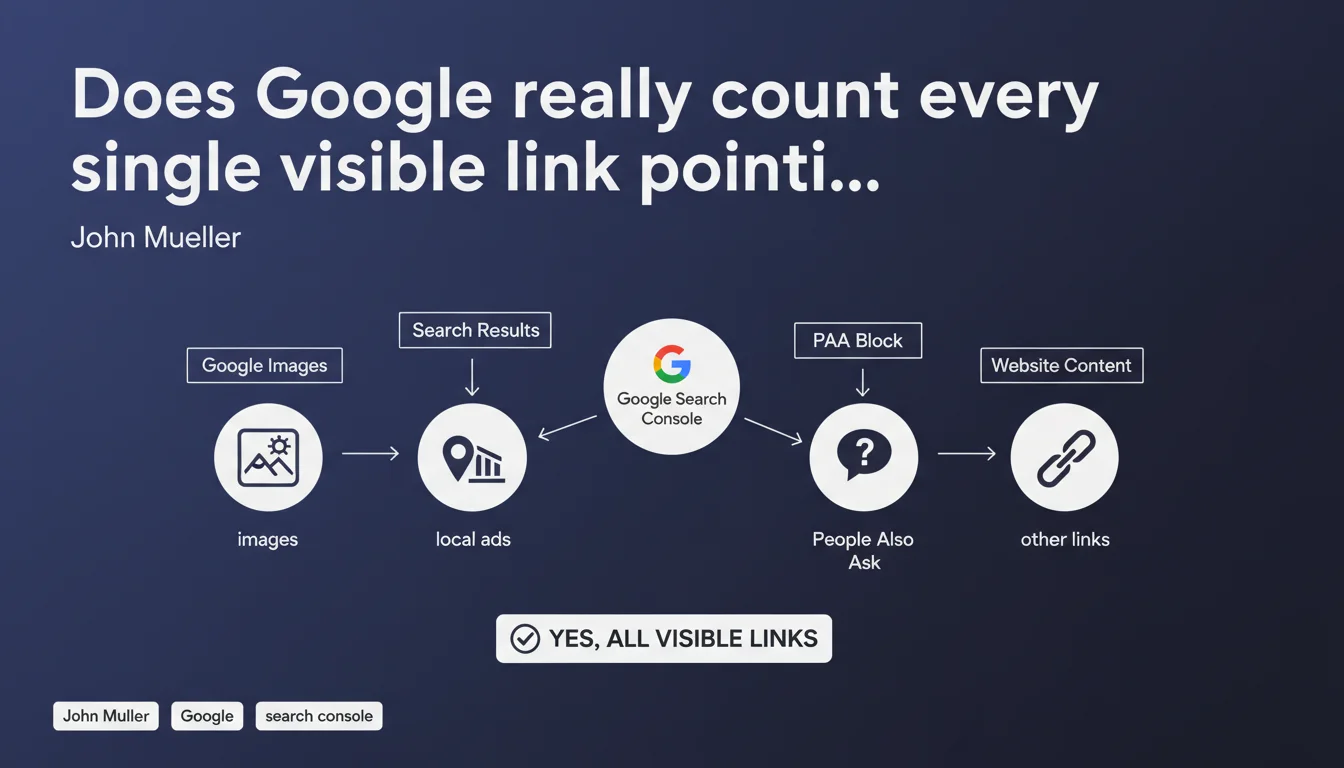
Google Search Console counts all elements containing a link to your website, including images in image packs, local ads, and 'People Also Ask' blocks. This statement from John Mueller expands the traditional notion of backlinks and forces us to rethink how we analyze our link profile.
What you need to understand
John Mueller clarifies here that Google Search Console is not limited to classic text links. The console integrates into its reporting all clickable elements that point to your domain.
Concretely? SERP components like image packs, Google Business Profile listings, or links in 'People Also Ask' blocks are counted.
Why does this distinction change everything?
Historically, we associate 'backlink' with an editorial link placed in the body of a web page. But Google broadens this definition to enriched SERP components that drive traffic to your site.
This means your link profile in Search Console can include hundreds — or even thousands — of 'links' that aren't backlinks in the traditional sense. These elements appear in the interface, but their algorithmic weight remains unclear.
What types of links are we talking about exactly?
- Images in image packs: when your visual appears in a SERP image carousel with a clickable link
- Local ads: links from your Google Business Profile listing displayed in the local pack
- 'People Also Ask' blocks: when a URL from your site is cited as a source in a PAA answer
- Knowledge Panel: links from your knowledge panel (often observed for entities)
Do these links carry the same weight as a traditional backlink?
The question remains unanswered. Mueller talks about accounting in Search Console, not ranking impact.
We can assume that Google differentiates these signals: a contextual editorial link probably doesn't carry the same weight as an appearance in a PAA. But no official data supports this hypothesis.
SEO Expert opinion
Is this statement consistent with field observations?
Yes, we do observe these types of links in Search Console. Sites that invest heavily in image SEO often see thousands of 'links' coming from image packs.
Same goes for local businesses: their Google Business Profile listings generate 'backlinks' internal to Google. But where things get murky is that Mueller says nothing about the impact of these links in terms of ranking.
What nuances should we add?
Let's be honest: not all links are created equal. A link from a PAA can drive qualified traffic, but nothing proves it transfers PageRank like a traditional editorial link.
Furthermore, these 'links' are often ephemeral and conditional. An image in a pack disappears as soon as it's no longer relevant for the query. A PAA can be removed during a SERP update. Their durability is incomparable to that of a link anchored in an indexed page.
[To verify]: does Google use these signals as backlinks in its ranking algorithm, or are they simply counted for reporting purposes? No public data allows us to settle this.
In what cases does this rule not apply?
Non-publicly visible links are not counted. For example, a link in a password-protected member area or a URL in JavaScript not executed server-side.
Similarly, nofollow links appear in Search Console, but their algorithmic treatment remains at Google's discretion since nofollow became a 'hint' in 2019.
Practical impact and recommendations
What should you do concretely to optimize these opportunities?
First step: audit your link profile in Search Console. Identify the types of links that dominate (editorial, images, PAA, local) and their respective volume.
If you spot a massive influx of links from image packs, it's a signal that your image optimization is working. Keep it up: descriptive filenames, precise alt tags, dedicated image sitemap.
For PAA, target featured snippets by structuring your content with clear question-answer pairs. FAQ schema can help, but content quality comes first.
What mistakes should you avoid when interpreting this data?
Don't over-optimize to artificially inflate the volume of these 'links'. What matters is business impact: qualified traffic, conversions, perceived authority.
Also avoid neglecting traditional editorial backlinks under the pretense that Search Console displays thousands of links. Contextual links from third-party sites remain a pillar of off-page SEO.
- Analyze the breakdown of link types in Search Console
- Optimize your images (names, alt text, weight, sitemap) to maximize image pack appearances
- Structure your content to target PAA (questions, short answers, heading hierarchy)
- For local businesses, care for your Google Business Profile (photos, posts, reviews)
- Don't confuse GSC link volume with backlink profile quality
- Continue developing traditional editorial backlinks through netlinking strategies
How can you verify that your strategy is paying off?
Cross-reference Search Console data with Google Analytics. Identify traffic sources coming from Google Images, local searches, or featured snippets.
Measure the conversion rate of these segments. A quantitatively impressive traffic surge from Google Images can be qualitatively disappointing if bounce rate skyrockets.
❓ Frequently Asked Questions
Les liens depuis les packs d'images comptent-ils vraiment pour le référencement ?
Un lien depuis un bloc 'People Also Ask' améliore-t-il mon autorité de domaine ?
Faut-il désavouer les liens provenant de packs d'images ou de PAA ?
Comment maximiser mes chances d'apparaître dans les blocs 'People Also Ask' ?
Ces liens GSC non traditionnels remplacent-ils le netlinking classique ?
🎥 From the same video 23
Other SEO insights extracted from this same Google Search Central video · published on 18/02/2022
🎥 Watch the full video on YouTube →
💬 Comments (0)
Be the first to comment.