
Official statement
Other statements from this video 23 ▾
- □ Does Google really count every single visible link pointing to your site in Search Console?
- □ Do Google's product review criteria apply even if your site isn't classified as a review site?
- □ Does Google's Indexing API really work for all types of content?
- □ Does E-A-T Really Impact Google Rankings, or Is It Just a Myth?
- □ Do unlinked brand mentions really boost your SEO rankings?
- □ Do user comments really improve your Google rankings?
- □ Do premium SSL certificates really impact Google rankings?
- □ Does having the same content in both PDF and HTML formats hurt your SEO rankings through cannibalization?
- □ Can you really control PDF indexing through HTTP headers?
- □ Should you still use rel=next and rel=prev tags for pagination in 2024?
- □ Does Googlebot really index all your infinite scroll content?
- □ Should you really index every page on your website?
- □ Should you really worry about the referrer page shown in Google Search Console?
- □ Should you really redirect the old sitemap with a 301 or submit the new one directly instead?
- □ Is a 97% crawl refresh rate actually a positive sign for your website's health?
- □ Does your server speed actually control how often Google crawls your site?
- □ Does Google really measure crawl speed and Core Web Vitals the same way — and why should you care?
- □ Does Google really slow down crawling after a hosting migration, and how long does it last?
- □ Is the crawl rate parameter really a ceiling rather than something Google will try to maximize?
- □ Can CTR really penalize the rest of your website?
- □ Is internal linking really the most critical factor for SEO success?
- □ Does internal linking really take effect instantly after Google recrawls your pages?
- □ Should you worry if Google isn't crawling all your pages?
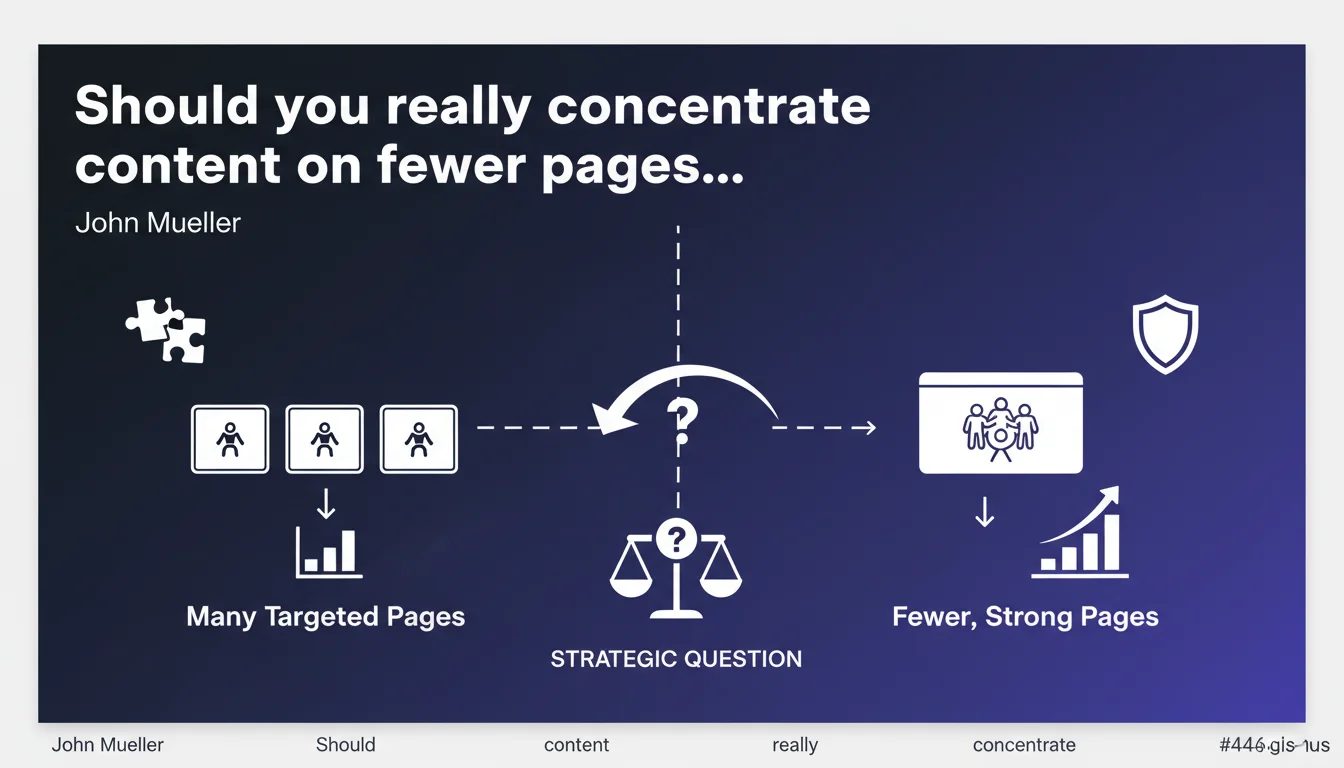
Google confirms that scattering your content across multiple weak pages dilutes SEO power. One strong page that centralizes authority and relevance signals performs better than five mediocre pages that cannibalize each other. The question isn't technical, it's strategic: where should you concentrate your editorial resources and backlinks?
What you need to understand
Why does Google take a stand against multiplying pages?
Mueller is talking here about a problem we all observe daily: signal dilution. When you split a topic across multiple URLs, each page fights to capture Google's attention. Result: neither one really emerges in the SERPs.
The search engine analyzes relevance signals — backlinks, engagement, depth of treatment — and these signals get distributed across your pages instead of concentrating on a single one. You're artificially creating internal competition.
In what contexts does this rule really apply?
We're typically talking about sites that decline the same subject into X variations to "target more keywords." Classic example: one page on "car insurance Paris," another on "auto coverage Paris," a third on "car policy Paris." They all address the same intent.
Another frequent case: blogs that break up a complete guide into 8 short articles to "produce more content." Each article in isolation lacks substance, and Google ends up ranking none of them properly.
What's different compared to older recommendations about the long tail?
Nothing fundamentally different actually. The long tail remains valid, but it doesn't justify creating near-identical pages. One dense, complete page can rank on dozens of semantic variations without needing to be split up.
The "one keyword per page" mantra from ten years ago doesn't hold anymore. Google understands intent, not just words. If two queries share the same intent, one strong page is enough.
- Concentrate signals: a single page captures all backlinks, CTR, time on page
- Avoid cannibalization: when multiple pages fight for the same query, Google hesitates and might not rank any of them correctly
- Strategic approach: better to invest in 10 robust pillar pages than in 50 mediocre pages stuck on page 3
SEO Expert opinion
Does this statement match real-world observations?
Yes, without question. We regularly see clients who create 15 pages targeting near-identical variations and rank on none of them. When you merge these pages into a single dense resource — same URL, consolidated content — the ranking takes off in a few weeks.
The problem is that many SEO practitioners still confuse "more pages" with "more visibility." They think in terms of production volume rather than value concentration. Google, on the other hand, rewards depth of treatment, not quantity.
In what cases should you still create multiple distinct pages?
When search intents clearly diverge. If "senior health insurance" and "student health insurance" map to different needs, different solutions, different audiences — then yes, two pages make sense.
The same goes for e-commerce sites: if you sell three lawn mower models with distinct specs, three product pages are justified. But if you have five pages on "mower accessories" that list the same categories from slightly different angles, you're diluting.
[To verify]: Mueller doesn't specify a threshold. At how many pages within the same thematic cluster does dilution start? No hard numbers from Google on this. We're navigating by instinct, relying on cannibalization detection tools and common sense.
What are the limits of this approach?
A single page can become an editorial monster of 8000 words, hard to maintain, slow to load, indigestible for users. You need to find balance: concentrate without overwhelming.
Another limit: some sites bet on multiplying pages to capture zero positions or varied featured snippets. A strategy that can work, but it's case-by-case — and it requires real editorial differentiation between each page.
Practical impact and recommendations
How do you identify pages to merge on your site?
Start with a cannibalization audit. List all pages that rank (or try to rank) on similar queries. Use Search Console: filter by query and see how many different URLs appear for the same intent.
If three pages fight for "online crm," analyze their individual performance. Often, none breaks the top 15. That's the typical dilution signal.
Next, compare content. If the pages say roughly the same thing with different wording, consolidation is the move. Keep the URL with the strongest authority (backlinks, age) and redirect the others with 301s.
What mistakes should you avoid when consolidating?
Never delete a page without a 301 redirect to the consolidated page. You'd lose accumulated signals — backlinks, history, trust. The redirect transfers most of that authority.
Another trap: merging without rewriting. If you paste together three mediocre articles, you get one long mediocre article. Consolidation must come with editorial overhaul: clear structure, logical flow, removal of redundancies.
Finally, monitor post-merge performance. Track positions on target queries for 4 to 6 weeks. If it stalls or drops, either the merge didn't add enough value — or you merged intents that were too different.
- Identify page clusters in cannibalization via Search Console
- Compare individual performance: if none ranks well, that's a dilution signal
- Choose the strongest URL (backlinks, traffic history) as your destination page
- Redirect other pages with permanent 301s to this single URL
- Rewrite consolidated content: not a paste-job, but a structured, exhaustive synthesis
- Optimize title tags, metas, H tags to reflect the main intent
- Monitor position and organic traffic evolution over 4 to 6 weeks
❓ Frequently Asked Questions
Combien de mots minimum pour qu'une page soit considérée comme « forte » par Google ?
Dois-je supprimer les pages faibles ou les rediriger ?
Peut-on avoir plusieurs pages fortes sur un même sujet général ?
La fusion de pages améliore-t-elle toujours les positions ?
Comment savoir si mes pages sont en cannibalisation ?
🎥 From the same video 23
Other SEO insights extracted from this same Google Search Central video · published on 18/02/2022
🎥 Watch the full video on YouTube →
💬 Comments (0)
Be the first to comment.