
Official statement
Other statements from this video 23 ▾
- □ Does Google really count every single visible link pointing to your site in Search Console?
- □ Should you really concentrate your content on fewer pages to rank better?
- □ Does Google's Indexing API really work for all types of content?
- □ Does E-A-T Really Impact Google Rankings, or Is It Just a Myth?
- □ Do unlinked brand mentions really boost your SEO rankings?
- □ Do user comments really improve your Google rankings?
- □ Do premium SSL certificates really impact Google rankings?
- □ Does having the same content in both PDF and HTML formats hurt your SEO rankings through cannibalization?
- □ Can you really control PDF indexing through HTTP headers?
- □ Should you still use rel=next and rel=prev tags for pagination in 2024?
- □ Does Googlebot really index all your infinite scroll content?
- □ Should you really index every page on your website?
- □ Should you really worry about the referrer page shown in Google Search Console?
- □ Should you really redirect the old sitemap with a 301 or submit the new one directly instead?
- □ Is a 97% crawl refresh rate actually a positive sign for your website's health?
- □ Does your server speed actually control how often Google crawls your site?
- □ Does Google really measure crawl speed and Core Web Vitals the same way — and why should you care?
- □ Does Google really slow down crawling after a hosting migration, and how long does it last?
- □ Is the crawl rate parameter really a ceiling rather than something Google will try to maximize?
- □ Can CTR really penalize the rest of your website?
- □ Is internal linking really the most critical factor for SEO success?
- □ Does internal linking really take effect instantly after Google recrawls your pages?
- □ Should you worry if Google isn't crawling all your pages?
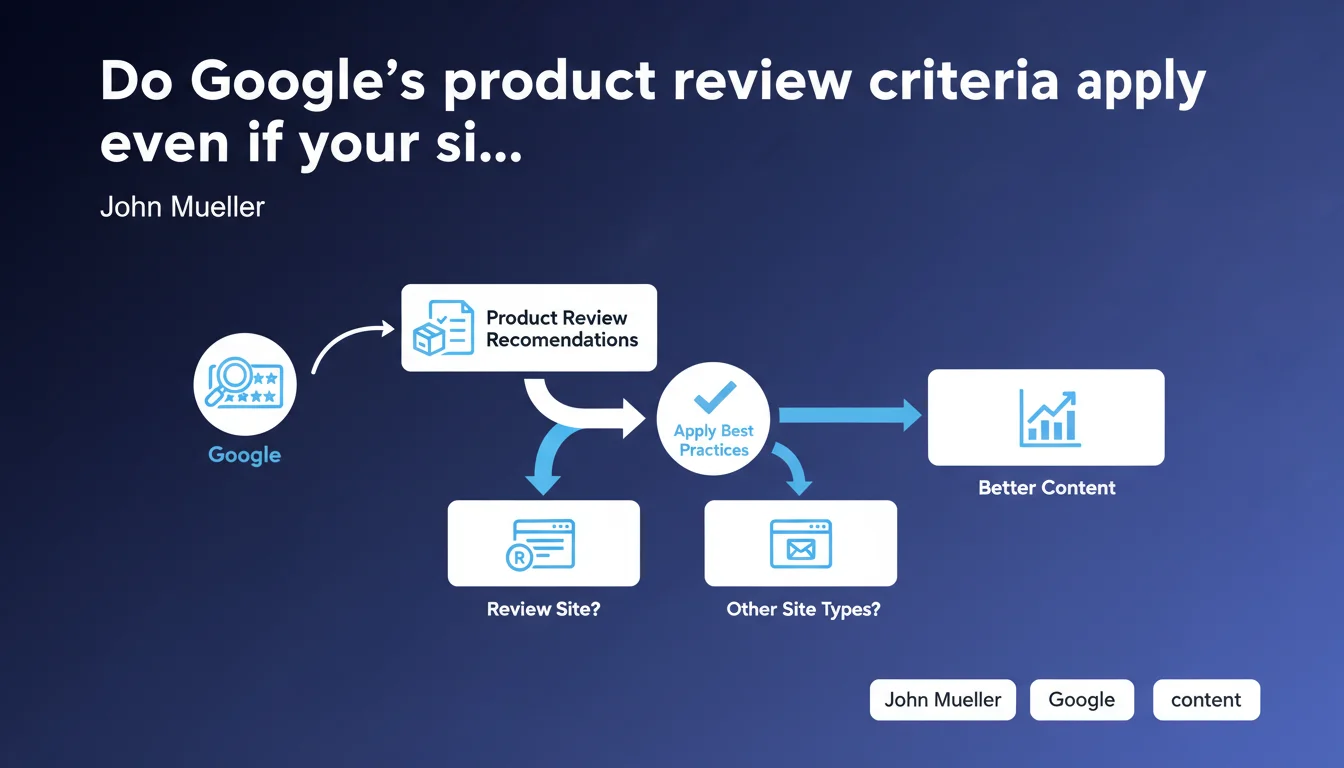
Google confirms that its product review recommendations apply to all sites that publish this type of content, whether or not they are identified as "review sites". If your pages contain product evaluations, the best practices from the Product Review Update are relevant to you.
What you need to understand
Why is Google expanding the scope of its product review recommendations?
Historically, Product Review Updates primarily targeted comparative review sites — aggregators, product testing magazines, affiliate sites. But Google has noticed that many other types of sites publish reviews: e-commerce with testimonial sections, niche blogs, vertical media outlets.
Mueller's position clarifies a frequent misunderstanding: just because Google doesn't classify your site in the "review site" category doesn't mean you can ignore these recommendations. If the content looks like a product review — comparison, test, evaluation — then quality criteria apply.
What defines a "product review" in Google's eyes?
Google doesn't publish an exhaustive taxonomy. The approach is pragmatic: if your page evaluates, compares, or recommends a product, it falls within the scope of Product Review Updates. It doesn't matter whether this is your main or secondary activity.
An article titled "Our 5 favorite CRM software" on a marketing blog? That's a product review. An e-commerce product sheet with an "Our expert opinion" section? Same thing. A comparative test in a vertical media outlet? Obviously.
What are the key takeaways from this clarification?
- Broader scope: All sites publishing product evaluations are affected, not just review aggregators.
- Qualitative logic: Google applies the same relevance and expertise criteria regardless of your primary activity.
- Self-determination: It's up to you to assess whether your content falls into this category — Google won't send you a notification.
- Strategic opportunity: Applying these best practices can give you a competitive advantage over competitors who think they're not affected.
SEO Expert opinion
Is this statement consistent with real-world observations?
Yes, and it's actually confirmed by several waves of fluctuations following Product Review Updates. We've observed impacts on e-commerce sites with integrated review sections, vertical media outlets, even personal blogs testing equipment. Mueller's statement formalizes what many were already noticing.
However, uncertainty remains about the intensity of application. Does Google apply the criteria with equal severity to an e-commerce site with 10% product reviews as to a pure comparison site? [To be verified] — publicly available data is insufficient to determine this.
What's the boundary between product review and simple commercial description?
This is where it gets tricky. A standard product sheet with technical specs and "Buy now" button isn't a product review. But as soon as you add a subjective evaluation, a comparison, or a user experience report, you cross into the scope of these recommendations.
The line is delicate: "This product is suitable for beginners"? Probably not a review. "We tested this product for 3 months and here are our conclusions"? Clearly a review. Between the two, it's a gray area. My advice: when in doubt, assume you're affected — it's the safest approach.
Should you fear a penalty if you don't follow these recommendations?
Google talks about "recommendations," not strict requirements. But let's be honest: a site publishing weak, superficial, or obviously biased product reviews risks visibility degradation during algorithm updates. It's not a manual penalty, it's algorithmic devaluation.
The real danger? Thinking you're not affected when Google considers part of your content as product reviews. Result: you keep publishing mediocre content while your competitors optimize according to quality criteria.
Practical impact and recommendations
How do you know if your site is affected by these recommendations?
Audit your content with this framework: do your pages evaluate products/services? Do they contain comparisons, tests, ratings, purchase recommendations? If yes, you're in scope.
Even if your primary activity is something else — e-commerce, media, niche blog — as soon as part of your pages falls into this logic, the criteria apply. And it's an opportunity: many competitors haven't figured this out yet.
What errors should you avoid in your product review content?
- Generic reviews copied-pasted from manufacturer datasheets with no real added value.
- Lack of tangible experience: no original photos, no concrete tests, just rewording from third-party sources.
- Undeclared commercial bias: reviews clearly oriented toward affiliate links without transparency.
- Superficial comparisons: spec tables with no qualitative analysis, no context of use.
- Lack of demonstrable expertise: no signals of authority or competence on the subject covered.
What should you actually do to align your content with these criteria?
Prioritize depth and authenticity. Google values reviews that demonstrate real usage: original photos, concrete measurements, comparisons based on experience, mention of drawbacks and limitations — not just praise.
Add expertise signals: who wrote this review? What's their legitimacy? How long did the test last? Under what conditions? The more you document the process, the better.
Rigorously applying these recommendations requires significant editorial effort: revamping existing content, structured testing protocols, editorial team training. For many companies, managing this transformation internally while maintaining daily production is daunting. Partnering with a specialized SEO agency can significantly accelerate the process — precise scope diagnosis, targeted content overhaul, implementation of sustainable workflows. It's an investment that saves you from navigating blindly on an issue where visibility is critical.
❓ Frequently Asked Questions
Mon site e-commerce avec quelques pages d'avis est-il concerné par ces recommandations ?
Faut-il obligatoirement avoir testé physiquement un produit pour publier un avis conforme ?
Les avis clients classiques sur fiches produits entrent-ils dans ce périmètre ?
Comment Google détermine-t-il qu'un site est un « site d'avis » ou non ?
Peut-on optimiser des avis produits existants ou faut-il tout réécrire ?
🎥 From the same video 23
Other SEO insights extracted from this same Google Search Central video · published on 18/02/2022
🎥 Watch the full video on YouTube →
💬 Comments (0)
Be the first to comment.