
Official statement
Other statements from this video 23 ▾
- □ Does Google really count every single visible link pointing to your site in Search Console?
- □ Should you really concentrate your content on fewer pages to rank better?
- □ Do Google's product review criteria apply even if your site isn't classified as a review site?
- □ Does Google's Indexing API really work for all types of content?
- □ Does E-A-T Really Impact Google Rankings, or Is It Just a Myth?
- □ Do unlinked brand mentions really boost your SEO rankings?
- □ Do user comments really improve your Google rankings?
- □ Do premium SSL certificates really impact Google rankings?
- □ Does having the same content in both PDF and HTML formats hurt your SEO rankings through cannibalization?
- □ Can you really control PDF indexing through HTTP headers?
- □ Should you still use rel=next and rel=prev tags for pagination in 2024?
- □ Does Googlebot really index all your infinite scroll content?
- □ Should you really index every page on your website?
- □ Should you really worry about the referrer page shown in Google Search Console?
- □ Should you really redirect the old sitemap with a 301 or submit the new one directly instead?
- □ Is a 97% crawl refresh rate actually a positive sign for your website's health?
- □ Does your server speed actually control how often Google crawls your site?
- □ Does Google really measure crawl speed and Core Web Vitals the same way — and why should you care?
- □ Does Google really slow down crawling after a hosting migration, and how long does it last?
- □ Is the crawl rate parameter really a ceiling rather than something Google will try to maximize?
- □ Is internal linking really the most critical factor for SEO success?
- □ Does internal linking really take effect instantly after Google recrawls your pages?
- □ Should you worry if Google isn't crawling all your pages?
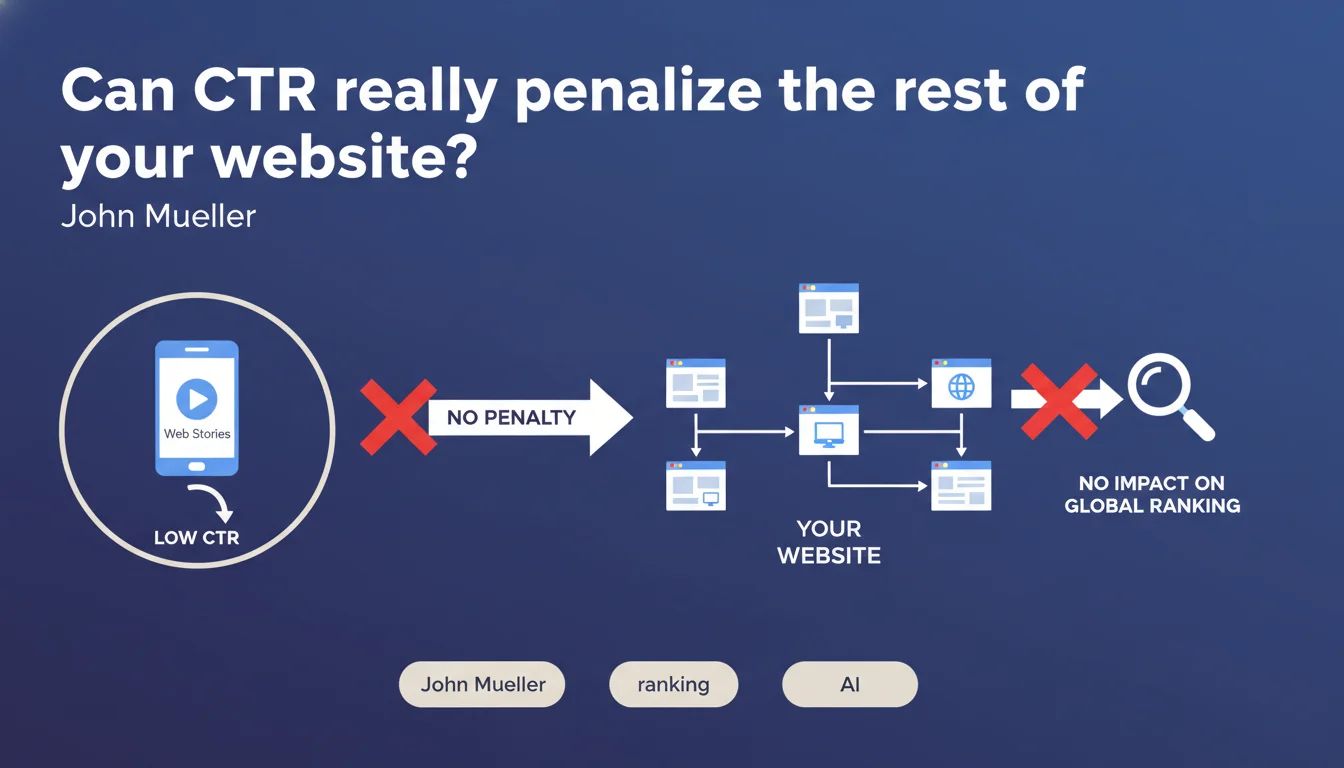
Google states that a low click-through rate on certain pages (Web Stories, for example) does not impact the ranking of other pages on the site. There is no global mechanism by which poor CTR on one section would spread to the rest of the domain. Each page is evaluated independently.
What you need to understand
Why this clarification about CTR and Web Stories?
John Mueller is responding here to a recurring concern: the fear that underperforming content (particularly Web Stories, the mobile AMP format) could degrade the site's overall visibility. The underlying idea is that an algorithm could interpret a low click-through rate as a signal of poor quality and extend this "punishment" to the entire domain.
Google denies this theory. The search engine treats each URL as a distinct entity. If your Web Stories generate few clicks, this will not create a negative feedback loop affecting your blog posts or product pages.
Does CTR play a role in ranking?
That's the real question. Google has always maintained an ambiguous position: CTR is not a direct ranking factor. But it can indirectly influence the perception of relevance — if a result is consistently ignored, the algorithm could adjust its position downward to test other candidates.
The nuance hinges on one word: local vs global. A page's CTR can affect that page. But it does not contaminate the entire domain. This is what Mueller clarifies here.
- Each page is evaluated independently for its CTR and relevance signals
- No "contagion" mechanism spreads poor CTR from one section to another
- Web Stories, despite their low engagement, do not penalize the site's classic content
- CTR remains a contextualized signal — Google does not use it as a site-wide metric
What does this mean for experimental formats?
If you test new formats — Web Stories, AMP, video carousels — you no longer need to fear a domino effect on your overall SEO. A localized failure remains localized. This provides some room for experimentation without systemic risk.
That said, if your Web Stories never convert, the question isn't really "will they penalize me?" but rather "why am I keeping them?". Useless content is primarily a waste of time and crawl budget.
SEO Expert opinion
Is this statement consistent with field observations?
Yes and no. In practice, no one has ever demonstrated that poor CTR on an isolated section (like Web Stories) leads to a widespread drop across the domain. Sites that publish large volumes of Stories without success don't see their classic pages demoted as a result.
But — and here's where it gets tricky — Google says nothing about the cumulative effect of poor CTR across the entire site. If 80% of your pages generate few clicks, doesn't the algorithm at some point draw an overall conclusion about the domain's relevance? [To be verified] — Mueller doesn't address this question. He limits himself to the specific case of Web Stories.
What nuances should be applied?
The first nuance is that CTR doesn't exist in a vacuum. If a page has a low click-through rate and a high bounce rate and low time on page, Google then has a bundle of converging signals. CTR alone may not penalize, but combined with other engagement metrics, it can contribute to a position adjustment.
Second nuance: Mueller speaks of "negative reinforcement loop". This very specific wording suggests there is no recursive mechanism where poor CTR leads to lower visibility, which leads to even fewer clicks, etc. But this does not mean CTR is completely ignored in evaluating an individual page.
In which cases does this rule not apply?
If your entire site suffers from catastrophic CTR across all pages — misleading titles, missing meta descriptions, unattractive snippets — you are not protected from global devaluation. Not because of CTR itself, but because it likely signals a content quality problem.
Another edge case: if you actively manipulate CTR (click farms, artificial incentives), Google can detect anomalous patterns and apply manual penalties. The problem would then not be low CTR, but the attempted manipulation.
Practical impact and recommendations
What should you concretely do with this information?
First, don't panic if you test experimental formats like Web Stories. A localized failure won't sink your overall SEO. You can continue experimenting without fearing a domino effect.
Next, focus on optimizing CTR page by page, not site by site. If a category underperforms in terms of clicks, work on its titles, meta descriptions, rich snippets — but don't worry about contamination spreading to other sections.
What mistakes should you avoid?
Don't confuse "no global penalty" with "CTR doesn't matter". CTR remains a valuable indicator of perceived relevance. If a page ranks well but generates no clicks, it's a signal that your snippet isn't compelling — or that intent matching failed.
Another mistake: keeping zombie content "just in case". If your Web Stories serve no purpose, they may not directly penalize you, but they consume crawl budget, dilute site topicality, and clutter your sitemap. Better to disindex or properly delete them.
- Audit your pages' CTR in Search Console, URL by URL
- Optimize snippets for high-potential, low-CTR pages (titles, meta descriptions, schema markup)
- Test alternative formats (Web Stories, videos, infographics) without fearing global negative impact
- Disindex or remove content that generates neither traffic nor added value
- Monitor pages with abnormally low CTR and high bounce rate — this signals intent misalignment
How do you verify that your site is properly optimized on this point?
Use Search Console to identify pages with good rankings (top 3-5) but CTR below the average for their category. These are your quick wins. Rework their snippets, add structured data (FAQ, HowTo, Product), test title variations.
Also measure CTR by content type. If your Web Stories are at 0.5% CTR but your in-depth articles at 3%, that's coherent — and not problematic. However, if everything is uniformly low, the problem is structural (weak ranking, missed intent, poor brand awareness).
❓ Frequently Asked Questions
Le CTR d'une page influence-t-il vraiment son propre classement ?
Si mes Web Stories ont un CTR faible, dois-je les supprimer ?
Comment savoir si mon CTR est bon ou mauvais ?
Google peut-il pénaliser un site entier pour un CTR globalement faible ?
Quels leviers utiliser pour améliorer le CTR d'une page ?
🎥 From the same video 23
Other SEO insights extracted from this same Google Search Central video · published on 18/02/2022
🎥 Watch the full video on YouTube →
💬 Comments (0)
Be the first to comment.