
Official statement
Other statements from this video 23 ▾
- □ Does Google really count every single visible link pointing to your site in Search Console?
- □ Should you really concentrate your content on fewer pages to rank better?
- □ Do Google's product review criteria apply even if your site isn't classified as a review site?
- □ Does Google's Indexing API really work for all types of content?
- □ Does E-A-T Really Impact Google Rankings, or Is It Just a Myth?
- □ Do unlinked brand mentions really boost your SEO rankings?
- □ Do premium SSL certificates really impact Google rankings?
- □ Does having the same content in both PDF and HTML formats hurt your SEO rankings through cannibalization?
- □ Can you really control PDF indexing through HTTP headers?
- □ Should you still use rel=next and rel=prev tags for pagination in 2024?
- □ Does Googlebot really index all your infinite scroll content?
- □ Should you really index every page on your website?
- □ Should you really worry about the referrer page shown in Google Search Console?
- □ Should you really redirect the old sitemap with a 301 or submit the new one directly instead?
- □ Is a 97% crawl refresh rate actually a positive sign for your website's health?
- □ Does your server speed actually control how often Google crawls your site?
- □ Does Google really measure crawl speed and Core Web Vitals the same way — and why should you care?
- □ Does Google really slow down crawling after a hosting migration, and how long does it last?
- □ Is the crawl rate parameter really a ceiling rather than something Google will try to maximize?
- □ Can CTR really penalize the rest of your website?
- □ Is internal linking really the most critical factor for SEO success?
- □ Does internal linking really take effect instantly after Google recrawls your pages?
- □ Should you worry if Google isn't crawling all your pages?
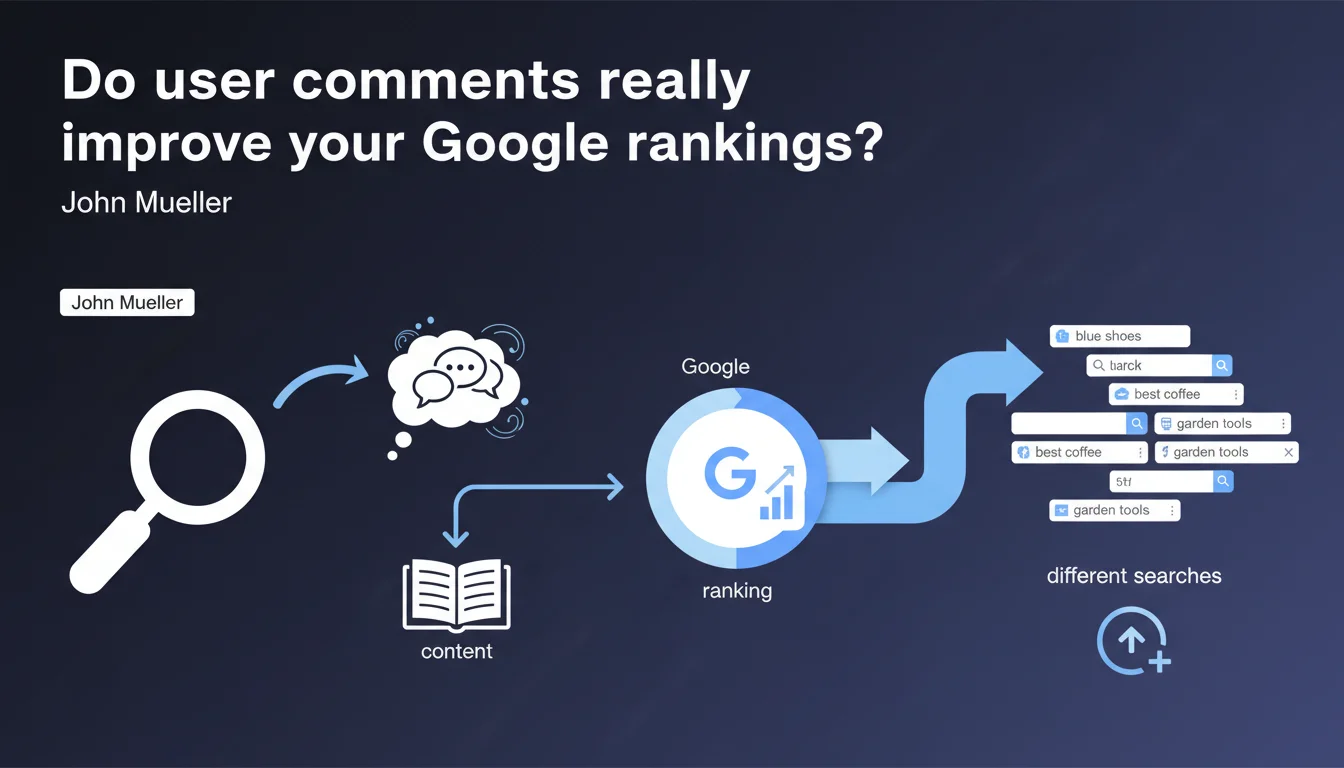
Google uses user comments as a contextual signal to better understand a page's content. They provide semantic variations and natural reformulations that enrich algorithmic understanding. In practice, a page with relevant comments has a better chance of appearing in long-tail search results.
What you need to understand
Why does Google place importance on user comments?
Comments represent user-generated content (UGC) that reflects how real people describe a topic. Unlike editorial content, which is often optimized and formatted, comments bring spontaneous vocabulary and varied expressions.
Google leverages this semantic diversity to identify secondary search intentions it wouldn't have detected with the main content alone. An article about "choosing a camera" can attract traffic for "best DSLR for beginners" thanks to comments using that exact phrasing.
Do comments directly influence rankings?
Mueller speaks of "useful context for ranking" — a careful formulation. Comments are not a direct ranking factor in the sense that more comments = better rankings. They enrich the semantic understanding of the page.
In practice? A page without comments can rank very well if its main content is solid. But at equal quality, one with relevant comments likely captures more adjacent queries thanks to the lexical diversity comments bring.
Are all comments equally valuable to Google?
No. Generic comments ("great article!", "thanks") add nothing. Google values substantive comments that develop, question, or supplement the main content.
Comment sections polluted by spam or off-topic content can actually harm rankings. Google may interpret a discussion that goes off the rails as a signal of low thematic relevance.
- Comments enrich the semantic coverage of the page
- They enable capturing long-tail queries that weren't anticipated
- Only substantive and relevant comments have value
- Spam or off-topic content can be counterproductive
- Comments don't replace solid main content
SEO Expert opinion
Is this statement consistent with real-world observations?
Absolutely. Sites with strong engagement — forums, specialized blogs, Q&A platforms — regularly capture traffic for keyword variations present only in comments. Reddit is the perfect example: a thread title is often generic, but in-depth discussions rank for ultra-specific queries.
However, on e-commerce sites, the impact is more subtle. Product reviews add context ("this jean runs large", "the color is darker than in the photo"), but their weight remains secondary compared to filters, technical specs, and descriptions.
What nuances should we add to this claim?
Mueller doesn't specify the weighting of this signal. "Useful" doesn't mean "decisive". [To verify]: no official data quantifies the impact of comments compared to backlinks, content depth, or domain authority.
Another unclear point: does Google distinguish between comments indexed with nofollow or in iframes? Some CMS load comments in JavaScript after initial rendering — are they treated differently? No clear answer.
Finally, comments add noise. A page with 200 comments, 150 of which are off-topic, risks diluting its main thematic signal. Moderation becomes an SEO concern, not just an editorial one.
In what cases does this rule not apply?
On purely transactional sites (price comparators, aggregators), comments have little impact. Google prioritizes structured data (price, availability) and content freshness.
Similarly, on highly competitive informational queries, comments alone will never overcome a deficit in authority or content depth. They're a supplement, not a crutch.
Practical impact and recommendations
What should you do concretely to leverage comments?
First, make engagement easy. A comment section buried at the bottom of the page, poorly visible, generates nothing. Position it strategically and encourage discussion with open-ended questions at the end of your article.
Next, moderate actively. Remove spam, but also contributions completely off-topic. One relevant comment is worth ten generic ones. Some sites even highlight the "best comments" through a voting system — both a social and semantic signal.
Technically, ensure your comments are crawlable and indexable. If you're loading them with deferred JavaScript, verify in Search Console that Googlebot retrieves them properly. Server-side rendering (SSR) or classic HTML pagination remains safer.
What mistakes should you absolutely avoid?
Never disable comments by default on a blog or editorial site without strategic reason. That's untapped SEO potential.
Also avoid the trap of pure automation. Anti-spam systems like Akismet are useful, but human moderation is still necessary to maintain thematic consistency. An auto-approved comment that's completely off-topic can pollute the signal.
Finally, don't rely on comments alone to compensate for weak main content. Google exploits them as contextual enrichment, not as a substitute for editorial content.
How can you verify that your comments provide SEO value?
Use Search Console to identify long-tail queries generating impressions. If some match terms present only in comments, that's a good sign.
Also analyze bounce rates and time on page for pages with vs without comments. Active discussion can improve engagement — an indirect but real signal for Google.
- Position the comments section in a visible and accessible way
- Encourage substantive contributions through open-ended questions
- Moderate to eliminate spam and off-topic content
- Verify comments are crawlable (not only in deferred JavaScript)
- Highlight top comments if relevant
- Monitor long-tail queries in Search Console
- Never sacrifice main content quality for the sake of comments
❓ Frequently Asked Questions
Les commentaires spam affectent-ils négativement le SEO ?
Faut-il indexer les commentaires en nofollow ?
Les commentaires peuvent-ils compenser un contenu principal faible ?
Les commentaires chargés en JavaScript sont-ils pris en compte ?
Comment encourager des commentaires de qualité sans manipulation ?
🎥 From the same video 23
Other SEO insights extracted from this same Google Search Central video · published on 18/02/2022
🎥 Watch the full video on YouTube →
💬 Comments (0)
Be the first to comment.