
Official statement
What you need to understand
What is Google's position on indexing comment pages?
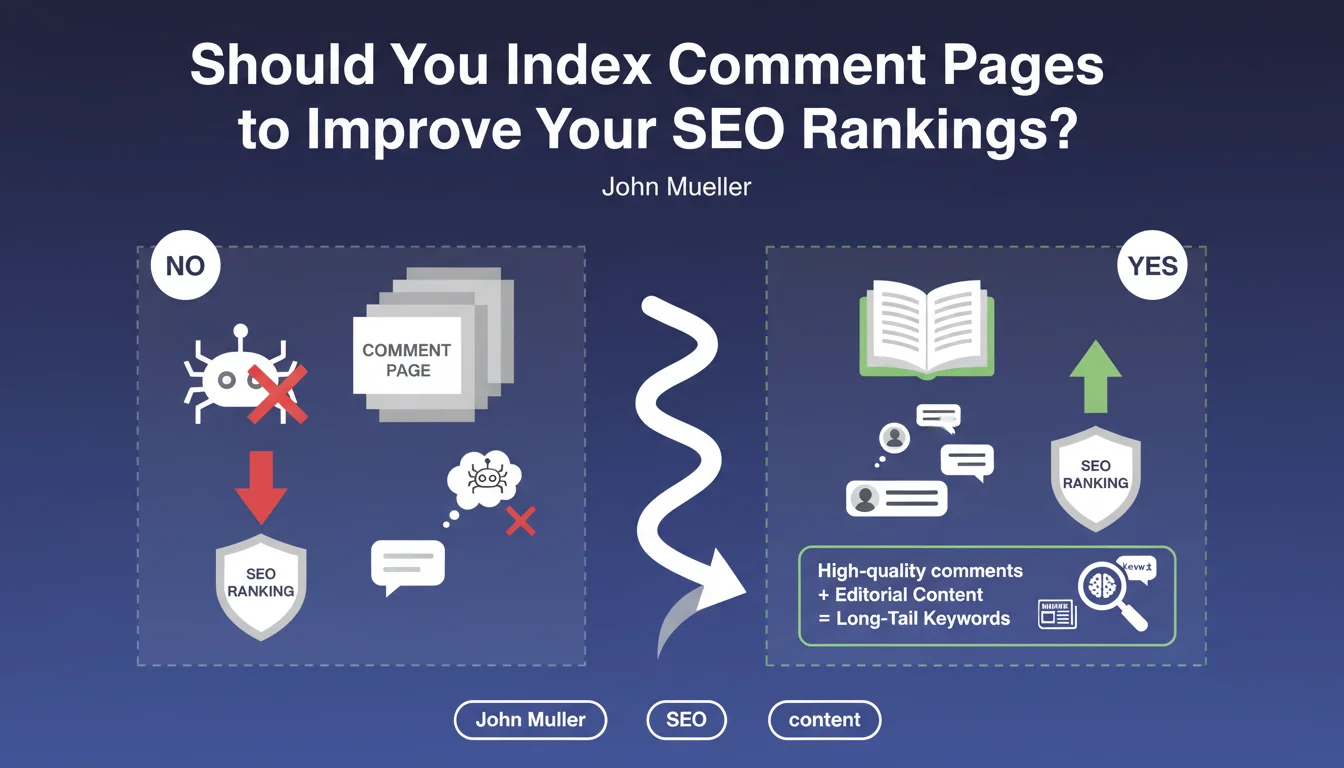
Google strongly advises against indexing pages dedicated solely to comments, without any editorial content. These pages are considered poor in added value and can harm the overall perceived quality of the site.
However, comments integrated beneath main content (blog articles, product pages) are valued if they provide relevant additional information. They enrich the page and contribute to its search engine optimization.
Why can quality comments improve rankings?
The search engine analyzes all content on the page, comments included. Quality exchanges naturally introduce expressions and questions that users search for.
This semantic diversity allows ranking for long-tail keywords that weren't necessarily present in the initial editorial content. This represents a significant competitive advantage.
How do you distinguish a quality comment from spam?
A quality comment provides real added value: it complements the information, asks a relevant question, shares an experience, or corrects an inaccuracy. It's written in proper language.
Conversely, spam is characterized by generic messages, off-topic content, link-stuffed text, or automatically generated content. Strict moderation is essential to maintain quality.
- 100% comment pages: should not be indexed according to Google
- Comments beneath editorial content: can enhance SEO if they're high-quality
- Long-tail: comments naturally create searched expressions
- Moderation essential: to filter spam and maintain quality
- Nofollow links: effective protection against backlink-motivated spam
SEO Expert opinion
Is this statement consistent with practices observed in the field?
Absolutely. I've observed for years that sites with moderated and relevant comments do indeed rank for supplementary queries not initially targeted. This is particularly visible on technical blogs and niche sites.
Conversely, sites that let spam proliferate or create paginated pages solely for comments often experience crawl budget degradation and sometimes even algorithmic penalties related to quality.
What nuances should be added to this recommendation?
The site's size and authority play an important role. An established site with strong authority can afford a more substantial comment section than a recent site that must prove its quality.
Additionally, certain sectors naturally generate rich comments: tech, gardening, cooking, DIY. Others primarily produce spam, even with moderation. You must adapt your strategy to the context.
In what cases does this rule not fully apply?
Forums and community sites constitute a special case. Their content is by nature composed of exchanges between users. For these platforms, indexing discussions is legitimate because it's the core of their value.
Similarly, structured customer reviews (with ratings, pros/cons) on e-commerce product pages deserve indexing. They represent rich, sought-after content, different from simple blog comments.
Practical impact and recommendations
What should you actually do to optimize comment management?
Implement systematic moderation before publication. Define clear criteria: minimum length, thematic relevance, absence of excessive promotional language.
Use rel="nofollow" attributes on all links within comments. This discourages spam motivated by obtaining backlinks while allowing genuine contributors to express themselves.
If you've paginated your comments onto separate pages, consider blocking them via robots.txt or meta noindex. Keep only the main page indexed with its content and initial comments.
What critical mistakes should you avoid with comment sections?
Never leave a comment system open without moderation. Spam develops exponentially and can compromise Google's quality perception of your entire site.
Avoid creating separate URLs for each comment or complex pagination systems. This dilutes your crawl budget on low-value pages.
Don't use unconfigured generic plugins that automatically create archives, tags, or categories based on comments. These pages are typically poor and counterproductive.
How do you audit and improve what's already on your site?
Analyze in Google Search Console the pages with comments that generate impressions. Identify those ranking for interesting long-tail expressions to measure actual impact.
Examine the average quality of comments: spam/legitimate content ratio, length, thematic relevance. If the ratio is unfavorable, drastically strengthen moderation.
Verify with a technical crawl (Screaming Frog, Oncrawl) whether purely comment pages are indexable. Correct with appropriate noindex directives.
- Activate mandatory moderation before publishing comments
- Define a clear comment policy and apply it strictly
- Configure all comment links to nofollow automatically
- Block indexing of separate paginated comment pages
- Audit comment quality monthly
- Regularly delete obsolete or irrelevant comments
- Monitor positions gained through comments in Search Console
- Encourage contributors to develop their responses (minimum length)
💬 Comments (0)
Be the first to comment.