
Official statement
What you need to understand
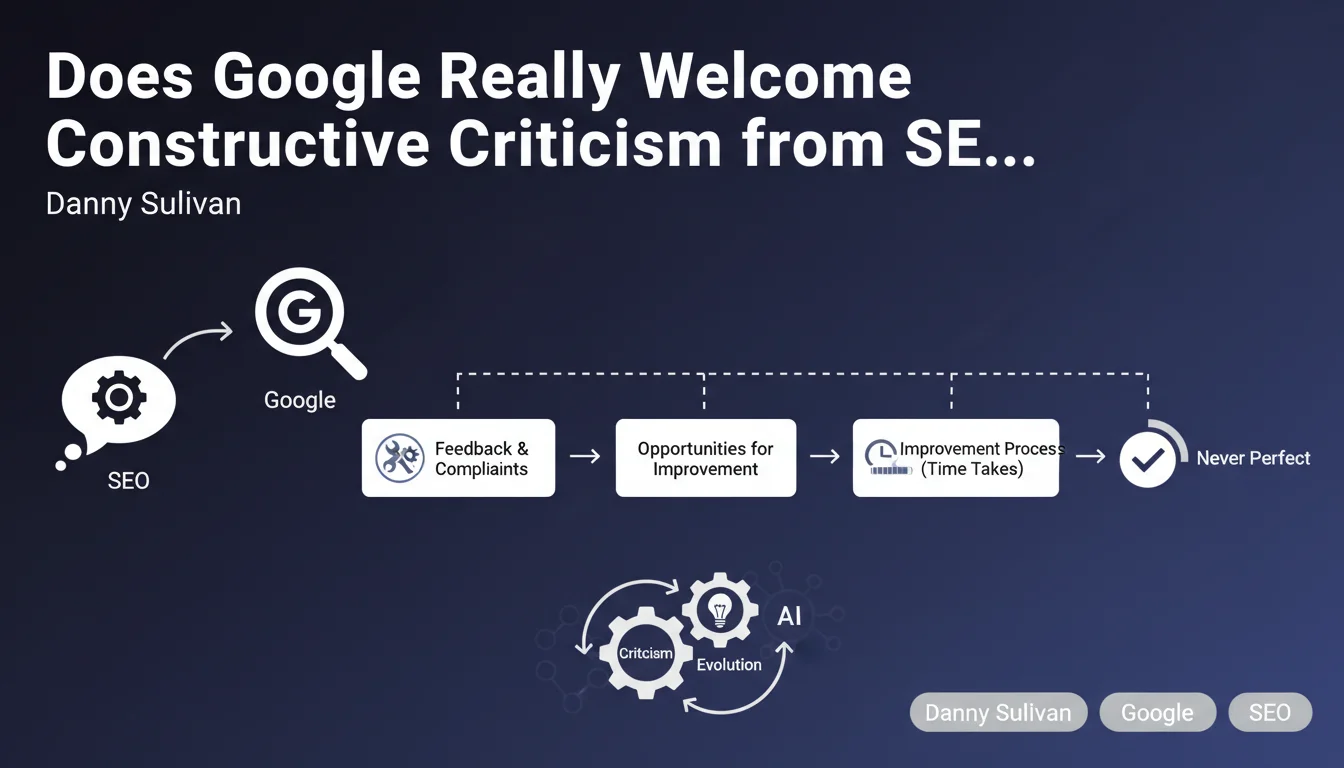
Google officially communicates its position regarding feedback and criticism from the SEO community. Danny Sullivan, Search Liaison, states that constructive feedback is considered as opportunities for improvement rather than attacks.
This statement aims to reassure SEO professionals who sometimes wonder about the usefulness of their field reports. Google explicitly encourages continued critical feedback, acknowledging that improvement is an ongoing and imperfect process.
Concretely, this means that reporting malfunctions or problematic results should not negatively impact your relationship with Google. On the contrary, this feedback would fuel internal improvement processes.
- Constructive criticism is officially welcomed by Google teams
- Google acknowledges that improvement takes time and never reaches perfection
- Feedback from the SEO community is considered as learning opportunities
- This stance encourages open dialogue between SEO professionals and the search engine
SEO Expert opinion
This communication is consistent with Google's recent evolution in its stance toward SEO professionals. In recent years, the search engine has multiplied exchange channels: Office Hours, social media presence, dedicated forums. However, a gap often persists between communication and concrete action.
In practice, we observe that certain issues raised by the community remain unanswered for months, even years. Bugs reported via Search Console or Twitter can take considerable time before being fixed. The important nuance: Google listens, but listening does not guarantee immediate or proportionate action.
As an expert, I recommend precisely documenting your observations before sharing them. Factual feedback, with concrete examples and measurable data, has a better chance of being considered than general criticism.
Practical impact and recommendations
This statement opens concrete prospects for optimizing your relationship with Google and potentially improving your results. Here's how to act effectively following this official position.
- Systematically document anomalies: screenshots, affected URLs, precise dates, measured impact
- Use official channels to report your observations: Search Console feedback, Google Search Central forums, dedicated forms
- Adopt a factual and professional tone in your feedback, avoiding emotional or accusatory language
- Also share positive points: improvements you've noticed strengthen the credibility of your criticism
- Participate in recognized SEO communities where Google is present and listening
- Don't count on immediate resolution: continue your optimizations in parallel
- Avoid publicly criticizing without first testing official channels
- Build a reputation as a reliable expert: your future feedback will carry more weight
In summary: Google claims to be open to constructive feedback, which represents an opportunity for SEO professionals to contribute to improving the search engine while reporting issues affecting their sites.
The key lies in the quality and precision of your reports. Rather than complaining generally, document, analyze and share concrete observations that help Google identify real malfunctions.
This approach requires a rigorous methodology for analysis and documentation that can be time-consuming. For companies managing complex sites or multiple web properties, structuring this qualitative monitoring while maintaining daily optimization represents a significant organizational challenge. In this context, support from a specialized agency can provide the depth of analysis and responsiveness necessary to fully leverage these communication channels with Google, while ensuring the continuity of your overall SEO strategy.
💬 Comments (0)
Be the first to comment.