
Official statement
What you need to understand
What exactly is a cloaked affiliate link?
A cloaked affiliate link is a link whose real URL is masked by a shorter or more aesthetic URL. For example, transforming "yoursite.com/go.php?id=partner123&product=xyz" into "yoursite.com/product-recommendation".
This practice typically uses 301 or 302 redirects, or dedicated WordPress plugins. The initial objective is often to improve the link's appearance and protect affiliate commissions.
Why do some webmasters hide their affiliate links?
The main motivations are multiple: making URLs more aesthetic and memorable, preventing visitors from bypassing the affiliate link, and centralizing affiliate link management.
Some also believe this improves the click-through rate because short URLs inspire more trust. Others hope that Google will treat these links differently in terms of SEO.
What is Google's official position on this practice?
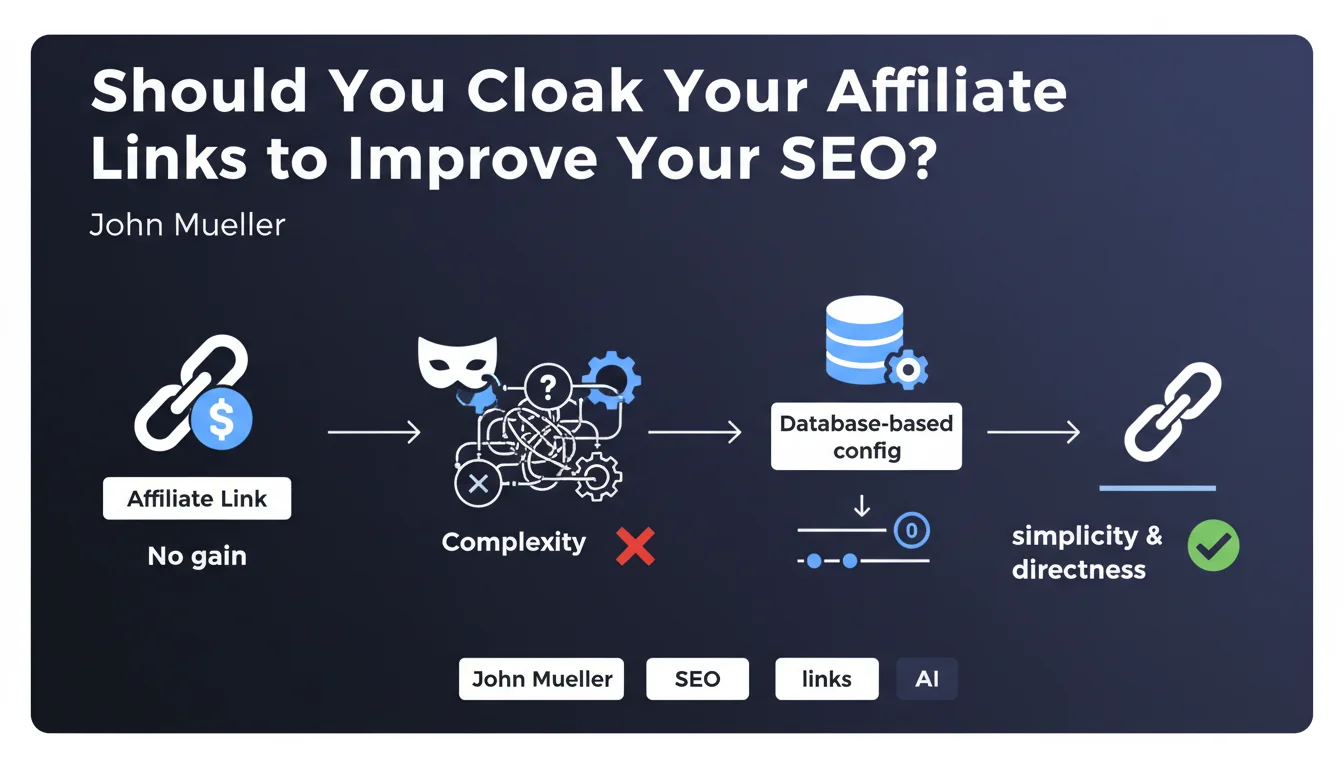
Google clearly indicates through John Mueller that cloaking affiliate links provides no advantage in terms of SEO. It simply adds an unnecessary layer of technical complexity.
The recommended alternative is to use a database-based configuration to manage these links, without resorting to masking. Google favors transparency and simplicity.
- Cloaking affiliate links does not improve SEO according to Google
- This practice adds unnecessary technical complexity to your site
- Google recommends more transparent solutions based on databases
- Affiliate links must be clearly identifiable to comply with guidelines
- The rel="sponsored" or rel="nofollow" attribute remains the recommended best practice
SEO Expert opinion
Is this statement consistent with practices observed in the field?
Absolutely. In 15 years of experience, I've observed that cloaking affiliate links has never produced measurable improvements in rankings. The best-performing sites are those that adopt a transparent approach.
Google's algorithms are now sophisticated enough to identify redirect patterns and understand the affiliate nature of a link, whether it's masked or not. Masking therefore becomes a cosmetic operation with no SEO value.
What real risks do you face with cloaked affiliate links?
The main danger is being perceived as using manipulative cloaking, a technique explicitly prohibited by Google. If the algorithm confuses your system with malicious cloaking, you risk manual or algorithmic penalties.
Additionally, these redirect systems add loading time and potential failure points. Each redirect consumes server resources and can negatively impact user experience.
In which specific cases does this recommendation particularly apply?
This directive applies to all sites monetized through affiliation, whether they're blogs, comparison sites, or media outlets. The site's size doesn't matter: transparency remains the golden rule.
For sites with thousands of affiliate links, the temptation to cloak is strong to simplify management. However, a well-designed database architecture with appropriate rel attributes remains superior in the long term.
Practical impact and recommendations
What should you do concretely with your existing affiliate links?
Audit all your current cloaked affiliate links and plan their transition to direct URLs with appropriate attributes. Systematically use rel="sponsored" (recommended since 2019) or rel="nofollow" on all your affiliate links.
If you manage numerous links, implement a database system that stores affiliate URLs and automatically generates links with the correct attributes. This offers flexibility and compliance without unnecessary complexity.
What critical mistakes should you absolutely avoid?
Never display a different URL to Google's robots versus human users. This is the very definition of prohibited cloaking that can lead to deindexing.
Avoid multiple redirect chains (301 to 302 to final URL) that dilute link equity and slow down the experience. A single, clear redirect remains acceptable, but a direct link remains optimal.
Never remove rel="sponsored" or rel="nofollow" attributes in hopes of passing PageRank. Google can detect affiliate link patterns and penalize you for manipulation.
How can you check and optimize your site's compliance?
Use Screaming Frog or a similar crawler to identify all your outbound links and filter those pointing to known affiliate platforms. Verify that each has the appropriate rel attribute.
Analyze your loading times with PageSpeed Insights and identify unnecessary redirects. Every millisecond counts for user experience and SEO.
- Audit all existing affiliate links on your site
- Systematically add the rel="sponsored" or rel="nofollow" attribute to each affiliate link
- Progressively remove cloaking systems and unnecessary redirects
- Implement centralized database management for high-volume sites
- Verify that Google's robots can normally crawl all your links
- Test response times and eliminate multiple redirects
- Document your affiliate link policy for transparency
- Regularly monitor Search Console to detect potential manual actions
💬 Comments (0)
Be the first to comment.