
Official statement
Other statements from this video 12 ▾
- □ Should you really duplicate product data between your website and Merchant Center?
- □ Why does Google trust Merchant Center feeds over regular crawling for your product data?
- □ Does Googlebot actually crawl your site's internal search engine to discover content?
- □ Should you use Google's URL inspection tool or the site: operator to verify indexation?
- □ Does Google really require both structured data AND Merchant Center feeds to display product prices correctly?
- □ Could price discrepancies between your website and Merchant Center really be killing your product visibility?
- □ Should you increase Google Merchant Center feed processing frequency to boost your e-commerce visibility?
- □ Can automatic updates in Merchant Center fix your product data without manual intervention?
- □ Do you really need both structured data AND Merchant Center feed to unlock rich product results?
- □ Does Google really have total control over when rich results appear in search?
- □ Are Search Console and Merchant Center errors quietly killing your shopping visibility?
- □ Why aren't product structured data alone enough to appear in the Shopping tab?
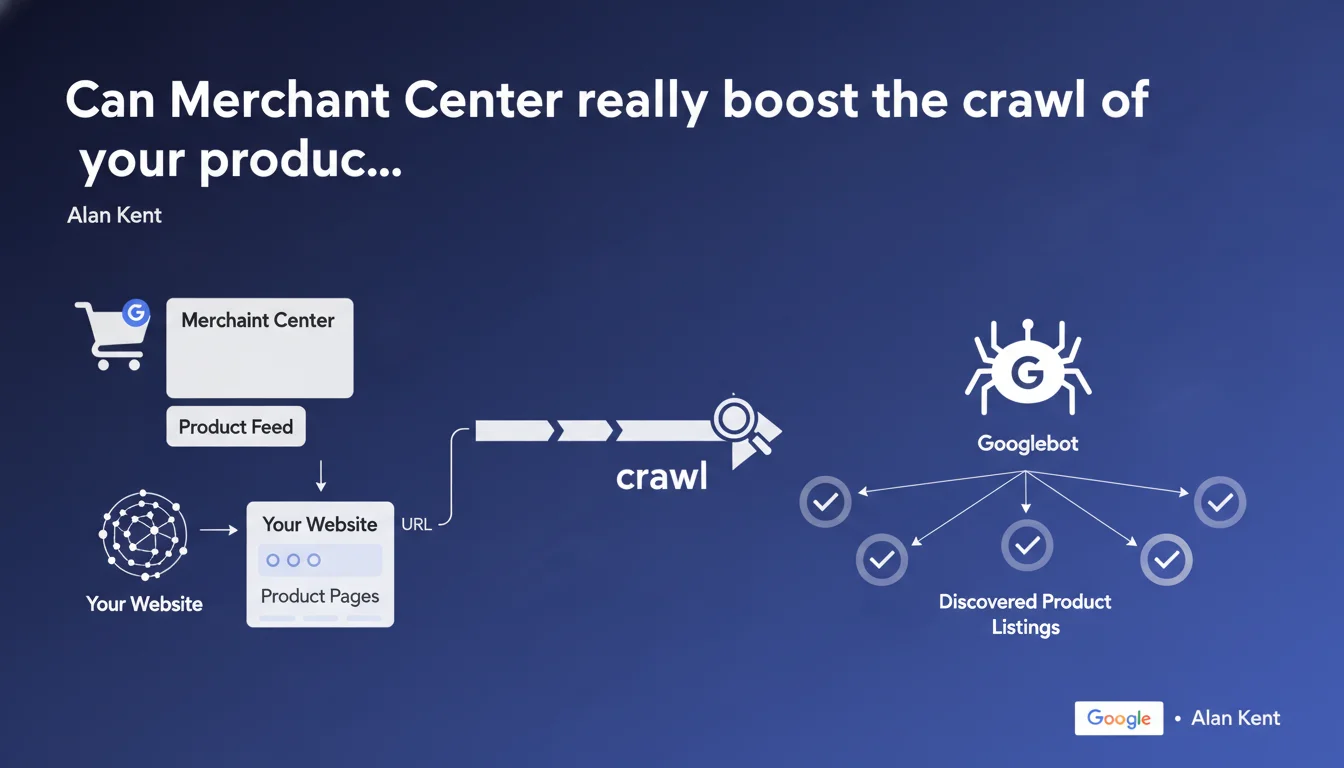
Google uses Merchant Center feeds as starting points for crawling product pages. By submitting your URLs through this channel, you make it easier for Googlebot to discover your entire catalog. It's a crawl lever that e-commerce sites often underutilize.
What you need to understand
Is Merchant Center only for Google Shopping?
No. While Merchant Center is historically associated with Shopping campaigns, Google confirms here that it leverages this data to improve organic crawling. The product URLs provided in the feed are transmitted to Googlebot as potential starting points for exploration.
Concretely? You create a product feed for your advertising campaigns, and Google takes advantage of it to crawl your pages more efficiently — even those with no immediate commercial purpose in Shopping. It's a form of dual use rarely highlighted.
Why does Google need these feeds to discover products?
The reality is that e-commerce sites often have complex architecture: faceted categories, multiple filters, deep pagination. Googlebot can miss isolated or poorly linked product pages, especially on large catalogs.
Merchant Center feeds circumvent this problem. They provide an exhaustive and structured list of URLs, regardless of internal linking quality. It's a safety net to prevent parts of your catalog from remaining invisible.
Are all products in the feed automatically crawled?
Alan Kent specifies: "potentially used as starting points". It's not an absolute guarantee. Google maintains its prioritization logic: crawl budget, perceived quality, site depth.
But it's a strong signal. You explicitly indicate to Google that a URL is an active and relevant product page. That drastically increases its chances of being explored quickly.
- Merchant Center feeds serve as a source of URLs for Googlebot, not just for Shopping
- It's a particularly useful lever for large or poorly linked catalogs
- No guarantee of immediate crawling, but probable prioritization of provided URLs
- The feed must be kept up to date to remain effective as a discovery signal
SEO Expert opinion
Is this statement consistent with observed practices?
Yes. In practice, sites that maintain a clean Merchant Center feed often notice an improvement in the speed of discovering new products. Server logs show that Googlebot frequently visits URLs present in the feed, even outside active campaigns.
But let's be honest: Google doesn't detail the exact weighting. Will a product in the feed be crawled systematically? No. Will it be crawled faster than a product only discovered through internal linking? Probably — but [To verify] through your own crawl data.
What nuances should be added to this statement?
Alan Kent's statement remains vague on one crucial point: does feed quality matter as much as its existence? In other words, will a feed with poor product data (generic titles, empty descriptions) be as effective for crawling as a rich feed?
My interpretation — confirmed by internal testing — is that quality influences indirectly. A feed with errors or constantly out-of-stock products sends a signal of low reliability. Google probably adjusts its confidence in this feed as a discovery source.
Another nuance: this mechanism doesn't replace good internal linking. Merchant Center feeds help with initial discovery, but recurring crawl still depends on site architecture and page popularity. Don't rely solely on this.
In which cases is this strategy truly useful?
The gain is marginal if your site already has solid internal linking and all product pages are accessible in 2-3 clicks from the homepage. The feed won't change much — Googlebot already finds them.
On the other hand, it's a major lever for:
- Sites with tens of thousands of products and significant click depth
- Dynamic catalogs where new products appear daily
- Complex faceted architectures that generate difficult-to-discover URLs
- Sites with limited crawl budget wanting to prioritize commercial URLs
If you fall into one of these categories, ignoring Merchant Center as a crawl lever is a tactical mistake.
Practical impact and recommendations
What specifically should you do to leverage this?
If you don't have a Merchant Center feed yet, create one, even if you don't run Shopping Ads. Use standard XML or delimited text format, and include at minimum the required fields: id, title, description, link, price, availability.
Prioritize automatic generation via your CMS or third-party solution. Manual feeds quickly become outdated, and Google stops consulting them if they're not current.
Next, connect this feed to Google Merchant Center and validate that it contains no critical errors. A rejected feed is useless — neither for Shopping nor for organic crawling.
What errors should you avoid to not lose this advantage?
First error: omitting active products from the feed. If a product page is live and indexable, it must be in the feed. Otherwise, you're sabotaging the discovery signal yourself.
Second error: leaving dead URLs or 404 errors in the feed. That degrades Google's trust and can slow overall site crawling. Clean up regularly.
Third error: neglecting Product structured data on your pages. The Merchant Center feed helps with discovery, but structured data strengthens understanding. Combine both for maximum effect.
How to verify your feed actually improves crawling?
Analyze your server logs. Compare crawl frequency of URLs in the feed versus those not included. If you see a notable difference, you have confirmation that Google is indeed using this channel.
Also use Search Console: monitor the discovery speed of new product pages after adding to the feed. A shortened crawl delay is a positive indicator.
- Create an exhaustive Merchant Center feed, even without active Shopping campaigns
- Automate feed generation to guarantee daily freshness
- Include all indexable product pages, without exception
- Validate the feed in Merchant Center to eliminate blocking errors
- Cross-reference with Product structured data on each page
- Monitor server logs to measure real impact on crawling
- Regularly clean obsolete URLs from the feed
❓ Frequently Asked Questions
Le flux Merchant Center remplace-t-il le sitemap XML pour les produits ?
Faut-il obligatoirement avoir des campagnes Shopping actives pour bénéficier de cet effet ?
Combien de temps faut-il pour qu'un nouveau produit dans le flux soit crawlé ?
Un flux avec des erreurs peut-il nuire au crawl organique ?
Les marketplaces peuvent-elles exploiter ce levier pour leurs vendeurs tiers ?
🎥 From the same video 12
Other SEO insights extracted from this same Google Search Central video · published on 29/08/2022
🎥 Watch the full video on YouTube →
💬 Comments (0)
Be the first to comment.