
Official statement
What you need to understand
What sparked this confusion about the future of Google Business Profile?
A promotional email from Google encouraging the use of Google Merchant Center (GMC) created doubt within the SEO community. Some professionals feared that Google was planning to remove the product feature from Google Business Profile.
This concern spread quickly, forcing Google to officially clarify its position through Ginny Marvin. The confusion illustrates the importance of distinguishing a commercial promotion from a strategic decision to remove a feature.
What is Google's official stance on products in GBP?
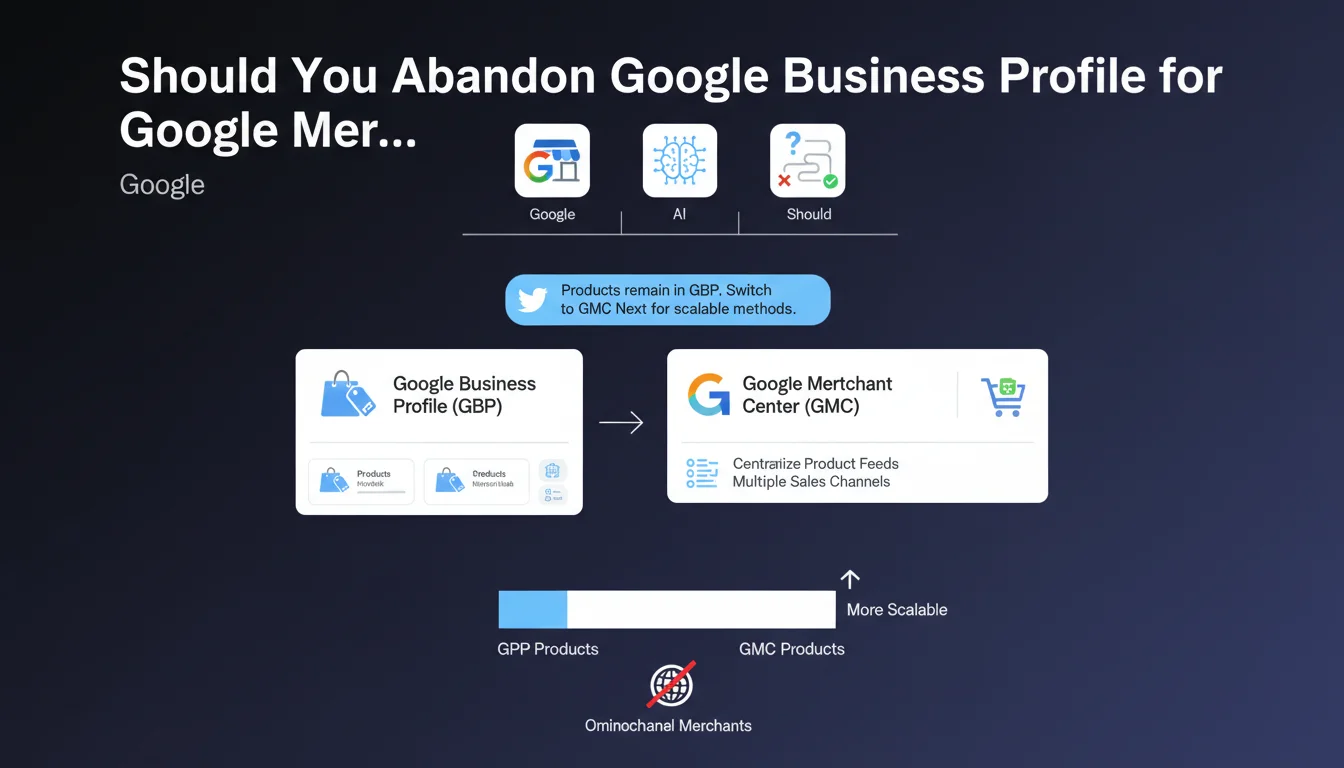
Google confirms unambiguously that products will remain available in Google Business Profile. There is no plan to remove this feature, contrary to circulating rumors.
However, Google encourages omnichannel merchants to migrate to GMC Next to benefit from more scalable methods. This recommendation particularly targets businesses managing a large number of products or multiple locations.
How do GBP and Google Merchant Center complement each other?
Google plans to improve the interoperability between the two platforms. Merchants will soon be able to edit their product data directly in GBP, regardless of the original source (GMC or GBP).
This evolution transforms these tools into complementary solutions rather than competing ones. GMC offers advanced feed management capabilities, while GBP remains ideal for local businesses with a limited catalog.
- No removal of products from Google Business Profile is planned
- GMC Next is recommended for omnichannel merchants with scalability needs
- Future bidirectional synchronization between GBP and GMC to facilitate management
- Both tools remain valid and maintained by Google
SEO Expert opinion
Does this statement align with Google's observed product strategy?
Absolutely. Google has historically taken an approach of multiplying touchpoints rather than brutal consolidation. The coexistence of GBP and GMC fits into this logic of offering multiple entry points depending on the user profile.
We also observe that Google regularly tests new integrations between its services before making final decisions. The announced synchronization between GBP and GMC confirms this trend toward interconnection rather than elimination.
Nevertheless, vigilance remains necessary. Google has already removed features after maintaining them for years (Google Posts, certain GBP statistics). Excessive dependence on a single platform remains risky in the long term.
What nuances should we add to this reassuring announcement?
While products remain in GBP, Google is clearly pushing toward GMC for advanced professional uses. This direction suggests that future developments and new features will likely favor GMC.
Merchants using only GBP risk finding themselves with a functional but less enriched tool over time. The sophistication gap between the two platforms could widen, favoring those who invest in GMC.
When does this distinction between GBP and GMC become critical?
For a single local business with 10-50 products, GBP remains largely sufficient and simpler to manage. Investment in GMC would bring little immediate added value.
On the other hand, for multi-location chains or e-commerce businesses with a physical presence, GMC becomes indispensable. Centralized feed management, connection with Google Ads, and automation capabilities fully justify the migration.
The dividing line also lies at the level of commercial ambition. A company planning rapid expansion should invest directly in GMC to avoid a later migration that is costly in time and resources.
Practical impact and recommendations
What should you actually do based on your business profile?
For small local merchants (restaurants, boutiques, artisans), continue using Google Business Profile without worry. Focus on optimizing your listing with quality photos, customer reviews, and up-to-date information.
If you manage multiple locations or an extensive catalog, seriously evaluate GMC Next. Start with a testing phase on a subset of products before a complete migration. Train yourself on the specifics of data feeds and the technical requirements of GMC.
For hybrid businesses (e-commerce + physical stores), migration to GMC should be a priority. This infrastructure will allow you to synchronize your inventories and deploy high-performing Shopping campaigns while feeding your local listings.
What mistakes should you avoid when managing your products on these platforms?
Don't manually duplicate your products between GBP and GMC without a clear synchronization strategy. This creates inconsistencies in prices, availability, and descriptions that penalize your credibility and local SEO.
Avoid neglecting product data quality on the grounds that GBP is simpler. Incomplete information (low-resolution images, generic descriptions, missing prices) drastically reduces your visibility in local results.
Don't indefinitely postpone GMC training if your growth requires it. The learning curve is significant, and a rushed migration during peak activity can generate costly errors in visibility and sales.
How can you verify that your product strategy is optimal?
Regularly audit your performance in Google Maps and local search. Compare your product visibility with similar competitors to identify gaps and improvement opportunities.
Systematically test the display of your products on different devices and queries. Verify that information is consistent, images display correctly, and links work to your landing pages.
Measure the actual commercial impact of your product listings via GBP or GMC statistics. Analyze clicks, direction requests, and conversions to adjust your content strategy and resource allocation.
- Keep your products updated in GBP if you're a simple local business
- Evaluate GMC Next if you manage more than 100 products or multiple locations
- Ensure data consistency across all your presence platforms
- Train your team on GMC's technical specifics before any migration
- Monitor your product performance in local results monthly
- Prepare a progressive transition strategy rather than an abrupt switch
- Document your update processes to ensure continuity
💬 Comments (0)
Be the first to comment.