
Official statement
Other statements from this video 12 ▾
- □ Faut-il vraiment doubler les données produits entre le site et Merchant Center ?
- □ Pourquoi Google préfère-t-il les flux Merchant Center au crawl classique pour vos données produits ?
- □ Merchant Center peut-il vraiment booster le crawl de vos fiches produits ?
- □ Googlebot crawle-t-il vraiment les moteurs de recherche internes de votre site ?
- □ Comment vérifier l'indexation d'une page : l'outil d'inspection ou l'opérateur site: ?
- □ Pourquoi Google exige-t-il à la fois des données structurées ET Merchant Center pour afficher les prix correctement ?
- □ Faut-il augmenter la fréquence de traitement des flux Google Merchant Center pour améliorer son référencement ?
- □ Les mises à jour automatiques dans Merchant Center peuvent-elles corriger vos données produits sans intervention manuelle ?
- □ Faut-il vraiment cumuler données structurées ET flux Merchant Center pour les résultats enrichis produits ?
- □ Les résultats enrichis sont-ils vraiment à la discrétion totale de Google ?
- □ Pourquoi les erreurs Search Console et Merchant Center sabotent-elles vos résultats shopping ?
- □ Pourquoi les données structurées produit ne suffisent-elles pas pour apparaître dans l'onglet Shopping ?
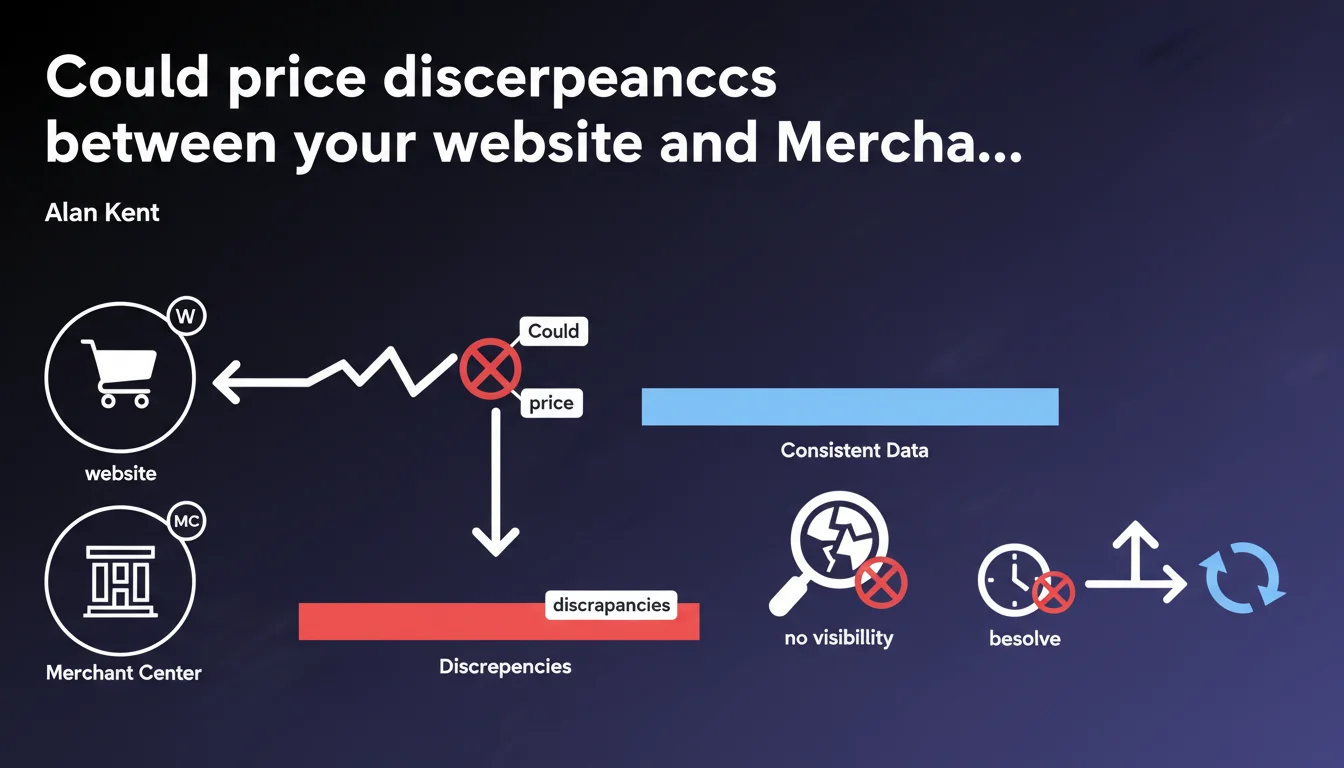
Google confirms that a divergence between prices displayed on your website and those declared in Merchant Center negatively impacts your products' presence in search results. The impact persists until the inconsistency is fully resolved. A rule that affects both organic results and Shopping surfaces equally.
What you need to understand
Why does Google penalize price inconsistencies?
Alan Kent's statement confirms what many suspected without having a clear official position. When a user clicks on a product from Google results and discovers a different price than the one announced, the user experience degrades dramatically. Google considers this a form of deception, even if unintentional.
The algorithm detects these divergences by comparing the Merchant Center feed to structured data and content crawled on the site. As soon as an inconsistency is identified, the product's visibility decreases progressively until the problem is resolved.
Does this penalty only affect Google Shopping?
No, and this is where many get it wrong. The statement specifically mentions "presence in search results" in the broad sense. This means that regular organic results can also be impacted, not just Shopping ads or rich product snippets.
If your product snippet appears in organic results with a price in structured data that differs from the one in Merchant Center, you're affected. Google applies this consistency rule across all its surfaces.
How long does the negative impact last?
Kent specifies "until the divergence is resolved," which remains deliberately vague. In practice, once the correction is made, you need to account for the site re-crawl time AND the processing of the new Merchant Center feed. We're typically talking about days to weeks depending on how frequently Google crawls your product pages.
No precise timeline is communicated, but the impact stops as soon as Google detects restored consistency across multiple successive verifications. The speed of correction is therefore critical.
- Price inconsistencies trigger a progressive drop in visibility, not a sudden disappearance
- The impact potentially affects all search results, not just Shopping
- Resolution requires both correction AND full re-crawl before returning to normal
- Google compares Merchant Center feed, structured data, and crawled content to detect divergences
- The penalty persists as long as the inconsistency is detectable by the algorithm
SEO Expert opinion
Is this statement consistent with real-world observations?
Let's be honest: we do indeed observe correlations between price inconsistencies and visibility drops, but rarely such a direct cause-and-effect relationship as Google suggests. Many sites with minor discrepancies (a few cents due to different rounding) show no measurable impact.
What appears to truly trigger the algorithm are significant divergences — beyond 5-10% difference — or repeated inconsistencies across multiple products. An isolated product with a €0.50 discrepancy will probably not cause visible penalties. [To be verified] as Google communicates no tolerance threshold.
What nuances should be added to this rule?
The statement doesn't specify how Google handles temporary promotions, geolocation-based personalized pricing, or VAT variations between countries. In theory, if your site displays a valid promotional price but your Merchant Center feed isn't updated in real-time, you're in inconsistency.
Another unclear point: websites with dynamic pricing (based on stock, demand, user profile). How does Google determine the "correct" reference price when it changes multiple times daily? The statement remains evasive on these complex use cases.
In which cases does this rule not apply strictly?
Products without Merchant Center presence are obviously not affected by this comparison logic. If you only do classic SEO without Shopping feeds, only the consistency between structured data and visible content matters.
Similarly, certain sectors (services, B2B with quote-based pricing) naturally escape this issue. The risk concerns almost exclusively e-commerce retailers with standardized product catalogs and active presence on Google Shopping.
Practical impact and recommendations
What should you concretely do to avoid these inconsistencies?
Automate synchronization between your product database, your website, and your Merchant Center feeds. Any price update must propagate simultaneously everywhere. Human errors during manual updates are the #1 cause of detected divergences.
Implement a monitoring system that daily compares prices crawled on your site with those in your active feed. Tools like DataFeedWatch or Channable can automate this verification, but an in-house script works just as well.
How do I verify that my site is currently compliant?
Use the URL Inspection tool in Search Console to see how Google interprets your product structured data. Then compare with the price declared in Merchant Center for the same SKUs. Any discrepancy beyond a few cents should be investigated.
Also remember to test with different geographic locations if you operate in multiple countries. A VPN or Google's structured data test tool allows you to simulate a crawl from different regions.
- Automate synchronized price updates across site + Merchant Center feed
- Implement daily monitoring comparing crawled prices vs active feed
- Verify structured data consistency via Search Console
- Test display from multiple geographic zones if relevant
- Document temporary promotion management in Merchant Center feed
- Plan identical propagation delays between site and feed during updates
- Set up automatic alerts in case of detected divergence for immediate correction
❓ Frequently Asked Questions
Un écart de quelques centimes sur un produit peut-il vraiment déclencher une pénalité ?
Comment gérer les prix promotionnels temporaires sans créer d'incohérence ?
L'impact négatif disparaît-il immédiatement après correction de l'incohérence ?
Cette règle s'applique-t-elle aussi aux produits absents de Google Shopping ?
Comment détecter rapidement si mes produits sont impactés par des incohérences de prix ?
🎥 From the same video 12
Other SEO insights extracted from this same Google Search Central video · published on 29/08/2022
🎥 Watch the full video on YouTube →
💬 Comments (0)
Be the first to comment.