
Official statement
Other statements from this video 12 ▾
- □ Faut-il vraiment doubler les données produits entre le site et Merchant Center ?
- □ Pourquoi Google préfère-t-il les flux Merchant Center au crawl classique pour vos données produits ?
- □ Merchant Center peut-il vraiment booster le crawl de vos fiches produits ?
- □ Googlebot crawle-t-il vraiment les moteurs de recherche internes de votre site ?
- □ Comment vérifier l'indexation d'une page : l'outil d'inspection ou l'opérateur site: ?
- □ Les incohérences de prix entre votre site et Merchant Center peuvent-elles vraiment plomber votre visibilité produit ?
- □ Faut-il augmenter la fréquence de traitement des flux Google Merchant Center pour améliorer son référencement ?
- □ Les mises à jour automatiques dans Merchant Center peuvent-elles corriger vos données produits sans intervention manuelle ?
- □ Faut-il vraiment cumuler données structurées ET flux Merchant Center pour les résultats enrichis produits ?
- □ Les résultats enrichis sont-ils vraiment à la discrétion totale de Google ?
- □ Pourquoi les erreurs Search Console et Merchant Center sabotent-elles vos résultats shopping ?
- □ Pourquoi les données structurées produit ne suffisent-elles pas pour apparaître dans l'onglet Shopping ?
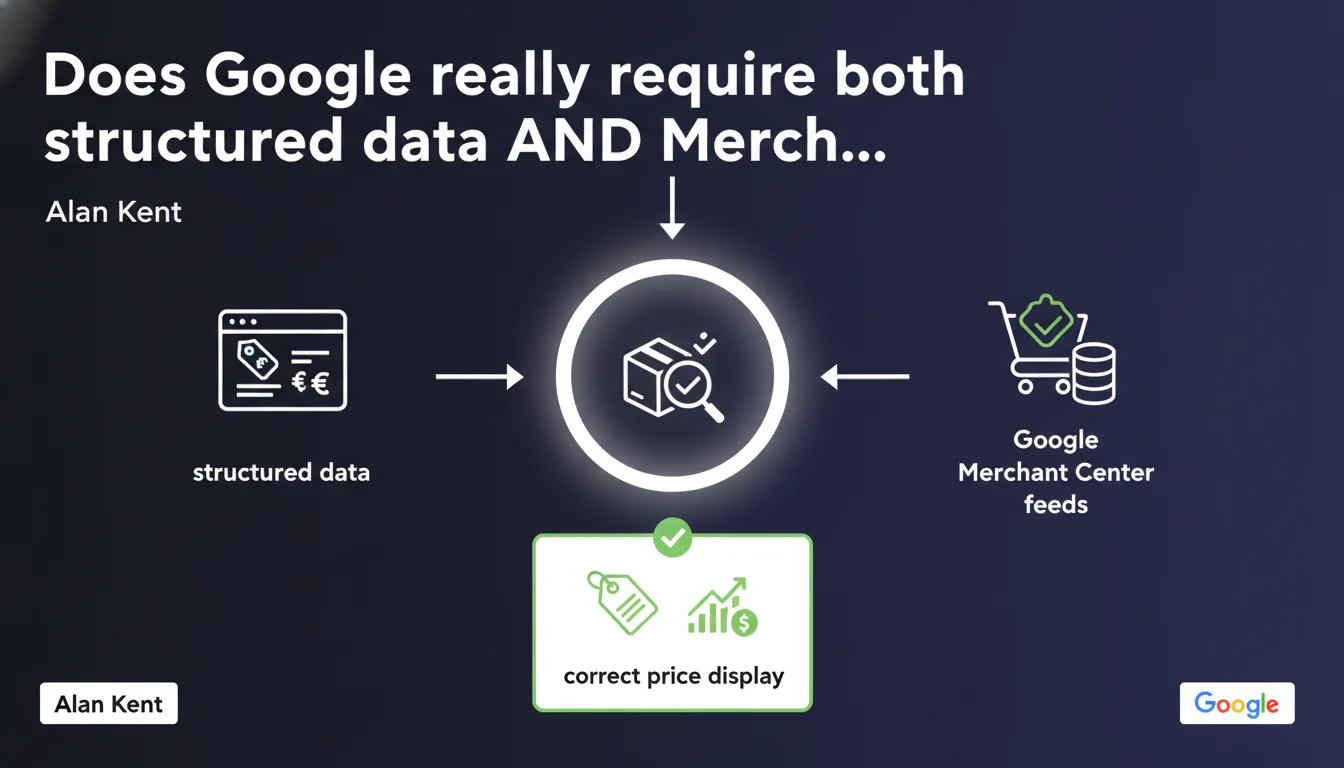
Google recommends combining structured data on product pages AND Merchant Center feeds to guarantee correct price extraction (list price, discounts, net price). The redundancy between these two sources allows the algorithm to validate and interpret pricing information displayed to users without ambiguity.
What you need to understand
Why this dual requirement when structured data alone seems sufficient?
Schema.org structured data (specifically Product and Offer) theoretically allows Google to extract price, availability, and promotions directly from HTML code. Yet Alan Kent insists on the necessity to also feed Merchant Center with a structured feed.
This redundancy is explained by the limitations of HTML parsing — variations in implementation, markup errors, ambiguities about currencies or discounts. The Merchant Center feed constitutes a centralized source of truth that Google can compare against structured data to detect inconsistencies and display errors.
What types of prices is Google trying to interpret precisely?
The statement explicitly mentions three elements: list price (the reference rate), discounts (percentages or amounts deducted), and net price (what the user actually pays).
These three components must be clearly differentiated so Google displays information correctly in shopping results, product rich snippets, and Performance Max ads. A strikethrough price without explicit structured data risks being ignored or misinterpreted.
What are the risks of incomplete implementation?
Without a Merchant Center feed, Google may refuse to display prices in rich results or apply sanctions on Shopping ads. Inconsistencies between visual display and structured data can trigger warnings in Google Merchant Center.
- Risk of ineligibility for product rich snippets with prices
- Possibility of Merchant Center feed suspension if prices don't match destination pages
- Display of incorrect or outdated prices in Shopping ads
- Loss of algorithmic trust in site data reliability
SEO Expert opinion
Is this dual requirement consistent with practices observed in the field?
Absolutely. Top-performing e-commerce sites on Google Shopping have systematically maintained this dual consistency for years. It's a standard practice, not a novelty — Alan Kent is simply formalizing what professionals already apply.
What's less obvious is the rigor required: a difference of a few cents between the feed and the page can be enough to trigger an alert. Google's cross-validation systems are stricter than people generally think.
What gray areas remain in this statement?
Alan Kent doesn't specify the tolerance delay between feed updates and site modifications. In reality, feeds are often updated daily while prices can change in real-time — let's be honest, this latency creates a risk of temporary inconsistency [To verify].
Another unclear point: how does Google handle personalized prices (based on geolocation, user history, loyalty programs)? The Merchant Center feed displays a single price while the page can adapt the display. Google provides no clear directive on this case — and it's problematic for sites with dynamic pricing strategies.
Does this recommendation apply only to sites with active Google Shopping?
No, and this is a crucial point many miss. Even without an active Shopping campaign, product structured data influences display in organic search (rich snippets). The free Merchant Center feed allows you to feed Google surfaces without paid advertising.
Practical impact and recommendations
What should you concretely do to comply with this recommendation?
First step: implement Product and Offer structured data on all product pages, explicitly specifying price, priceCurrency, and if relevant priceValidUntil. For discounts, use the priceSpecification property with price and eligibleQuantity.
Next, create a Merchant Center feed (XML or Google Sheets) containing the same information: price, sale_price, sale_price_effective_date. Automate daily feed generation to ensure data freshness.
Finally, set up a cross-validation system: a script that periodically compares the feed against structured data and alerts on discrepancies. Many e-commerce platforms generate feeds and schema.org from the same database — this is the best way to avoid inconsistencies.
What common mistakes must you absolutely avoid?
Classic error: displaying a strikethrough price visually without correctly marking the difference between reference price and sale price. Google doesn't always detect CSS to understand that a price is outdated.
Another pitfall: updating the Merchant Center feed but forgetting to regenerate structured data (or vice versa). This frequently happens when marketing and technical teams don't communicate.
- Verify that each product has a unique identifier (SKU or GTIN) consistent between feed and structured data
- Test price display in Google Search Console (Products report) to detect markup errors
- Monitor Merchant Center alerts for price discrepancies between feed and landing pages
- Use the Schema Markup Validator to validate structured data syntax
- Automate synchronization between product database, feed, and schema.org
- Document the update process to prevent human errors
How to verify that implementation is working correctly?
The Products report in Search Console indicates markup errors detected by Google. Particularly watch for warnings about missing prices, unrecognized currencies, or invalid formats.
In Merchant Center, the Diagnostics tab flags inconsistencies between feed and destination pages. An error rate above 5% warrants thorough investigation.
❓ Frequently Asked Questions
Les données structurées schema.org suffisent-elles sans flux Merchant Center pour afficher les prix dans les SERP organiques ?
Que se passe-t-il si le prix sur la page change entre deux mises à jour du flux Merchant Center ?
Faut-il créer un flux Merchant Center même sans campagne Shopping active ?
Comment gérer les prix personnalisés selon l'utilisateur dans les données structurées ?
Les variations de prix dues aux taxes ou frais de port doivent-elles être indiquées dans les données structurées ?
🎥 From the same video 12
Other SEO insights extracted from this same Google Search Central video · published on 29/08/2022
🎥 Watch the full video on YouTube →
💬 Comments (0)
Be the first to comment.