
Official statement
Other statements from this video 12 ▾
- □ Faut-il vraiment doubler les données produits entre le site et Merchant Center ?
- □ Merchant Center peut-il vraiment booster le crawl de vos fiches produits ?
- □ Googlebot crawle-t-il vraiment les moteurs de recherche internes de votre site ?
- □ Comment vérifier l'indexation d'une page : l'outil d'inspection ou l'opérateur site: ?
- □ Pourquoi Google exige-t-il à la fois des données structurées ET Merchant Center pour afficher les prix correctement ?
- □ Les incohérences de prix entre votre site et Merchant Center peuvent-elles vraiment plomber votre visibilité produit ?
- □ Faut-il augmenter la fréquence de traitement des flux Google Merchant Center pour améliorer son référencement ?
- □ Les mises à jour automatiques dans Merchant Center peuvent-elles corriger vos données produits sans intervention manuelle ?
- □ Faut-il vraiment cumuler données structurées ET flux Merchant Center pour les résultats enrichis produits ?
- □ Les résultats enrichis sont-ils vraiment à la discrétion totale de Google ?
- □ Pourquoi les erreurs Search Console et Merchant Center sabotent-elles vos résultats shopping ?
- □ Pourquoi les données structurées produit ne suffisent-elles pas pour apparaître dans l'onglet Shopping ?
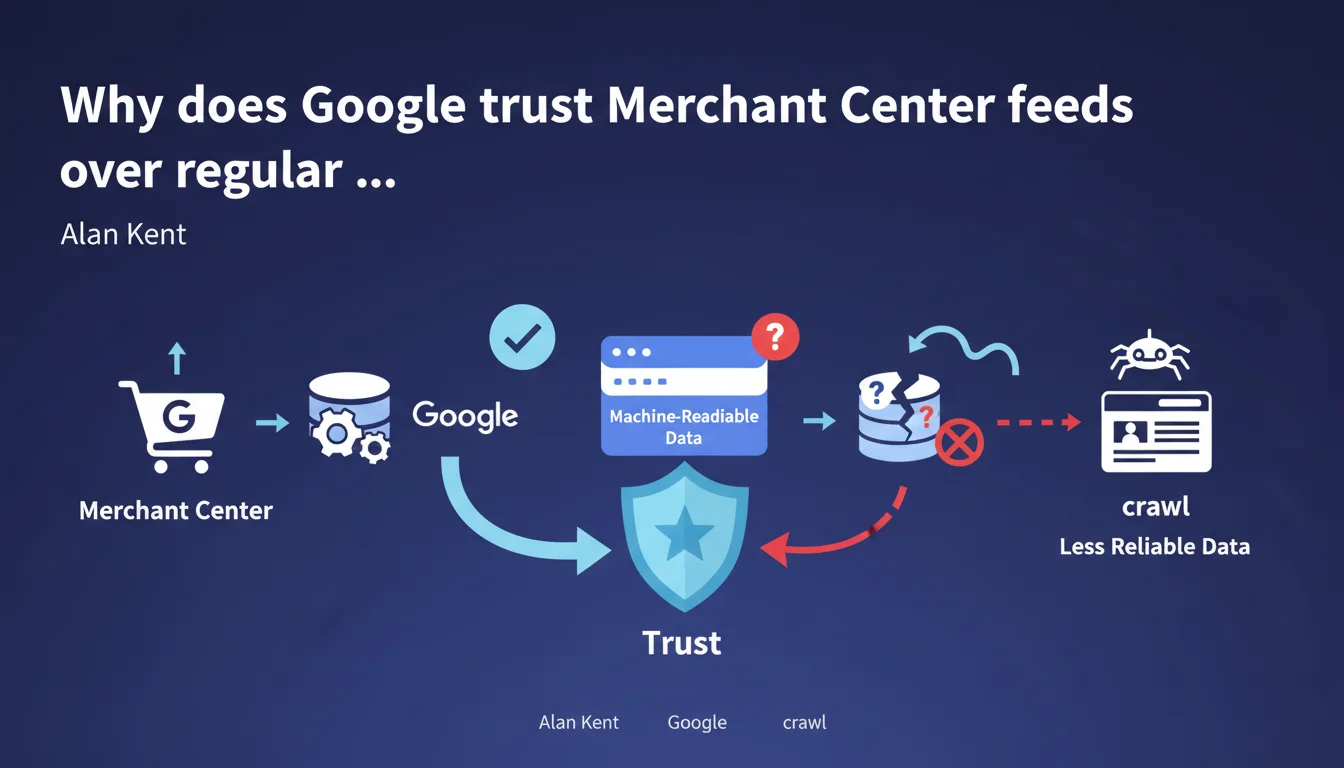
Google claims that data extracted from Merchant Center feeds is more reliable than data crawled from your product pages. Structured feeds, designed to be read by machines, avoid the ambiguities of HTML content interpretation. For e-commerce businesses, this means a well-configured feed can compensate for poorly optimized pages — but cannot replace them entirely.
What you need to understand
Why does Google make this distinction between feeds and crawling?
The answer comes down to one word: reliability. When Googlebot crawls a product page, it must interpret HTML, JavaScript, microdatathat may be poorly implemented, prices displayed in variable formats. Merchant Center feeds, on the other hand, are structured files (XML, CSV, API) with standardized columns: product ID, title, price, availability, GTIN.
This structuring eliminates ambiguity. There's no risk of a promotional price being confused with a struck-through price, no confusion between currency or VAT. Google knows exactly where to find each piece of data. It's mechanical, predictable, and scalable at large volumes.
Does this mean crawling product pages becomes secondary?
No. Feeds power Google Shopping and commerce surfaces (Search, Images, YouTube). But for traditional organic search, Googlebot continues to crawl your pages. The feed doesn't replace on-page optimization: title tags, meta descriptions, heading structure, internal linking, page speed.
What Google is saying is that for transactional data (price, stock, variants), the feed is more stable. If your page displays "In Stock" but your feed says "Out of Stock", the feed takes precedence for Shopping. For organic search, it's the page that counts.
What types of data benefit from this superior reliability?
- Price and promotions: standardized format, no parsing errors
- Stock availability: clear signal and real-time if the feed is updated frequently
- Product attributes: size, color, GTIN, category, brand — everything that's often poorly structured in HTML
- Product images: direct URL, no risk of lazy-loading or JavaScript blocking crawl
- Variants and multiple SKUs: a feed can cleanly list 20 variants of the same product, where a page might display them confusingly
SEO Expert opinion
Is this statement consistent with real-world observations?
Yes, absolutely. We've observed for years that e-commerce sites with well-configured Merchant Center feeds have better visibility in Google Shopping, even if their product pages are only moderately optimized. Conversely, sites with impeccable pages but poorly configured feeds (incorrect prices, outdated stock) see their Shopping ads disabled or underperforming.
But — and this is where Google's message can be misleading — this reliability doesn't transfer to organic search. I've seen sites with perfect feeds and catastrophic product pages: they dominate Shopping but are invisible in traditional SEO. The two channels are complementary, not interchangeable.
What nuances should be added to this claim?
Google isn't saying the feed improves your organic SEO. It's saying that for commerce surfaces, the feed is more reliable. That's a crucial distinction. If your goal is to rank in position zero or in product rich snippets, it's the schema.org Product markup on your pages that matters, not the Merchant Center feed.
Another point: the "reliability" of a feed assumes it's properly configured. In reality, many feeds contain errors: miscategorized categories, missing GTINs, broken image links, truncated titles. A poorly built feed is worse than good crawling. [To verify]: Google doesn't specify whether this "reliability" includes cases where the feed is incorrect but well-formatted — which would mean reliably propagating false data, the worst-case scenario.
In what cases does this rule not apply?
If you're not an e-commerce site, this statement doesn't concern you. Merchant Center is reserved for physical or digital products sold online. Content sites, blogs, and brochure sites don't have access to this channel.
Practical impact and recommendations
What should you do concretely to leverage this finding?
First step: audit your Merchant Center feed. Log into your account, go to "Diagnostics" and check the errors reported by Google. The most common: missing GTINs, non-compliant images, prices inconsistent with the destination page, missing required attributes (brand, MPN).
Next, automate feed updates. A static feed updated once a week isn't enough anymore. Ideally, your feed should regenerate multiple times a day to reflect stock and price changes. Use the Content API if you have the technical resources, or configure a dynamic feed via your CMS (Shopify, WooCommerce, Magento all have dedicated plugins).
What mistakes should you absolutely avoid?
- Don't duplicate the same data between the feed and schema.org markup — but ensure they're consistent
- Avoid generic product titles in the feed ("Sports Shoe") — Google favors descriptive titles with brand, model, color
- Never leave an out-of-stock product in your feed without flagging it — this degrades your Merchant Center quality score
- Avoid poor quality images or images with watermarks — Google may reject the product
- Don't ignore optional attributes (size, color, material) — they improve the relevance of your Shopping ads
How do you verify your configuration is optimal?
Use the "Merchant Center Diagnostics" tool to track warnings and errors. Even if your feed is accepted, warnings can limit your visibility. Also monitor your Shopping ads click-through rate (CTR): a low CTR despite a good feed often signals an image or title attractiveness problem.
Compare data displayed in Google Shopping with your product pages. If inconsistencies appear (different price, stock shown when there's none), your feed isn't synchronized with your database. Invest in a centralized feed management system (Channable, DataFeedWatch, Feedonomics) if you manage a large catalog.
This Google statement reminds us of a technical reality: machines prefer structured data. For e-commerce sites, this means a well-configured Merchant Center feed is as powerful a visibility lever as traditional SEO optimization — but on different surfaces. Don't sacrifice one for the other.
If implementing these optimizations seems complex or time-consuming, it may be wise to get guidance from an e-commerce SEO specialist. The technical challenges (feed-catalog synchronization, variant management, update automation) often require specialized expertise to avoid costly mistakes and maximize your Google Shopping ROI.
❓ Frequently Asked Questions
Le flux Merchant Center améliore-t-il mon référencement organique ?
Dois-je dupliquer mes données schema.org dans le flux Merchant Center ?
À quelle fréquence dois-je mettre à jour mon flux Merchant Center ?
Que se passe-t-il si mon flux contient des erreurs mais est bien formaté ?
Puis-je me passer d'optimiser mes pages produits si mon flux est parfait ?
🎥 From the same video 12
Other SEO insights extracted from this same Google Search Central video · published on 29/08/2022
🎥 Watch the full video on YouTube →
💬 Comments (0)
Be the first to comment.