
Official statement
Other statements from this video 23 ▾
- □ Does Google really count every single visible link pointing to your site in Search Console?
- □ Should you really concentrate your content on fewer pages to rank better?
- □ Do Google's product review criteria apply even if your site isn't classified as a review site?
- □ Does Google's Indexing API really work for all types of content?
- □ Does E-A-T Really Impact Google Rankings, or Is It Just a Myth?
- □ Do user comments really improve your Google rankings?
- □ Do premium SSL certificates really impact Google rankings?
- □ Does having the same content in both PDF and HTML formats hurt your SEO rankings through cannibalization?
- □ Can you really control PDF indexing through HTTP headers?
- □ Should you still use rel=next and rel=prev tags for pagination in 2024?
- □ Does Googlebot really index all your infinite scroll content?
- □ Should you really index every page on your website?
- □ Should you really worry about the referrer page shown in Google Search Console?
- □ Should you really redirect the old sitemap with a 301 or submit the new one directly instead?
- □ Is a 97% crawl refresh rate actually a positive sign for your website's health?
- □ Does your server speed actually control how often Google crawls your site?
- □ Does Google really measure crawl speed and Core Web Vitals the same way — and why should you care?
- □ Does Google really slow down crawling after a hosting migration, and how long does it last?
- □ Is the crawl rate parameter really a ceiling rather than something Google will try to maximize?
- □ Can CTR really penalize the rest of your website?
- □ Is internal linking really the most critical factor for SEO success?
- □ Does internal linking really take effect instantly after Google recrawls your pages?
- □ Should you worry if Google isn't crawling all your pages?
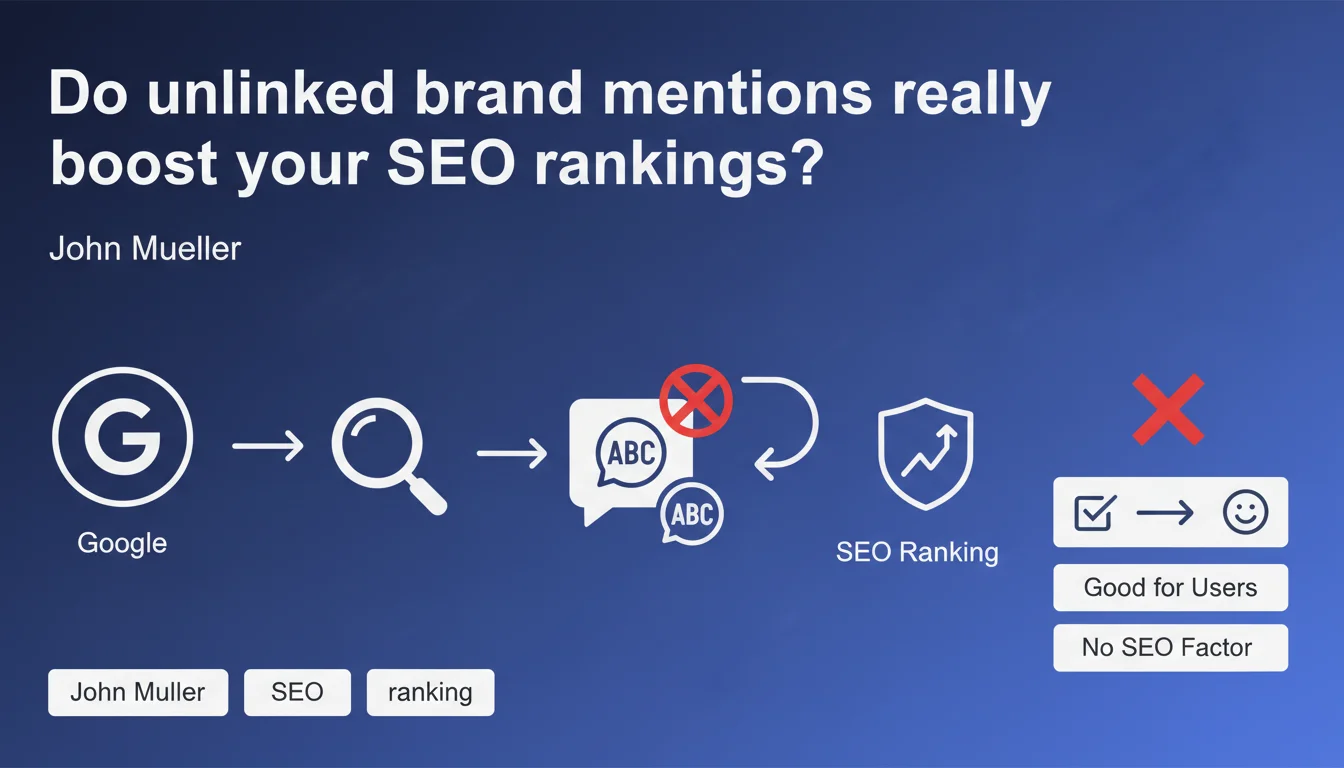
Google states it does not identify or value unlinked brand mentions in its ranking algorithm. Contrary to widespread belief in the SEO community, these citations without hyperlinks provide no direct benefit in terms of positioning. Focus your efforts on acquiring traditional backlinks rather than chasing simple mentions.
What you need to understand
For several years now, a theory has been circulating: brand mentions without hyperlinks (called "unlinked brand mentions" or "citations") would have SEO value. The underlying idea? Google would be capable of identifying when your brand is cited across the web and deriving signals of notoriety, authority, or thematic relevance from it.
Mueller sets the record straight: this scenario is pure speculation. Google does not track these unlinked mentions, at least not with the objective of transforming them into a ranking factor.
Why does this confusion persist in the SEO community?
Several Google patents indeed mention methods for identifying entities and their co-occurrences in text. But there's a big leap from that to concluding these techniques are deployed at scale to influence SERPs.
The confusion also stems from the fact that brand mentions have a measurable indirect impact: they generate direct traffic, strengthen brand awareness, can trigger branded searches. All of this positively influences your digital ecosystem — but it's not SEO in the strict sense.
What's the difference between a mention and a backlink from an algorithmic perspective?
A backlink is an explicit technical signal: one URL points to another, transmitting PageRank and anchor signals. Google has no ambiguity to resolve.
An unlinked mention is plain text. To exploit it, Google would need to extract entities, understand context, evaluate sentiment, assign weight... all at the scale of the crawled web. Technically possible? Probably. Used as a ranking factor? Mueller says no.
- Unlinked brand mentions do not directly influence rankings according to Google's official statement
- They remain useful for brand awareness, direct traffic, and branded searches
- Google does not deploy crawling mechanisms specifically designed to track these citations
- Traditional backlinks remain the main external popularity signal
SEO Expert opinion
Is this statement consistent with real-world observations?
Yes and no. On one hand, no solid correlation has ever been established between the volume of unlinked mentions and ranking improvement — studies claiming otherwise often confuse correlation with causation. A site that gets many mentions also gets many links, traffic, and engagement.
On the other hand, we observe that strong brands — those cited massively — perform better in SERPs. But it's a bundle of clues: search history, organic CTR, engagement signals, backlinks. Isolating the unlinked mention as a factor is methodologically risky.
Why doesn't Google want to exploit this signal?
Because it's a nightmare to validate and secure. How do you distinguish a positive mention from a negative one? How do you prevent text spam stuffed with competitor brand names? How do you attribute an ambiguous mention ("Apple" = the brand or the fruit)?
Backlinks have their flaws, but they offer a binary and verifiable signal. Mentions are semantic quicksand. Google probably prefers to invest its resources elsewhere — understanding natural language for queries, yes; assigning SEO weight to textual citations, no.
[To verify]: Some SEO tools claim to measure "brand authority" via mentions. These metrics are proprietary and don't necessarily reflect Google's algorithm. Take them as indicators of notoriety, not as validated ranking factors.
In what cases could this rule evolve?
If Google drastically improves its ability to understand the context and sentiment around an entity, it could theoretically integrate these signals. But Mueller speaks in the present tense: today, it doesn't exist.
A possible evolution — and already underway — concerns the Knowledge Graph and entity recognition for featured snippets, knowledge panels, etc. But again, this isn't about classic organic ranking, rather enriched display.
Practical impact and recommendations
What should you do concretely after this statement?
Stop investing time or budget in strategies specifically aimed at generating unlinked mentions for SEO purposes alone. If your PR or content marketing generates citations, great for your brand awareness — but don't count on it to climb the SERPs.
Redirect your resources toward acquiring real backlinks: quality guest blogging, creating linkable content (case studies, original data, free tools), targeted press relations that result in links, partnerships.
How should you prioritize your link-building efforts after this clarification?
Focus on quality over quantity. One contextual link from an authority site in your niche is worth more than 50 scattered textual mentions. Prioritize editorial placements that offer both visibility and a clickable link.
If you run PR campaigns, systematically negotiate the inclusion of a hyperlink. A mention in a press article without a link is branding — useful, but not SEO. With a dofollow link, you gain both benefits.
- Audit your current brand mentions and identify which ones could be converted into backlinks
- Contact sites mentioning you without a link to politely request the addition of a hyperlink
- Adjust your PR and content marketing briefs: objective = link, not just citation
- Stop measuring unlinked mentions as an SEO KPI — replace with backlink metrics (referring domains, DR/DA, anchor text)
- Continue monitoring mentions for reputation management and link-building opportunities
Brand mentions without links remain an asset for your overall visibility and brand awareness, but they don't constitute a direct SEO lever. Reorient your strategies toward acquiring tangible, measurable backlinks.
Managing an effective link-building strategy — identifying opportunities, qualifying sources, negotiating, tracking metrics — requires time and pointed expertise. If your organization lacks internal resources or you're looking to accelerate results, working with a specialized SEO agency can prove decisive in structuring your efforts and maximizing your return on investment.
❓ Frequently Asked Questions
Les mentions de marque sur les réseaux sociaux ont-elles un impact SEO ?
Dois-je arrêter de suivre mes mentions de marque ?
Un lien en nofollow vaut-il mieux qu'une simple mention ?
Les citations NAP (nom, adresse, téléphone) pour le SEO local sont-elles concernées ?
Google pourrait-il changer de position sur ce sujet à l'avenir ?
🎥 From the same video 23
Other SEO insights extracted from this same Google Search Central video · published on 18/02/2022
🎥 Watch the full video on YouTube →
💬 Comments (0)
Be the first to comment.