
Official statement
Other statements from this video 17 ▾
- □ Can you really erase the SEO past of a purchased domain?
- □ Should you really disavow links that don't match your current niche anymore?
- □ Should you really remove backlinks pointing to your domain's old content?
- □ Do server errors really kill your Google rankings?
- □ Should you include your brand name in news article titles for better search visibility?
- □ Why does changing only the title of copied content fool absolutely nobody?
- □ Should you really be putting dates in your article titles?
- □ Does adding categories to your URLs really boost your SEO rankings?
- □ Why does Google crawl pages it never adds to its index?
- □ What's the real secret to getting Google to index all your content?
- □ Are backlinks to your non-indexed pages really wasting your SEO potential?
- □ Why Does Google Drastically Reduce Its Crawl Rate After a CDN Migration?
- □ Does server response time really impact your Google rankings?
- □ Should you really update your backlinks after a domain migration?
- □ Should you really block pages with robots.txt if Google can index them without any content?
- □ Does image alt text in a link carry the same SEO weight as visible anchor text?
- □ Does retouched product photography actually hurt your review rankings?
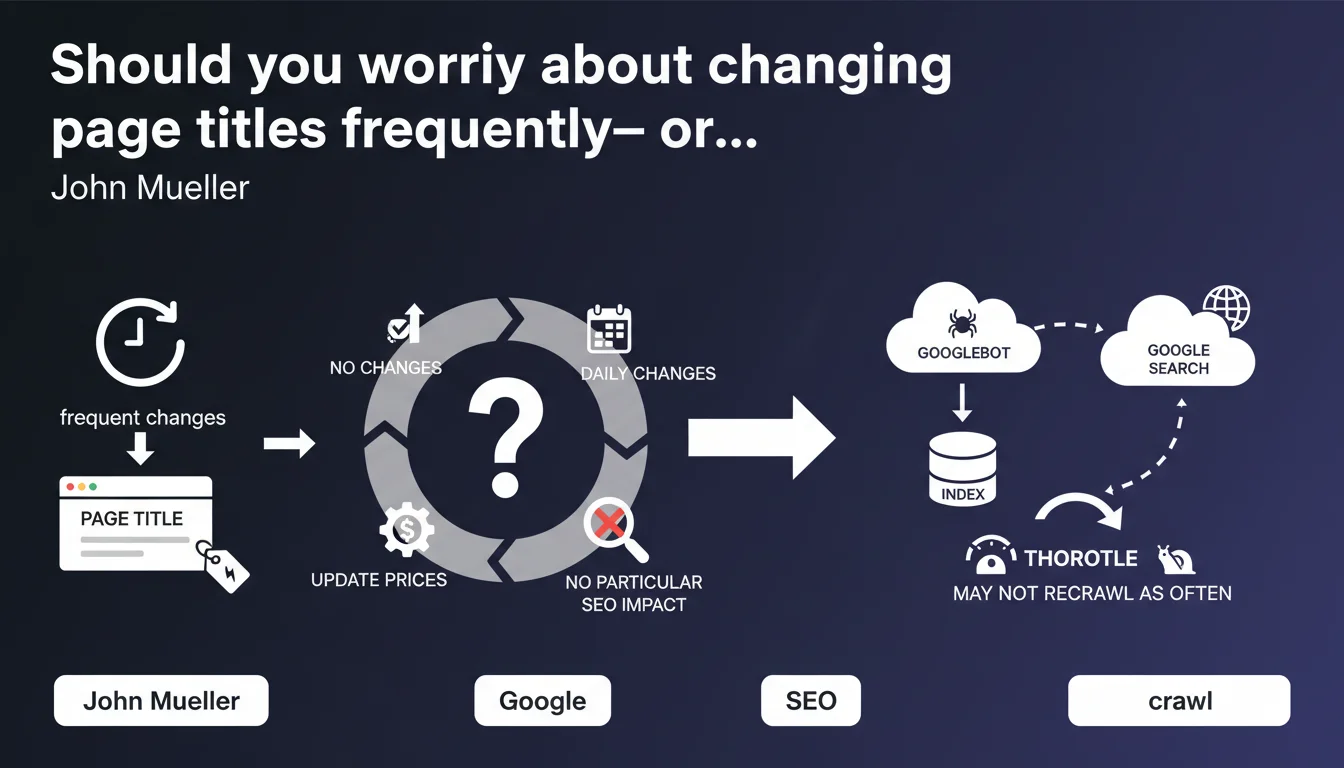
Changing your title tags daily (to display prices, promotions, or dates) has no negative SEO impact. Google doesn't penalize frequent changes, but the real challenge is crawl speed: if your page isn't recrawled often enough, Google won't pick up your modifications in time.
What you need to understand
Why does this Google clarification matter so much?
For years, many SEOs feared that frequent title changes would be interpreted as a spam signal or instability indicator by Google. John Mueller's statement puts this concern to rest.
Google confirms there is no penalty system linked to how often you modify your title tags. Whether you change your title once a year or every single day, the algorithm neither rewards nor punishes you for it.
So what's the real technical challenge here?
The problem isn't SEO impact—it's the time lag before changes take effect. If you modify your title daily but Googlebot only recrawls your page once a week, your changes will never show up in real-time SERPs.
For e-commerce sites displaying dynamic prices or limited stock in titles, this is a genuine operational constraint—but not a ranking factor.
Does this rule apply to all types of changes?
Mueller is specifically talking about minor, predictable changes (prices, dates, numbers). This isn't about radically shifting the page's topic or flip-flopping from an optimized title to clickbait every morning.
- Cosmetic changes (prices, dates, stock indicators) have zero SEO impact
- The real issue is crawl frequency, not title stability
- Google gives no bonus to stable titles and no penalty to changing ones
- This statement doesn't cover radical shifts in topic or content
SEO Expert opinion
Is this statement backed up by real-world observations?
Absolutely. Sites using dynamic titles (booking platforms, price comparison engines, event sites) show no observable penalties related to these variations. As long as the page content stays aligned with the title, Google handles these changes without issue.
What does cause problems is when the title changes but the content doesn't. Example: a title advertising a promotional price while the page displays the standard price. That's a user experience problem that can indirectly hurt your performance.
What nuances should we add to this claim?
Mueller only addresses the direct ranking impact. But a daily-changing title can create other issues: reduced CTR if users see a different title than what they saw yesterday, confusion if Google indexes a version of the title that no longer matches reality.
Plus, if you modify titles massively across thousands of pages simultaneously, you risk exhausting your crawl budget. Google will need to recrawl all those pages to detect the changes—which could slow down exploration of newer, more strategic URLs. [To verify]: Google has never clarified whether title-only modifications trigger systematic recrawling or are treated differently from content changes.
When does this rule NOT apply?
If you radically shift the topic or intent your page covers, that's no longer just a cosmetic tweak. Google may then reindex the page as a new document, with temporary ranking loss on historical queries.
Practical impact and recommendations
What should you actually do if you're modifying titles frequently?
First, verify that your site has sufficient crawl budget for Google to detect your changes within an acceptable timeframe. Use Search Console to monitor crawl frequency for your strategic pages.
Next, make sure your changes are consistent with page content. A title announcing price X while the page displays price Y creates user frustration—and Google picks that up through behavioral signals.
What mistakes should you avoid at all costs?
Don't change your titles just for the sake of changing them. If your current title performs well, modifying it without strategic reason can tank your CTR with zero SEO upside.
Also avoid creating overly similar variations that make your pages hard to distinguish in SERPs. Google might rewrite your titles if it judges them too alike or uninformative.
How do you verify that your changes are actually being picked up?
Use the URL Inspection tool in Search Console to force a recrawl after a strategic change. Also monitor which version of your title appears in SERPs—Google might choose to rewrite it if it deems it poorly suited to the query.
- Check your crawl frequency in Search Console for pages with dynamic titles
- Ensure alignment between your title and actual page content
- Test the impact of changes on your CTR before rolling out broadly
- Document large-scale changes to isolate their impact if fluctuations occur
- Use version control if managing dynamic titles at scale
❓ Frequently Asked Questions
Est-ce que changer mon title tous les jours va nuire à mon référencement ?
Dois-je forcer un recrawl après chaque modification de title ?
Google peut-il réécrire un title qui change trop souvent ?
Les modifications de title consomment-elles beaucoup de crawl budget ?
Peut-on utiliser des titles dynamiques en fonction de la requête de l'utilisateur ?
🎥 From the same video 17
Other SEO insights extracted from this same Google Search Central video · published on 04/02/2022
🎥 Watch the full video on YouTube →
💬 Comments (0)
Be the first to comment.