
Official statement
Other statements from this video 17 ▾
- □ Should you worry about changing page titles frequently—or is Google totally fine with it?
- □ Can you really erase the SEO past of a purchased domain?
- □ Should you really disavow links that don't match your current niche anymore?
- □ Should you really remove backlinks pointing to your domain's old content?
- □ Do server errors really kill your Google rankings?
- □ Should you include your brand name in news article titles for better search visibility?
- □ Why does changing only the title of copied content fool absolutely nobody?
- □ Should you really be putting dates in your article titles?
- □ Does adding categories to your URLs really boost your SEO rankings?
- □ Why does Google crawl pages it never adds to its index?
- □ What's the real secret to getting Google to index all your content?
- □ Are backlinks to your non-indexed pages really wasting your SEO potential?
- □ Why Does Google Drastically Reduce Its Crawl Rate After a CDN Migration?
- □ Does server response time really impact your Google rankings?
- □ Should you really update your backlinks after a domain migration?
- □ Should you really block pages with robots.txt if Google can index them without any content?
- □ Does retouched product photography actually hurt your review rankings?
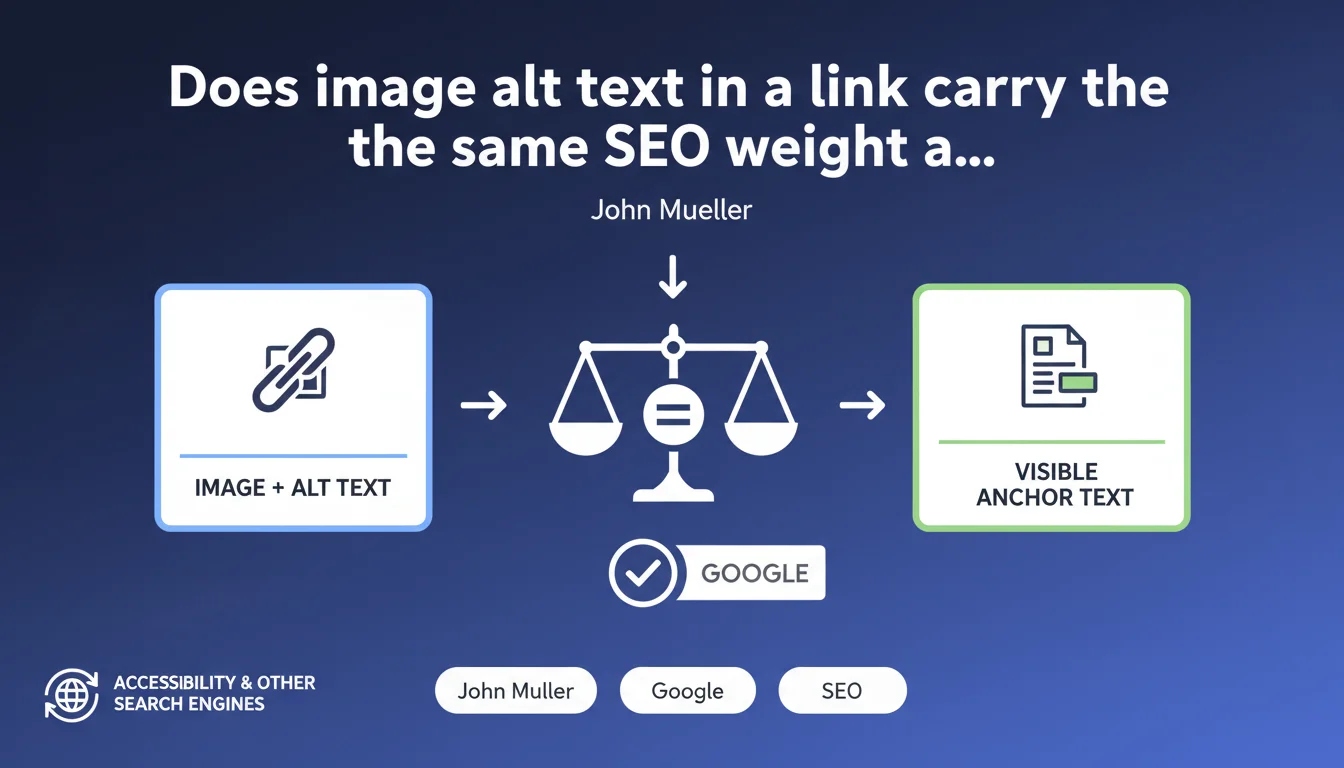
Google treats the alt text (alt) of an image placed within a link exactly like standard anchor text. Both have equivalent value for SEO, regardless of their order in the HTML code. However, retaining visible text remains essential for accessibility and third-party search engines.
What you need to understand
Why this clarification about mixed text-image links?
Many websites use hybrid links combining an image (logo, icon, visual) and clickable text. The question arose: does Google weigh the image's alt attribute and visible text differently? The answer is no.
This statement closes a gray area: in an <a> tag containing both an <img> and text, the engine aggregates both sources without hierarchy. The image's alt text is not "secondary" — it counts as much as visible text for building the anchor signal.
Does the HTML code order influence the weight?
No. Whether the image is placed before or after the text in the DOM, Google makes no distinction. Both fragments are merged into the same semantic context of the link.
This simplifies developers' lives: no need to reorganize markup for optimization. What matters is thematic coherence between the two elements, not their technical sequence.
Why keep visible text despite the equivalence?
Because accessibility extends beyond Google. Screen readers, users browsing without images, and alternative search engines (Bing, DuckDuckGo) have their own rules. A purely graphical link without visible text may work for Google, but excludes part of your audience.
Additionally, user experience remains a priority: clear text anchoring helps visitors anticipate the link destination, which reduces bounce rate and improves behavioral signals.
- The
alttext of an image in a link has the same SEO value as visible anchor text - The order of elements (image before or after text) has no impact on processing
- Keeping visible text remains essential for accessibility and third-party search engines
- Google aggregates both sources into a single anchor signal
SEO Expert opinion
Is this statement consistent with field observations?
Yes, it confirms what we observed empirically: mixed links (logo + text) in navigation menus or footers transmit link juice with composite anchoring. A/B tests on e-commerce sites show that modifying a link image's alt text can influence the target page's ranking for queries related to that text.
However, Google does not clarify how it handles semantic conflicts. If the alt says "running shoes" and visible text says "see our catalog," which signal dominates? [To verify] — the documentation remains silent on resolving obvious inconsistencies.
What nuances should we add?
The stated equivalence does not mean the two sources reinforce each other multiplicatively. Google aggregates them, but we don't know if a link with alt + text weighs more than a text-only link of equivalent length. The phrasing "essentially the same way" leaves room for interpretation.
Another point: this rule applies to internal and external links, but external backlinks with image anchors are rare. The practical impact mainly concerns internal linking (navigation, related posts modules, etc.).
alt attribute with keywords hoping to multiply signals remains spam. Google detects over-optimizations — the alt attribute must describe the image naturally, not serve as a second arbitrary anchor field.In which cases does this rule not apply?
If the image lacks an alt attribute or it's empty (alt=""), only visible text counts. Google does not guess an image's content without metadata.
Similarly, a link containing only an image (without visible text) will pass link juice based solely on the alt text. But this setup is fragile: if the image fails to load or the crawler encounters a problem, the anchor signal disappears.
Practical impact and recommendations
What should you concretely do with mixed text-image links?
Start by auditing your navigation links: main menus, breadcrumbs, footers. Identify those containing an image (logo, icon) and text. Verify that the image's alt complements or reinforces visible text without creating unnecessary redundancy.
For example, a "Home" link with a logo whose alt says "Company logo" adds little value. Better to use alt="Home" or alt="" if visible text suffices. The goal: semantic coherence, not padding.
What mistakes should you avoid when optimizing alt attributes?
Don't treat alt as a second keyword field. A product page link with visible text "Nike Air Max 90" and alt="running shoes men cheap shipping free" reeks of spam.
Also avoid inconsistencies: if the image shows a sneaker visual and the text says "Our Services," the alt should describe the image ("Nike Air Max Sneaker"), not echo the text. Google aggregates, but a visually impaired user must understand what they're looking at.
How can you verify that your links follow best practices?
A Screaming Frog crawl or Sitebulk allows you to export all links with their anchors. Filter those containing an <img> tag and analyze the "Anchor Text" column — modern tools already concatenate visible text and alt.
Then review for inconsistencies: empty anchors, generic alt text ("image," "photo"), exact duplicates. Correct manually or via templating rules if your CMS allows it.
- Audit mixed text-image links in navigation and internal modules
- Ensure the
altcomplements visible text without unnecessary redundancy - Avoid over-optimization:
altmust describe the image, not stuff keywords - Verify semantic coherence between
altand visible text - Use a crawler to identify empty or generic anchors
- Retain visible text for accessibility and third-party search engines
❓ Frequently Asked Questions
Si mon lien contient une image et du texte, lequel Google privilégie-t-il ?
Dois-je dupliquer le texte visible dans l'attribut alt de l'image ?
Un lien avec uniquement une image (sans texte visible) est-il pénalisé ?
Cette règle s'applique-t-elle aux backlinks externes ?
Que faire si l'alt et le texte visible se contredisent ?
🎥 From the same video 17
Other SEO insights extracted from this same Google Search Central video · published on 04/02/2022
🎥 Watch the full video on YouTube →
💬 Comments (0)
Be the first to comment.