
Official statement
Other statements from this video 17 ▾
- □ Should you worry about changing page titles frequently—or is Google totally fine with it?
- □ Can you really erase the SEO past of a purchased domain?
- □ Should you really disavow links that don't match your current niche anymore?
- □ Should you really remove backlinks pointing to your domain's old content?
- □ Do server errors really kill your Google rankings?
- □ Should you include your brand name in news article titles for better search visibility?
- □ Why does changing only the title of copied content fool absolutely nobody?
- □ Should you really be putting dates in your article titles?
- □ Does adding categories to your URLs really boost your SEO rankings?
- □ Why does Google crawl pages it never adds to its index?
- □ Are backlinks to your non-indexed pages really wasting your SEO potential?
- □ Why Does Google Drastically Reduce Its Crawl Rate After a CDN Migration?
- □ Does server response time really impact your Google rankings?
- □ Should you really update your backlinks after a domain migration?
- □ Should you really block pages with robots.txt if Google can index them without any content?
- □ Does image alt text in a link carry the same SEO weight as visible anchor text?
- □ Does retouched product photography actually hurt your review rankings?
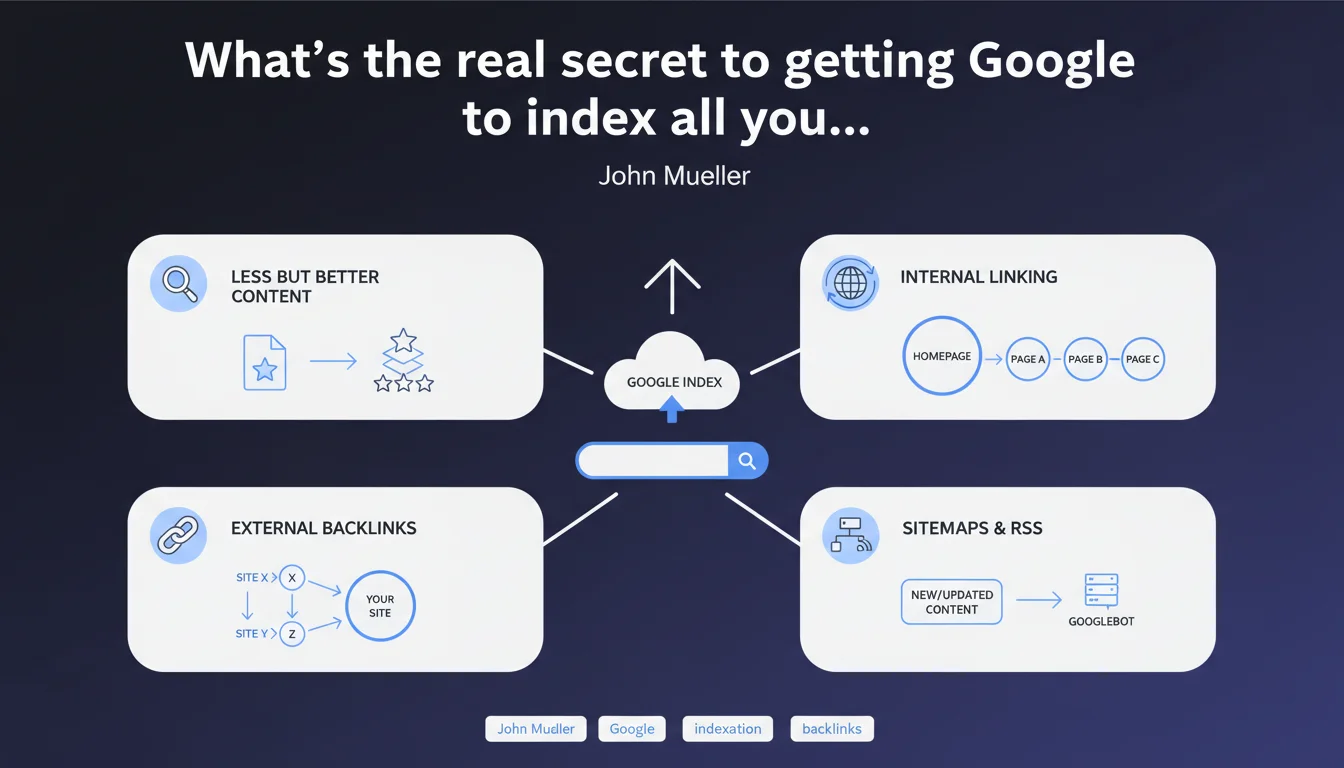
Google prioritizes quality over quantity when indexing. Mueller recommends producing less but better content, structuring internal linking from the homepage, acquiring external backlinks, and using sitemaps and RSS feeds to signal new updates. The goal: make it easier for Google to identify what truly matters.
What you need to understand
Why does Google really insist on quality over quantity?
Google must make indexation choices. Not all sites have the same crawl budget, and not all content deserves to be indexed. Mueller is crystal clear about this: creating less content but of much better quality makes the work easier for search engine bots.
What does this mean in practice? A site publishing 50 mediocre articles per month will struggle to get its pages indexed compared to one publishing 10 truly solid pieces. Google prefers to index content that delivers real value — everything else can be left aside.
What role does internal linking play in indexation?
Internal linking structures your site's hierarchy. Linking a page from your homepage sends a powerful signal: this page matters. Bots follow links — if a page is 5 clicks deep, it might never get crawled.
Mueller also mentions external backlinks. A quality backlink can trigger the indexation of a page that was previously ignored. It's an external validation signal that Google takes seriously.
Are sitemaps and RSS feeds enough to guarantee indexation?
No. XML sitemaps and RSS feeds make it easier to discover new or updated content, but they guarantee nothing. Google uses them as hints, not as commands.
If your content is weak or your site lacks authority, submitting 1,000 URLs via sitemap won't change anything. It's a tool among many, not a magic wand.
- Quality over Quantity: Google indexes what has value, not everything that gets published
- Strategic internal linking: linking from the homepage = priority signal
- External backlinks: a solid backlink can unlock indexation of a previously missed page
- Sitemaps and RSS: useful for signaling updates, but not sufficient on their own
SEO Expert opinion
Is this statement consistent with what we observe in practice?
Yes. We regularly see sites that artificially inflate their content volume hit an indexation wall. Google no longer indexes everything by default — it filters. Weak pages get stuck in "Discovered – currently not indexed" status in Search Console.
Mueller's recommendation about internal linking is conventional but true: orphaned pages or those buried too deep are never crawled. And external backlinks? Yes, a single quality backlink can genuinely trigger indexation of a previously ignored page.
What nuances should we add?
The notion of "better quality" remains vague. [To be verified] What does Google actually consider "quality" for indexation purposes? Article length? Originality? User engagement? Mueller doesn't provide measurable criteria.
Another point: saying "use sitemaps" without clarifying that they're ignored if your site lacks authority is incomplete. Many SEOs still believe a sitemap forces indexation — it doesn't. Google uses it as a hint, nothing more.
In which cases does this rule not apply?
On news sites or large e-commerce platforms, freshness and volume are sometimes necessary. A news site can't survive on just 10 articles per month. But even there, editorial quality remains a differentiator.
And let's be honest: if your site already has strong authority (solid backlinks, clean history), Google will index almost everything. This recommendation is mainly for sites that don't yet have that trust capital.
Practical impact and recommendations
What exactly should you do to improve indexation?
First, audit your existing content. Identify weak pages: low traffic, few backlinks, high bounce rate. Merge them, improve them, or delete them. Google will appreciate a more focused site.
Next, review your internal linking structure. Strategic pages should be accessible from the homepage, ideally in 1 or 2 clicks. Use explicit and varied anchor text.
For new content, prioritize depth over breadth. A well-structured, sourced, and unique 3,000-word article beats three generic 1,000-word pieces. And don't forget to submit your XML sitemaps in Search Console.
What mistakes should you avoid?
Don't think submitting a sitemap guarantees indexation. Don't publish weak content hoping Google will index it "by default". And don't neglect external backlinks — a good backlink can make all the difference.
Another classic mistake: creating content without properly linking it. An orphaned page, no matter how great, will never be crawled. Internal linking isn't optional, it's essential.
How do you verify your site is compliant?
Check Search Console, specifically the "Coverage" section. Look for "Discovered – currently not indexed" pages and analyze why. Usually it's a quality or internal linking issue.
Use a crawler (Screaming Frog, Oncrawl) to identify orphaned pages and click depth. If a strategic page is more than 3 clicks from the homepage, fix it.
- Audit existing content and remove or improve weak pages
- Structure internal linking: strategic pages accessible from the homepage
- Prioritize editorial quality over publishing volume
- Acquire quality backlinks to strengthen site authority
- Submit XML sitemaps and RSS feeds to signal new content
- Monitor Search Console regularly to detect indexation issues
- Crawl your site to identify orphaned pages and fix click depth
❓ Frequently Asked Questions
Un sitemap XML garantit-il l'indexation de toutes mes pages ?
Combien de clics depuis la page d'accueil est acceptable pour une page stratégique ?
Faut-il supprimer les pages peu performantes pour améliorer l'indexation ?
Les flux RSS sont-ils encore utiles pour l'indexation en 2025 ?
Un seul backlink peut-il vraiment débloquer l'indexation d'une page ?
Thematic analysis
🎥 From the same video 17
Other SEO insights extracted from this same Google Search Central video · published on 04/02/2022
🎥 Watch the full video on YouTube →
💬 Comments (0)
Be the first to comment.