
Official statement
Other statements from this video 17 ▾
- □ Should you worry about changing page titles frequently—or is Google totally fine with it?
- □ Can you really erase the SEO past of a purchased domain?
- □ Should you really disavow links that don't match your current niche anymore?
- □ Do server errors really kill your Google rankings?
- □ Should you include your brand name in news article titles for better search visibility?
- □ Why does changing only the title of copied content fool absolutely nobody?
- □ Should you really be putting dates in your article titles?
- □ Does adding categories to your URLs really boost your SEO rankings?
- □ Why does Google crawl pages it never adds to its index?
- □ What's the real secret to getting Google to index all your content?
- □ Are backlinks to your non-indexed pages really wasting your SEO potential?
- □ Why Does Google Drastically Reduce Its Crawl Rate After a CDN Migration?
- □ Does server response time really impact your Google rankings?
- □ Should you really update your backlinks after a domain migration?
- □ Should you really block pages with robots.txt if Google can index them without any content?
- □ Does image alt text in a link carry the same SEO weight as visible anchor text?
- □ Does retouched product photography actually hurt your review rankings?
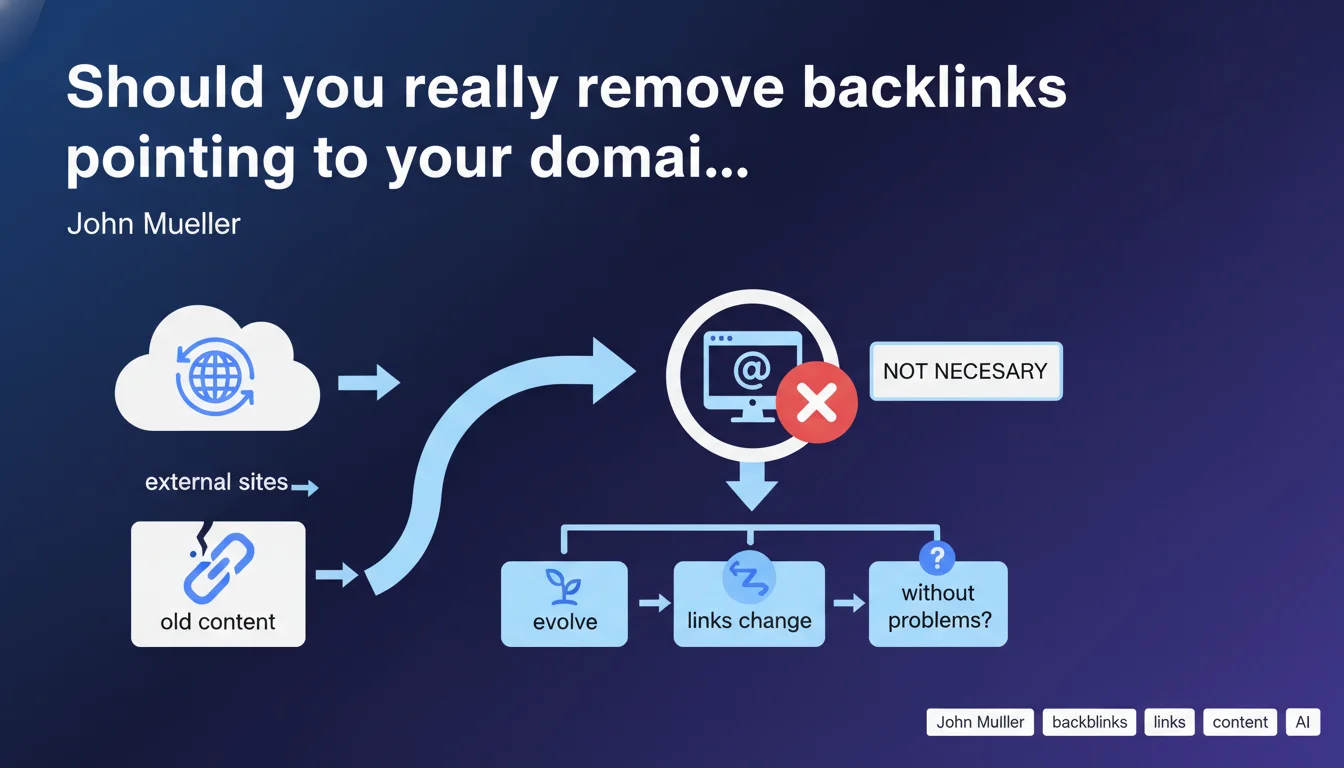
Google confirms that it is not necessary to request the removal of external links pointing to the former activity of a purchased or repositioned domain. Websites evolve naturally and obsolete backlinks do not cause ranking problems, even if they no longer match current content.
What you need to understand
Why is Google clarifying this about obsolete backlinks?
This statement from John Mueller addresses a recurring concern: what to do with inherited backlinks when a domain dramatically changes topic or business focus? Typical case: you purchase a domain with a history in shoe e-commerce, and you launch a B2B SaaS software site.
The question becomes: will hundreds of links pointing to disappeared product pages penalize the new project? Google answers clearly in the negative. The search engine understands that websites evolve, pivot, change ownership.
How does Google technically handle links that have become irrelevant?
The ranking system does not treat an obsolete backlink as a negative signal. A link that pointed to a product page that no longer exists will simply be ignored or naturally devalued in the PageRank calculation.
Google has mechanisms to identify thematic changes in a domain. The algorithm distinguishes between a domain's history and its current indexed content. It is the latter that determines relevance for search queries.
What are the concrete situations where this rule applies?
- Expired domain purchase: you acquire a domain with a link profile in a different topic
- Strategic pivot: a company completely changes its business model and target audience
- Major overhaul: removal of entire site sections (blog, e-shop, etc.) that generated backlinks
- Merger/acquisition: consolidation of multiple entities with different histories
- CMS migration: loss of URLs and content during a poorly managed technical migration
SEO Expert opinion
Is this position consistent with real-world observations?
Yes, and it's reassuring. Empirical data confirms that a domain with a diverse backlink profile does not systematically suffer penalties. We regularly observe sites that perform well despite hundreds of links pointing to 404s or unrelated content.
But — and this is where it gets complicated — this statement says nothing about the potential positive impact of these obsolete links. Are they counted as zero or do they still transmit a fraction of their juice to the homepage via redirect? [To verify]
What nuances should be added to this claim?
Google mentions links that "may no longer work in the future without causing problems". The key word here is "problems", not "benefits". In other words: no penalty, but no guarantee of value transmission either.
Second nuance: this rule applies to obsolete natural backlinks, not spam or manipulative links. If your domain has a history of PBN or mass link buying, disavow remains an option to consider — even if Google claims to handle it automatically.
In what cases is this rule insufficient?
If you inherit a domain with an identified toxic profile (historical manual penalty, documented mass spam), don't settle for this statement. A full audit and potentially targeted disavow still remain justified.
Same for situations where old backlinks generate unqualified referral traffic that tanks your engagement metrics. There, the problem is no longer pure SEO but UX and conversion — and that deserves action.
Practical impact and recommendations
What should you concretely do with these obsolete backlinks?
First step: identify backlinks pointing to non-existent URLs or removed content. Use Search Console, Ahrefs, or Majestic to extract the complete list. Cross-reference with your current sitemap to spot gaps.
Next, categorize these links by domain authority and referral traffic volume. Links from high-authority sites deserve particular attention — even if thematically obsolete, they can still transmit value if properly redirected.
What mistakes should you absolutely avoid?
- Don't waste time contacting hundreds of webmasters requesting removal of obsolete links — that's precisely what Google says is unnecessary
- Don't set up 301 redirects to the homepage for all dead links — it dilutes the signal and Google may ignore these irrelevant redirects
- Don't use the disavow file for simply obsolete but non-toxic backlinks — reserve this tool for genuine spam cases
- Don't brutally delete all old URLs without analyzing their backlink profile — you could lose valuable juice
How do you maximize the value of obsolete backlinks?
The optimal strategy is to create relevant replacement content where you have quality backlinks. If 20 links point to an old page "Nike Running Shoes", create related content (sports equipment guide, comparison, etc.) and redirect to this new resource.
For truly off-topic backlinks, a 410 redirect (Gone) is preferable to a 404. It explicitly indicates the content has disappeared permanently and accelerates deindexing of the obsolete URL.
❓ Frequently Asked Questions
Si je rachète un domaine expiré avec des backlinks dans une autre thématique, vais-je être pénalisé ?
Faut-il utiliser le fichier de désaveu pour des backlinks obsolètes mais propres ?
Les backlinks vers des pages 404 transmettent-ils encore du PageRank ?
Dois-je supprimer les anciennes URLs qui reçoivent des backlinks mais n'existent plus ?
Comment identifier rapidement les backlinks obsolètes de mon domaine ?
🎥 From the same video 17
Other SEO insights extracted from this same Google Search Central video · published on 04/02/2022
🎥 Watch the full video on YouTube →
💬 Comments (0)
Be the first to comment.