
Official statement
Other statements from this video 17 ▾
- □ Faut-il éviter de modifier fréquemment les balises title pour préserver son référencement ?
- □ Peut-on vraiment effacer le passé SEO d'un domaine racheté ?
- □ Faut-il vraiment supprimer les backlinks pointant vers l'ancien contenu de votre domaine ?
- □ Les erreurs serveur tuent-elles vraiment votre classement Google ?
- □ Faut-il inclure le nom de marque dans les titres des sites d'actualités ?
- □ Pourquoi modifier uniquement le titre d'un contenu copié ne trompe-t-il personne ?
- □ Faut-il vraiment inclure la date dans les titres de vos articles ?
- □ Les catégories dans les URL influencent-elles vraiment le référencement ?
- □ Pourquoi Google crawle-t-il des pages sans jamais les indexer ?
- □ Comment faciliter l'indexation de vos contenus selon Google ?
- □ Les liens vers vos pages non indexées sont-ils vraiment perdus pour votre SEO ?
- □ Pourquoi Google réduit-il drastiquement son crawl après une migration CDN ?
- □ Le temps de réponse serveur influence-t-il vraiment le classement Google ?
- □ Faut-il vraiment mettre à jour les backlinks après une migration de domaine ?
- □ Faut-il vraiment bloquer des pages par robots.txt si elles peuvent être indexées sans contenu ?
- □ Le texte alternatif d'une image dans un lien a-t-il la même valeur SEO que le texte d'ancrage visible ?
- □ Les photos de produits retouchées nuisent-elles au classement des avis produits ?
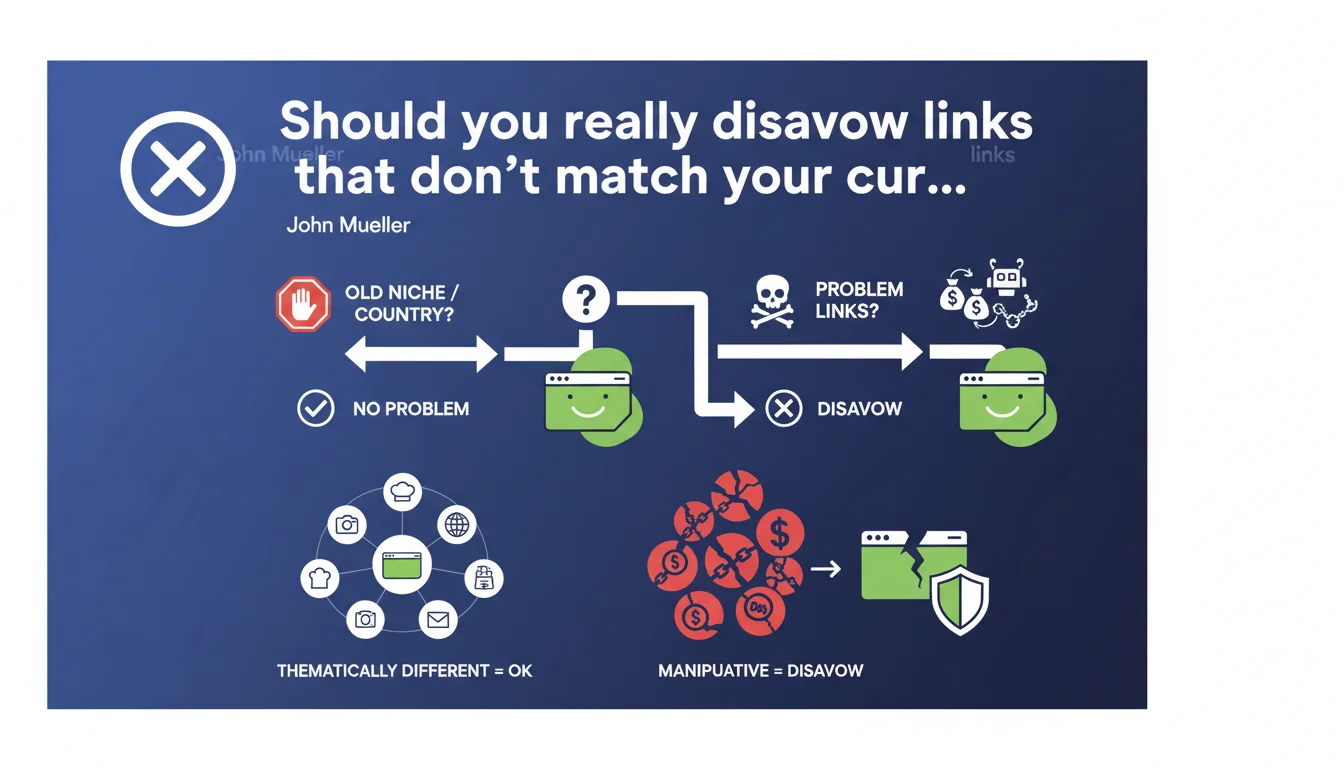
Google states that it's unnecessary to disavow links simply because they come from an old business activity or a different country. Disavowal should only be used to eliminate bought or manipulative links, not links that are thematically misaligned.
What you need to understand
Why does Google distinguish between problematic links and thematically misaligned links?
Mueller's statement targets a widespread practice: preventive disavowal of links deemed "irrelevant". Many SEOs disavow backlinks from expired old domains, foreign sites, or distant topics, believing they harm the semantic coherence of their link profile.
Google is reminding us here that its algorithm naturally distinguishes manipulative links (bought, from PBNs, spammy) from links that are simply "misaligned" but organic. A thematically distant link isn't a negative signal in itself — it's simply ignored or undervalued.
What is a "truly problematic" link according to Google?
Google primarily targets bought links, private blog networks (PBNs), massive organized exchanges, and artificially over-optimized anchors. These links violate guidelines and can trigger a manual action.
On the other hand, a link from a site in another language, from a legitimate past business partnership, or from a repurposed domain that changed topics is not a violation. It may be weak, unhelpful, but it isn't toxic.
When is disavowal still relevant?
Disavowal remains useful if you've suffered a manual penalty for artificial links, or if you've inherited a polluted profile (domain acquisition, old black hat SEO). In these situations, disavowing problematic links is part of the reconsideration request process.
Outside of penalty context, the usefulness of disavowal is debatable. Google has been saying for years that its algorithm knows how to ignore low-quality links. There's a risk of accidentally disavowing useful links.
- Disavowal only serves manipulative links, not thematically misaligned ones
- Google naturally ignores weak or irrelevant links
- A link from an old activity or different country is not a negative signal
- Disavowal remains relevant in case of manual penalty or massive spam inheritance
- Over-cautious disavowal can remove useful signals
SEO Expert opinion
Is this statement consistent with real-world observations?
Yes, but with nuances. Audits show that Google does indeed tolerate heterogeneous link profiles without penalty. Sites with backlinks in multiple languages, from old topics, or from obsolete partnerships continue to rank without issues.
However, the boundary between "misaligned link" and "manipulative link" remains blurry. An old PBN that became legitimate? A paid link from 5 years ago still present? Google provides no objective criteria. [To verify] on edge cases.
What are the risks of never disavowing?
The main risk concerns sites with a troubled history. If your domain was used for spam, acquired after expiration, or if you inherited an old black hat link profile, ignoring disavowal can slow recovery.
Another weakness of this statement: it assumes Google always correctly detects manipulative links. Yet some sophisticated link networks fly under the radar for months. Passively waiting for the algorithm to ignore them isn't always the best strategy.
Why does Google insist so much on this point?
Because massive disavowal has become common practice, often fueled by tools that label hundreds of links as "toxic" without discernment. This creates noise, overloads the disavowal tool, and pushes SEOs to remove potentially useful links.
Google also seeks to limit its liability. By repeating that "disavowal is almost never necessary", they reduce expectations for manual intervention and reinforce the message: "our algorithm handles it alone". Convenient, but not always reassuring when you spot inconsistencies.
Practical impact and recommendations
What should you concretely do with your thematically misaligned links?
Nothing. If your links come from legitimate old activities, past partnerships, or foreign sites that cited you naturally, leave them in place. They don't penalize you and may even provide residual traffic or an age signal.
Focus your energy on acquiring new relevant links rather than paranoid profile cleanup. The ratio of positive signals to background noise works in your favor if you keep building.
How to identify true problematic links to disavow?
Analyze your profile with Google Search Console and third-party tools (Ahrefs, Majestic, Semrush), but don't blindly trust "toxicity" scores. Instead, look for these concrete signals:
- Links from private blog networks with identical footprints (same IP, same structure, same anchor patterns)
- Over-optimized anchors en masse ("buy viagra", "best lawyer paris" repeated 50 times)
- Links from visibly penalized sites (deindexed, blacklisted)
- Links from satellite pages created only to push juice (auto-generated pages)
- Bought links you have records of (invoices, email exchanges)
What strategy to adopt if you've already disavowed massively?
Don't panic. The disavowal file isn't permanent. You can modify it anytime via Search Console. If you suspect you've disavowed legitimate links, gradually reduce the list by removing doubtful domains.
Monitor the evolution of your rankings after each file update. Some sites have seen traffic rebounds after removing overly aggressive disavowals. [To verify] depending on your specific history.
In summary: Only disavow clearly manipulative links (bought, PBN, spam). Ignore thematically misaligned links, multi-language ones, or those from old activities. If you're unsure about a specific link, favor inaction — Google is supposed to handle background noise.
For sites with complex histories or those that suffered penalties, this analysis can become technical. Distinguishing an aging legitimate link from a link bought years ago requires pointed expertise and thorough manual auditing. If you lack visibility into your link profile or hesitate about strategy, relying on a specialized SEO agency can help you avoid costly mistakes and accelerate your recovery.
❓ Frequently Asked Questions
Dois-je désavouer les liens d'un site qui a changé de thématique après m'avoir lié ?
Un lien provenant d'un site étranger peut-il nuire à mon SEO local ?
Comment savoir si un lien est vraiment manipulatoire ?
Que faire si j'ai déjà désavoué des centaines de liens par précaution ?
Le désaveu est-il encore utile en cas de negative SEO ?
🎥 From the same video 17
Other SEO insights extracted from this same Google Search Central video · published on 04/02/2022
🎥 Watch the full video on YouTube →
💬 Comments (0)
Be the first to comment.