
Official statement
What you need to understand
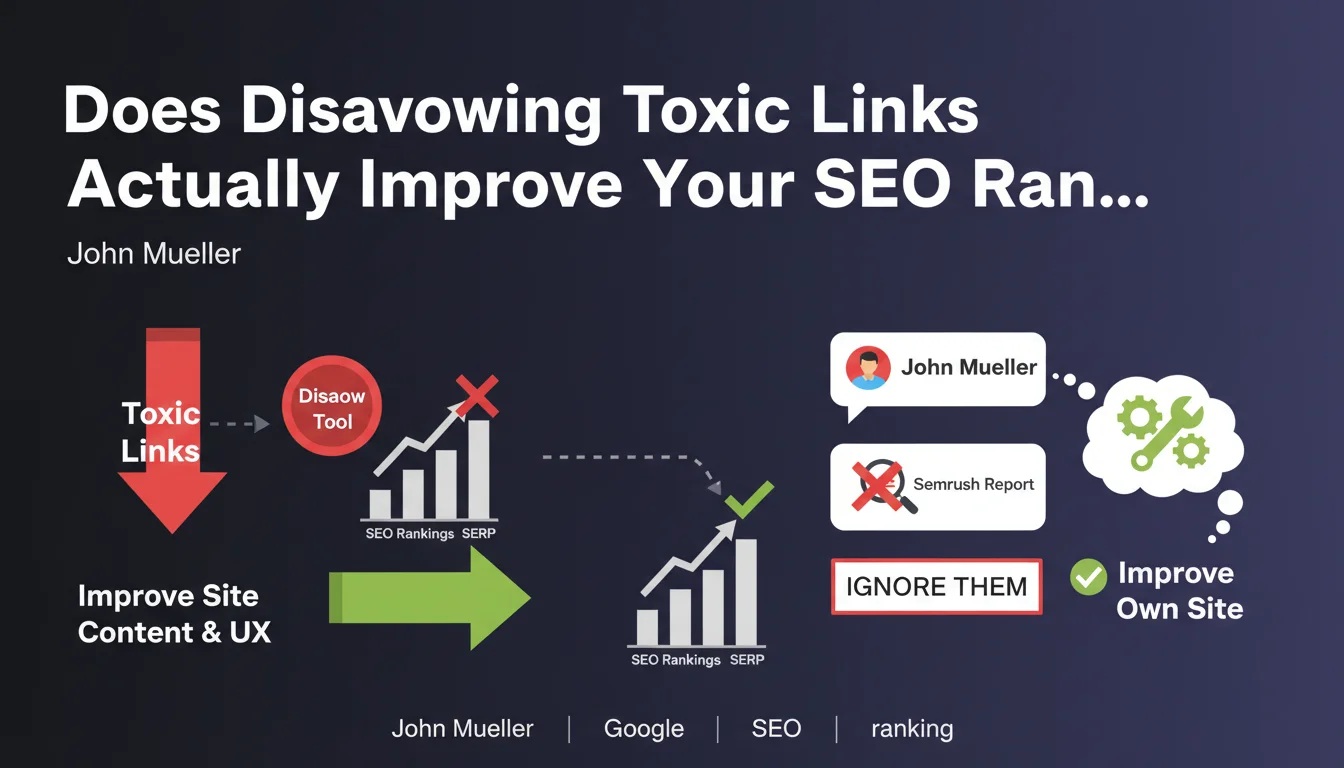
Google clearly states that disavowing links considered toxic will not help you recover lost rankings. This statement is part of Google's consistent communication over the past several years: the link disavow tool, initially created after Penguin, has become largely obsolete with algorithm evolutions.
Modern search engines are now capable of automatically identifying and ignoring low-quality links without manual intervention. "Toxic link" reports offered by certain third-party SEO tools often create false alarms and can lead to counterproductive decisions.
The emphasis is on a crucial reality: time spent analyzing and disavowing links is time not invested in actual improvement of your site. It's this improvement that genuinely generates positive results in terms of rankings.
- The disavow tool is no longer a priority in modern SEO strategy
- Google automatically ignores low-quality links without penalizing your site
- Toxic link reports from third-party tools are often inaccurate and anxiety-inducing
- Your energy should focus on creating quality content and improving user experience
- A competitor spending their budget on disavowing rather than improving their site is doing you a favor
SEO Expert opinion
This position is completely consistent with what we've been observing in the field since 2016-2017. In the vast majority of cases, sites that have recovered their positions did so by improving their content and structure, never solely by disavowing links.
Nevertheless, there are a few marginal exceptions where the disavow tool remains relevant: after a documented manual action from Google, in case of massive and obvious negative SEO attack (rare), or when dealing with past black hat link building campaigns whose traces you want to clean up before they're discovered.
The real question to ask isn't "which links should I disavow?" but rather "why isn't my site ranking well?". The answer is usually found in content quality, technical architecture, user experience, or topical relevance, rarely in the inbound link profile.
Practical impact and recommendations
- Stop consulting toxic link reports from Semrush, Ahrefs, or other similar tools
- Don't use the disavow tool except in case of explicit manual action from Google documented in Search Console
- Reallocate the time previously spent on backlink analysis toward content audits and on-page optimization
- Focus your resources on creating expert, unique, and genuinely useful content for your users
- Invest in technical improvements: loading speed, Core Web Vitals, information architecture
- Develop your link building strategy toward acquiring natural and quality links rather than cleanup
- Analyze the real causes of ranking loss: outdated content, technical issues, increased competition
- Only monitor manual actions in Google Search Console, ignore alerts from third-party tools
Implementing a truly effective SEO strategy requires deep expertise to identify the levers that genuinely impact your site. Between technical audits, content optimization, user experience improvement, and developing topical authority, there are numerous and complex projects to tackle.
For businesses wanting to maximize their organic visibility without scattering their efforts on low-impact actions, guidance from a specialized SEO agency provides a clear strategic vision, action prioritization based on real ROI, and sharp technical expertise to avoid costly mistakes.
💬 Comments (0)
Be the first to comment.