
Official statement
What you need to understand
What Does This Google Statement Really Mean?
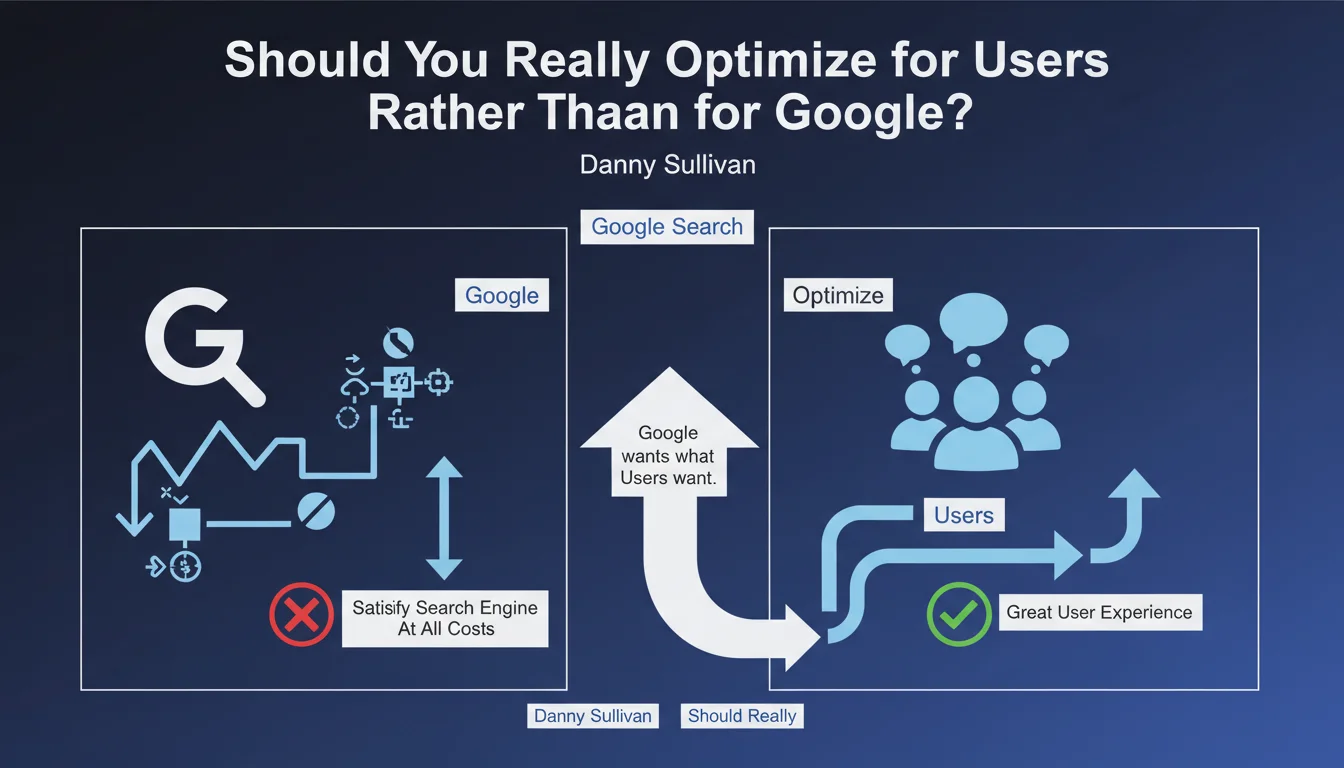
Danny Sullivan reminds us of a fundamental principle: Google seeks to satisfy its users, not webmasters. The search engine analyzes behavioral signals to determine whether a page meets internet users' expectations.
Concretely, this means that the algorithm is designed to detect what pleases visitors: time spent on page, bounce rate, interactions, returns to search results. Google wants to rank pages that users find useful.
Why Does Google Emphasize This Approach So Much?
This communication aims to discourage purely technical over-optimization practices. Too many sites apply SEO recipes without questioning whether they provide real added value.
Sullivan also admits the system's limitations: the algorithm isn't perfect. Low-quality content can still rank, but Google continuously works to improve it.
How Should You Interpret Google's Advice According to This Principle?
Each SEO recommendation must be evaluated on a case-by-case basis according to your audience. A relevant rule for an e-commerce site may be useless for a niche blog.
What matters is understanding the intention behind each guideline rather than applying it blindly. Always ask yourself: does this really improve my visitors' experience?
- Google optimizes for user satisfaction, not for pure SEO techniques
- Behavioral signals are key indicators for the algorithm
- Each SEO tip must be adapted to your site's specific context
- The algorithm remains imperfect and constantly evolving
- Technical over-optimization without added value is counterproductive
SEO Expert opinion
Is This Statement Consistent with Actually Observed Practices?
In theory, yes. In practice, it's more nuanced. After 15 years of observation, I find that Google does reward user-centric sites in the long term.
However, there are still divergences between discourse and reality. Mediocre but technically well-optimized content can temporarily dominate. Sites with excellent UX sometimes struggle to rank against more technical competitors.
The real balance consists of combining technical excellence and user orientation. One without the other remains insufficient in most competitive sectors.
What Critical Nuances Should You Bring to This Discourse?
User signals are difficult for Google to interpret. A long reading time can mean captivating content or a confusing page. A quick bounce can indicate an immediate answer or disappointment.
Moreover, some sectors require advanced technical optimizations that have no visible impact for the end user but remain essential: structured data, JavaScript indexing, crawl architecture.
In What Cases Is This User Approach Not Enough?
In ultra-competitive markets, UX excellence is a prerequisite, not a differentiator. All your competitors already offer a good experience. The difference then comes down to advanced technical aspects.
For technical or B2B sites, engagement metrics are naturally different. Technical documentation with a quick bounce can be perfectly successful if the user immediately found their answer.
Finally, some optimizations are never directly perceived by the user: server speed, crawl budget, canonicalization. They remain crucial for your visibility.
Practical impact and recommendations
What Should You Concretely Change in Your SEO Strategy?
Start by analyzing your visitors' actual behavior. Google Analytics 4, Hotjar, or Microsoft Clarity reveal how users interact with your pages.
Identify pages with high bounce rates or low engagement time. These are your optimization priorities, even if they rank well. Google will eventually adjust their positioning.
Systematically integrate a user validation phase before each SEO modification. Ask yourself: "Does this improve the experience, or only my technical metrics?"
What Common Mistakes Should You Absolutely Avoid?
Never sacrifice readability for keyword density. Natural, fluid content always outperforms text artificially stuffed with target queries.
Avoid applying standardized SEO recipes without thinking. For example, adding 2000 words to each article only makes sense if those words bring value to your specific audience.
Don't neglect technical aspects under the pretext of being user-centric. A beautiful but slow or poorly crawlable page will serve neither Google nor your users.
How Can You Verify That Your Approach Is Balanced?
Use Google Search Console to identify pages with good impressions but low clicks (CTR). Improve your titles and descriptions to better respond to search intent.
Analyze your Core Web Vitals and engagement metrics together. A correlation between poor technical performance and low engagement indicates where to act as a priority.
- Audit pages with high bounce and low engagement monthly
- Test each optimization with real users before deployment
- Maintain a 60% content/UX and 40% technical/crawl balance
- Document user intent for each strategic page
- Monitor the evolution of behavioral metrics post-optimization
- Prioritize improvements with both user AND technical impact
- Avoid over-optimizing already performing pages
- Train your teams to think "user first, SEO second"
💬 Comments (0)
Be the first to comment.