
Official statement
Other statements from this video 6 ▾
- □ Are Core Web Vitals Really a Google Ranking Factor?
- □ Are Core Web Vitals really a Google ranking factor for SEO?
- □ Does Googlebot really click through your pages like a real user would?
- □ Is Google really patient with JavaScript rendering, or should you worry about speed?
- □ Can an ultra-fast but empty page rank thanks to Core Web Vitals?
- □ Has Google really transformed the web ecosystem with Core Web Vitals, or is it just marketing hype?
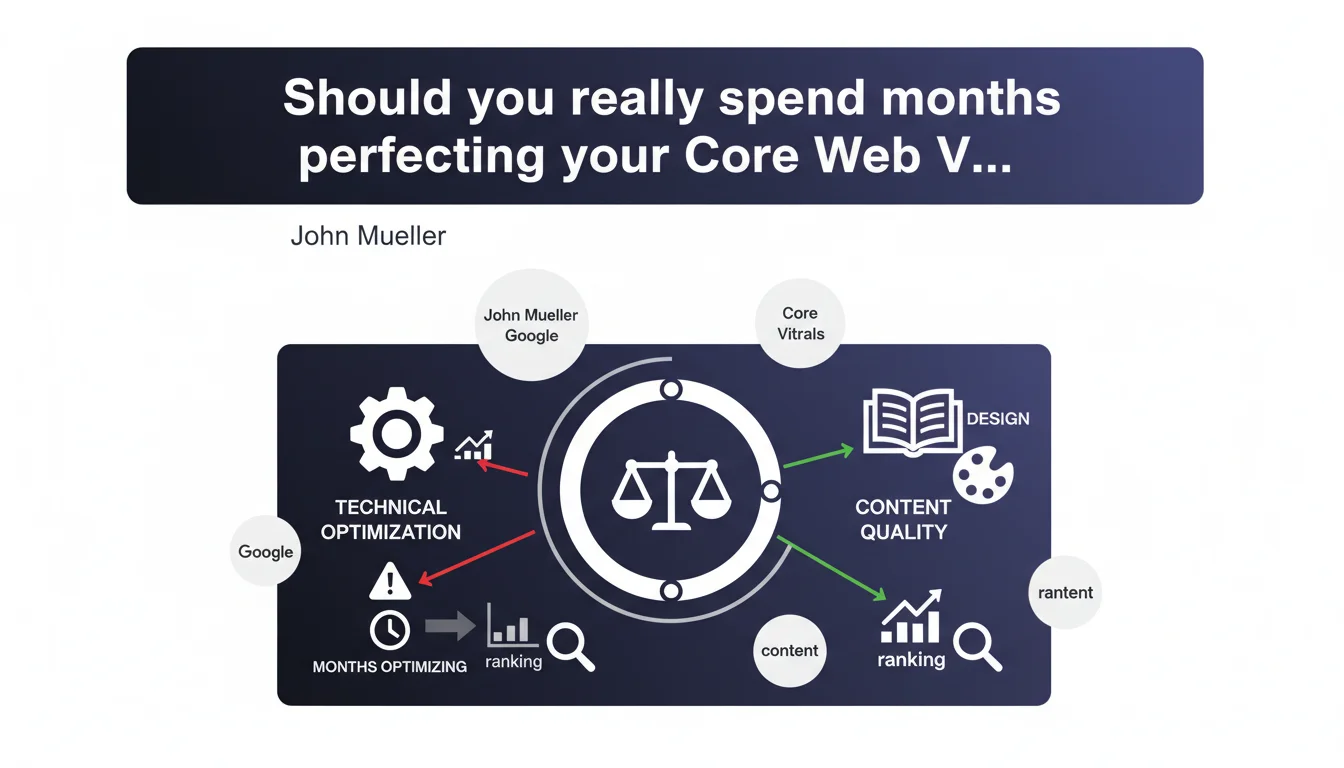
Google advises against spending months on micro-optimizations of Core Web Vitals that will have no visible impact on search rankings. The balance between technical performance, content quality, and design takes priority over chasing perfect scores. Over-optimizing technical aspects at the expense of everything else is counterproductive.
What you need to understand
Why is Google warning against over-optimizing Core Web Vitals?
Mueller's statement targets an observable drift: some sites spend disproportionate time shaving off milliseconds on LCP or hundredths of a point on CLS, when the marginal impact of these incremental improvements doesn't translate into search results.
Google reminds us that Core Web Vitals are just one signal among hundreds of others. Moving from "good" to "excellent" on PageSpeed Insights guarantees nothing if your content remains mediocre or the user experience falls apart beyond the metrics.
What's the real optimization threshold to aim for?
The "good" thresholds defined by Google (LCP < 2.5s, FID < 100ms, CLS < 0.1) are sufficient targets for most sites. Aiming for "perfect" — 100/100 across the board — often comes down to technical ego rather than rational SEO strategy.
Once these thresholds are reached, the return on investment of further optimizations collapses. The time spent chasing 0.2 seconds of LCP would be much better invested in deepening content, improving semantic structure, or building thematic authority.
What does "balancing technical and content" actually mean in practice?
It means not sacrificing editorial richness or usability on the altar of raw performance. A site that loads in 1.5s but has hollow content or poor organization won't outrank a competitor at 2.3s with expert content and solid internal linking.
Overall user experience includes speed, yes, but also relevance, readability, design, and navigation. Optimizing one lever while degrading others is a dead end.
- Core Web Vitals are just one signal among hundreds of other ranking factors.
- Reaching the "good" thresholds is sufficient — chasing absolute perfection has diminishing returns.
- Time invested in micro-technical optimization must be weighed against content, UX, and authority needs.
- Google favors overall balance: technical + content + design, not one at the expense of others.
SEO Expert opinion
Is this warning consistent with what we see in the field?
Absolutely. Cases of sites moving from 50/100 to 95/100 on PageSpeed without budging in the SERPs are legion. Conversely, sites with average technical scores but solid content and strong thematic authority continue to dominate.
The reality: Google needs sites to be reasonably fast, not ultra-optimized. A site "good" across all CWV metrics that publishes expert content regularly will always crush a technically "perfect" but hollow site.
What nuances should we add to this statement?
First point: in ultra-competitive sectors (generalist e-commerce, news media), every millisecond can matter. But even then, overall experience wins — a smooth checkout beats a perfect LCP with a broken conversion funnel.
Second nuance: Mueller isn't saying to ignore CWV, he's saying not to over-optimize at the expense of everything else. If your site is below the thresholds, you need to work on it. If you're in the green, spending six months shaving 0.3s off LCP is probably wasted time.
[To verify] Google remains vague about the real weight of CWV in the algorithm. Real-world A/B tests show variable impacts depending on queries and niches. Takeaway: treat CWV as a hygiene signal, not as a magic growth lever.
In what cases does this rule not apply?
If your site is below the "good" thresholds, this statement doesn't concern you — you need to get out of the red first. That's non-negotiable.
If you're in a sector where speed directly conditions conversion (mobile retail, SaaS, booking), optimizing CWV remains profitable even beyond the threshold. But then you're optimizing for conversion, not organic SEO — important distinction.
Practical impact and recommendations
What should you actually do with this information?
First, audit your priorities. If you're spending more time on PageSpeed Insights than analyzing your rankings, internal linking, or content, that's a red flag. Rebalance your effort.
Next, aim for the "good" thresholds and stop. Once reached, shift your energy to content, thematic authority, semantic structure. That's where SEO ROI is highest.
Finally, document your trade-offs. If a technical optimization degrades UX (for example, removing images to gain 0.2s of LCP), ask yourself if it's worth it. Often, the answer is no.
What mistakes should you absolutely avoid?
Mistake #1: ignoring CWV under the pretext that "Google says it's not that important." Mueller says not to over-optimize, not to under-optimize. If you're below the thresholds, you have a problem.
Mistake #2: sacrificing usability or editorial richness to scrape technical points. A fast but empty or poorly designed site doesn't convert and doesn't rank.
Mistake #3: falling into the 100/100 PageSpeed trap. This score is a lab indicator, not a ranking guarantee. Field CWV data (CrUX) matters far more, and even then, it's just one signal among others.
How can you verify your approach is balanced?
Run a simple test: track where you're spending your SEO time this month. If more than 30% is devoted to technical performance while you're already hitting CWV targets, you're unbalanced.
Use Search Console to cross-reference CWV data with your organic performance. If you improved LCP by 20% with no impact on impressions/clicks, that's a sign the effort was miscalibrated.
Finally, prioritize your projects by estimated ROI. Producing 10 expert pieces of content with solid internal linking will probably have more impact than shaving 500ms off an already-performant site.
- Audit your current SEO priorities and rebalance if you're over-indexing on pure technical work.
- Aim for the "good" CWV thresholds (LCP < 2.5s, FID < 100ms, CLS < 0.1) then shift to content and authority.
- Never sacrifice UX or editorial richness to shave tenths of seconds.
- Measure the ROI of each technical optimization before committing to it — if the SEO impact is uncertain, deprioritize.
- Cross-reference CWV data with organic performance to validate (or invalidate) real impact.
- Document your trade-offs to avoid falling back into chasing perfect scores.
❓ Frequently Asked Questions
Les Core Web Vitals sont-ils toujours un facteur de classement en 2025 ?
Dois-je viser un score de 100/100 sur PageSpeed Insights ?
Combien de temps faut-il consacrer à l'optimisation des CWV ?
Mon concurrent a un meilleur score PageSpeed mais je le surclasse — pourquoi ?
Faut-il ignorer les CWV si mon contenu est bon ?
🎥 From the same video 6
Other SEO insights extracted from this same Google Search Central video · published on 28/03/2024
🎥 Watch the full video on YouTube →
💬 Comments (0)
Be the first to comment.