
Official statement
Other statements from this video 6 ▾
- □ Les Core Web Vitals sont-ils vraiment un facteur de classement Google ?
- □ Faut-il vraiment passer des mois à optimiser les Core Web Vitals ?
- □ Les Core Web Vitals sont-ils vraiment un facteur de classement SEO ?
- □ Googlebot clique-t-il vraiment sur vos pages comme un utilisateur ?
- □ Google est-il vraiment patient avec le rendering JavaScript ou faut-il s'inquiéter de la vitesse ?
- □ Une page ultra-rapide mais vide peut-elle ranker grâce aux Core Web Vitals ?
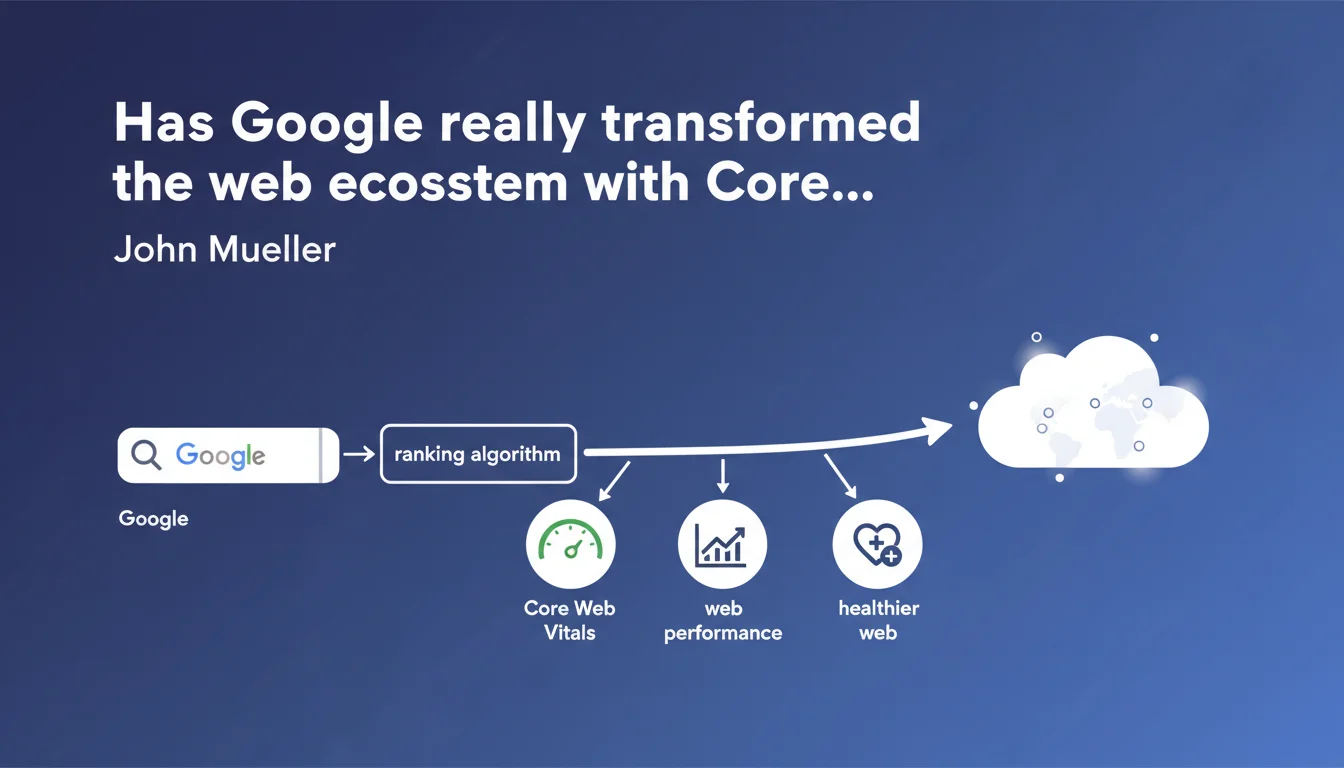
Google claims that integrating Core Web Vitals into its algorithm has raised awareness about performance issues and measurably improved web metrics over time. This statement aims to justify the positive impact of this ranking factor, but remains vague about the actual scale of improvement and the direct correlation with rankings.
What you need to understand
What does this Google statement actually mean in practical terms?
Google is acknowledging here that Core Web Vitals — LCP, FID (now replaced by INP), CLS — are not just another ranking criterion among many. They also serve as a massive awareness-raising tool to push web actors to improve their sites.
The underlying idea? By turning performance into a ranking factor, Google forces site owners to care about metrics they would have otherwise ignored. It's an interventionist approach to shape a faster and more accessible web.
What concrete results does Google claim to achieve?
According to this statement, metrics have improved in a measurably significant way since Core Web Vitals were introduced. Google talks about a "healthier global web ecosystem," but remains vague about precise figures and affected sectors.
The HTTP Archive does show actual progress in the number of sites passing Core Web Vitals thresholds — notably for LCP. The question remains whether this improvement stems from the ranking factor itself or simply from media pressure surrounding these metrics.
Why this communication right now?
This statement comes at a time when some professionals are questioning the actual impact of Core Web Vitals on rankings. A/B tests have sometimes shown no significant position gains after optimization.
Google is likely trying to reframe the debate: regardless of whether Core Web Vitals directly boost your ranking, they contribute to a better web. It's an argument about mission rather than pure SEO mechanics.
- Core Web Vitals serve as much as an awareness tool as they do a ranking criterion
- Google claims measurable improvements in web performance since their integration
- The statement remains vague about precise data and impacted sectors
- The argument shifts from direct ranking impact to a broader ecosystem benefit
SEO Expert opinion
Is this statement consistent with real-world observations?
Yes and no. On paper, we do observe genuine overall progress in Core Web Vitals metrics — the HTTP Archive documents this. Sites are paying more attention to LCP, CLS, and now INP which replaces FID.
But the claim that this would make "the web ecosystem healthier" deserves some nuance. Many sites have optimized their Core Web Vitals superficially — aggressive lazy loading, CDN, image optimization — without addressing structural performance issues. We're seeing sites that pass Core Web Vitals thresholds but still feel slow in real-world usage. [To verify]: Does the improvement in metrics translate to genuinely better user experience or just artificially inflated scores?
What is the true weight of Core Web Vitals in the algorithm?
Google never communicates precise figures, and that's where the problem lies. The statement talks about "integration into the algorithm" but carefully avoids quantifying the impact. Field tests show that Core Web Vitals are a weak signal compared to content, backlinks, and search intent.
Concretely? If your site has catastrophic CLS but dominates on relevance and authority, you'll still rank. Core Web Vitals work more as a tiebreaker between equivalent sites — and even then, not always. Google uses this statement to maintain pressure without admitting that the signal is marginal in most cases.
What are the limitations of this claim?
First limitation: Google measures Core Web Vitals through aggregated Chrome data (CrUX). This excludes Firefox, Safari, and Chrome users and masks geographic and device-type disparities. A site could have excellent desktop Core Web Vitals and be catastrophic on 3G mobile in rural areas — but only the average counts.
Second limitation: the measurable improvement Google mentions says nothing about distribution. If 80% of sites haven't moved and 20% have massively improved, the global average goes up — but that doesn't make the "ecosystem" healthier. Without granular data, this statement remains a marketing assertion.
Practical impact and recommendations
What should you do concretely about Core Web Vitals?
Start by measuring your actual Core Web Vitals through PageSpeed Insights, Search Console, and Chrome User Experience Report. Don't rely solely on lab tools (Lighthouse) — they don't reflect real-world usage. Focus on CrUX data which is what Google uses.
Next, prioritize optimizations based on impact. For LCP: fast server, optimized images (WebP, lazy loading), CDN. For CLS: fixed dimensions for images/videos, avoid dynamic injections at page top. For INP (replacing FID): limit blocking JavaScript, optimize event handlers.
What mistakes should you avoid when optimizing Core Web Vitals?
Classic mistake: over-optimizing at the expense of real experience. Overly aggressive lazy loading that delays useful content display, removing necessary features to gain a few milliseconds. Core Web Vitals are a means, not an end.
Another trap: focusing only on the homepage. Google measures Core Web Vitals page by page, and your category pages or product sheets often carry more organic traffic weight. Audit all your critical templates, not just the showcase.
How do you verify your site meets Google's expectations?
Use the Core Web Vitals report in Search Console — it's the most reliable source because it's based on actual CrUX data from your Chrome visitors. Identify problematic URL groups and address them by traffic volume order.
Supplement with manual testing on different devices and connection speeds. A site can pass Core Web Vitals thresholds on 4G with a recent smartphone but fail miserably on weaker connections. If your target audience primarily uses mobile with average coverage, test in those conditions.
- Measure your Core Web Vitals via Search Console and PageSpeed Insights (CrUX data)
- Prioritize LCP, CLS, INP optimizations based on your weakest metrics
- Audit all your critical templates, not just the homepage
- Never sacrifice real user experience to improve an artificial score
- Test on varied network conditions and devices matching your actual audience
- Regularly monitor the Core Web Vitals report in Search Console to detect regressions
❓ Frequently Asked Questions
Les Core Web Vitals sont-ils vraiment un facteur de ranking important ?
Faut-il optimiser toutes les pages de mon site pour les CWV ?
Quelle est la différence entre FID et INP ?
Les données Lighthouse suffisent-elles pour évaluer mes CWV ?
Un bon score CWV garantit-il un meilleur classement ?
🎥 From the same video 6
Other SEO insights extracted from this same Google Search Central video · published on 28/03/2024
🎥 Watch the full video on YouTube →
💬 Comments (0)
Be the first to comment.