
Official statement
Other statements from this video 6 ▾
- □ Faut-il vraiment passer des mois à optimiser les Core Web Vitals ?
- □ Les Core Web Vitals sont-ils vraiment un facteur de classement SEO ?
- □ Googlebot clique-t-il vraiment sur vos pages comme un utilisateur ?
- □ Google est-il vraiment patient avec le rendering JavaScript ou faut-il s'inquiéter de la vitesse ?
- □ Une page ultra-rapide mais vide peut-elle ranker grâce aux Core Web Vitals ?
- □ Les Core Web Vitals ont-ils vraiment transformé l'écosystème web comme le prétend Google ?
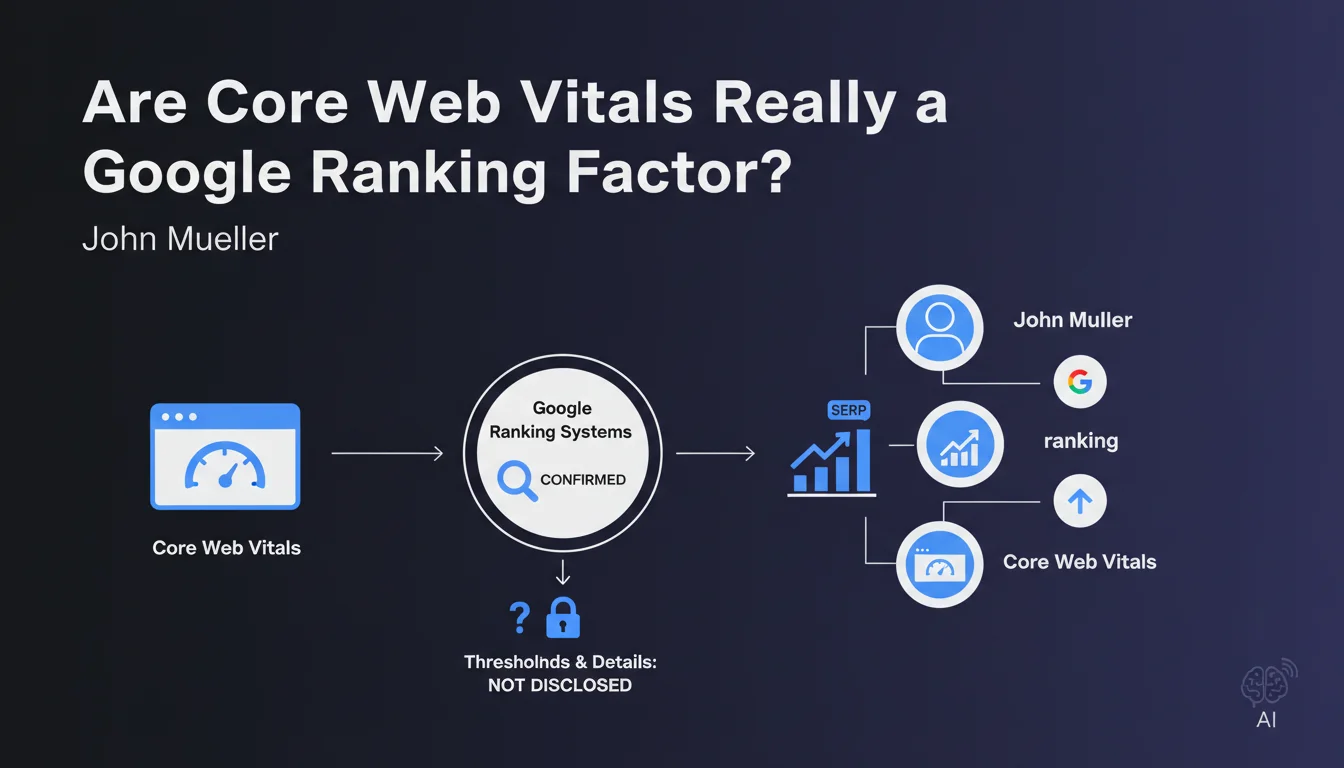
Google officially confirms that Core Web Vitals play a role in its ranking systems. This clarification followed an internal review with the ranking teams, but Google remains opaque about the thresholds and actual weight of this signal. In practical terms, we know they count — without knowing exactly how much.
What you need to understand
Why is Google formalizing something that was already known?
Core Web Vitals (LCP, FID/INP, CLS) have been presented as a ranking factor since the Page Experience announcement. However, Google had never documented their usage so explicitly in its official technical documentation.
This revision comes after coordination work between the communications teams and the ranking teams. In other words: Google is formalizing what was already being applied, but without ever providing figures.
What does this actually change for a website in practice?
Nothing fundamentally new. If your Core Web Vitals are in the red, you already know it's a problem — if only for user experience. What changes is that Google now openly assumes these metrics play a role in ranking, not just in experience.
But be careful: Google still doesn't say how much it matters, or whether a site with perfect Core Web Vitals but mediocre content will beat a competitor better positioned on relevance.
- Core Web Vitals are confirmed as an official ranking signal
- Google discloses no precise thresholds or weighting
- This confirmation followed an internal review with the ranking teams
- The impact remains variable depending on queries and sectors
SEO Expert opinion
Is this statement consistent with field observations?
Yes and no. On paper, we do observe a correlation between good Core Web Vitals and good rankings — but this correlation is not systematic. Sites with catastrophic metrics continue to rank in the top 3 on competitive queries, simply because their content and authority outweigh everything else.
Google confirms it's a signal, not the signal. The problem is we still don't know where to draw the line. [To verify]: the actual scope of impact depending on niches and query types remains unclear.
What nuances should be made?
First point: John Mueller talks about "ranking systems," in the plural. This suggests that Core Web Vitals may intervene differently depending on the query context — informational queries, transactional queries, local queries, etc.
Second point: the absence of public thresholds is intentional. Google doesn't want sites optimizing for an arbitrary number, but for a smooth experience. Except for an SEO professional, it's impossible to prioritize without knowing what really counts.
In what cases does this signal not apply?
Probably in queries where freshness or authority trump everything. A news article published 10 minutes ago with a 5-second LCP will rank better than a technically perfect competitor published 3 days ago.
Same for YMYL queries where source credibility overshadows technical considerations. Core Web Vitals are a signal among many — and clearly not the most decisive in all contexts.
Practical impact and recommendations
What should you do concretely?
First, measure. Google Search Console gives an overview of problematic pages, but data is aggregated over 28 days and sometimes delayed. Supplement with PageSpeed Insights and continuous monitoring tools (Lighthouse CI, WebPageTest).
Then, prioritize. Don't fix everything at once. Target pages that generate traffic or conversions, and those close to "Good" thresholds. A shift from "Needs Improvement" to "Good" will potentially have more impact than marginal improvement on an already excellent page.
What mistakes should you avoid?
Don't fall into the cosmetic optimization trap. Loading images with lazy-loading without reviewing resource size, or hiding content to improve CLS without fixing the real structural problem, is just window dressing.
Another common mistake: wanting to achieve perfect lab scores (Lighthouse) without checking field data (CrUX). A site can score 100/100 in the lab and tank real metrics because of a third party (analytics, chat, ads).
- Core Web Vitals audit via Search Console and CrUX
- Identification of priority pages (traffic, conversions, proximity to thresholds)
- Targeted optimization: images, lazy-loading, reducing blocking JS/CSS
- Continuous monitoring to detect regressions after deployment
- Test performance on mobile (the majority of traffic)
- Verify that optimizations don't impact UX or conversion
How can you verify that your site is compliant?
Use Search Console as the reference: it's the data Google uses. If a URL is marked "Good" in the Core Web Vitals report, it's validated on Google's side. But keep an eye on monthly changes — a site update, the addition of a third-party script, or a traffic spike can degrade metrics.
Also test manually on throttled 3G or 4G connections. Core Web Vitals reflect the real experience of users, not that of an office on fiber optics.
❓ Frequently Asked Questions
Les Core Web Vitals ont-ils le même poids sur mobile et desktop ?
Un site avec des Core Web Vitals parfaits peut-il ranker moins bien qu'un concurrent plus lent ?
Google a-t-il communiqué des seuils de performance à respecter ?
Faut-il viser un score de 100/100 sur Lighthouse ?
Les Core Web Vitals influencent-ils toutes les requêtes de la même manière ?
🎥 From the same video 6
Other SEO insights extracted from this same Google Search Central video · published on 28/03/2024
🎥 Watch the full video on YouTube →
💬 Comments (0)
Be the first to comment.