
Official statement
Other statements from this video 17 ▾
- □ Should you worry about changing page titles frequently—or is Google totally fine with it?
- □ Should you really disavow links that don't match your current niche anymore?
- □ Should you really remove backlinks pointing to your domain's old content?
- □ Do server errors really kill your Google rankings?
- □ Should you include your brand name in news article titles for better search visibility?
- □ Why does changing only the title of copied content fool absolutely nobody?
- □ Should you really be putting dates in your article titles?
- □ Does adding categories to your URLs really boost your SEO rankings?
- □ Why does Google crawl pages it never adds to its index?
- □ What's the real secret to getting Google to index all your content?
- □ Are backlinks to your non-indexed pages really wasting your SEO potential?
- □ Why Does Google Drastically Reduce Its Crawl Rate After a CDN Migration?
- □ Does server response time really impact your Google rankings?
- □ Should you really update your backlinks after a domain migration?
- □ Should you really block pages with robots.txt if Google can index them without any content?
- □ Does image alt text in a link carry the same SEO weight as visible anchor text?
- □ Does retouched product photography actually hurt your review rankings?
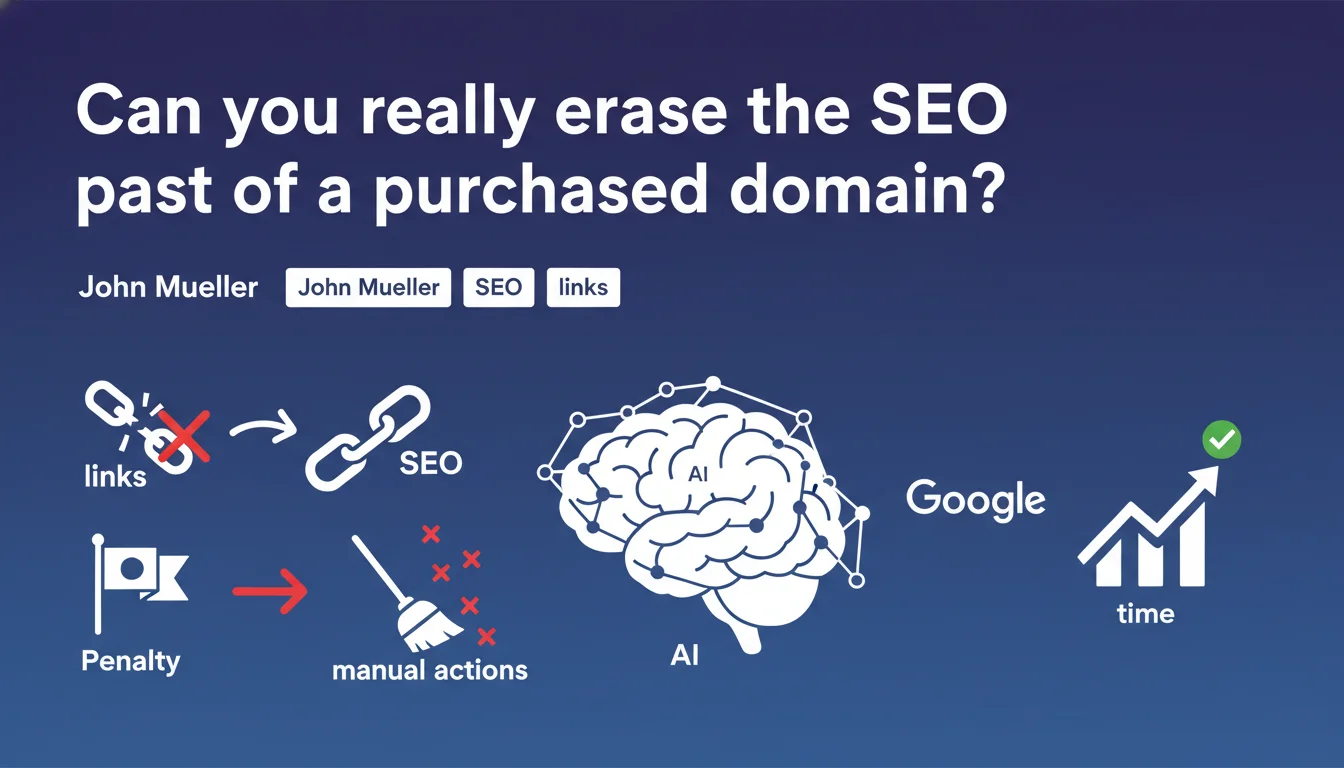
Google progressively learns that a domain is changing activities, with no guaranteed timeline. The absolute priority: clean up manual actions and disavow toxic inherited links. The rest? A matter of patience and consistent signals sent to the search engine.
What you need to understand
What technically happens when Google detects an activity change?
Google doesn't have a reset button for domains. When you reuse an existing domain for a new activity, the algorithm observes and adjusts its understanding progressively. The signals that trigger this reevaluation? New content, new structure, new backlinks, changes in click patterns.
The search engine doesn't trust instantly. It compares the old thematic profile with the new one, analyzes the consistency of incoming signals, and adjusts its indexing. It's an organic transition, not a binary switch.
Why does Google refuse to give a precise timeline?
Because situations vary enormously. A domain going from "florist in Paris" to "plumber in Lyon" requires a complete reevaluation of thematic relevance. A domain that stays in the same sector but changes positioning? The transition will be faster.
Content volume, quality of new signals, crawl frequency, domain authority — all these factors influence transition speed. Google can't fit all of that into a simplistic "3 to 6 months" formula.
What does "cleaning up manual actions and problematic links" concretely mean?
Manual actions are penalties applied by a human reviewer at Google. If the domain inherited one, it remains active until corrected and a reconsideration request is submitted. No transition is possible while it weighs on the site.
For toxic links, two approaches: request their removal (time-consuming, often ineffective) or use the disavow file via Search Console. This file tells Google to ignore certain backlinks when calculating your link profile.
- Check Search Console to detect any ongoing manual actions
- Audit the backlink profile with third-party tools (Ahrefs, Majestic, SEMrush)
- Identify spammy links, PBNs, over-optimized anchors inherited from the previous owner
- Create a comprehensive disavow file and submit it via Search Console
- Document each disavow decision for traceability
SEO Expert opinion
Is this statement consistent with field observations?
Yes, but with a major caveat. On repurchased domains with a clean history, the transition typically happens in 3 to 6 months with quality content and a coherent link strategy. However, on domains that suffered negative SEO or massive spam campaigns, I've seen cases where the transition took over a year.
The problem? Google never specifies how much the past can poison the present. Can a domain with 10,000 Russian PBN backlinks really start from scratch? Field feedback suggests that some domains remain "marked" well beyond what Mueller suggests. [To verify]: the true duration of Google's "memory" regarding a massive toxic link profile.
What are the unspoken limitations of this approach?
Mueller talks about "organic" transition, but doesn't mention situations where buying an existing domain is a pure strategic mistake. If the domain was deindexed for severe spam, or if it appears in malicious website databases, the cleanup cost often outweighs the value of its residual authority.
Another limitation: link disavowal. It works, but it's not instantaneous. I've observed delays of 4 to 8 weeks between file submission and visible results impact. During that time, the domain continues to carry the weight of its past.
Should you always keep the old content during the transition?
No. In fact, it's often counterproductive. If the old content has no relation to your new activity, leaving it online sends contradictory signals to Google. Better to delete cleanly (410 for content permanently removed, 301 if you can map to equivalent content).
However, if some pages from the old site have traffic or quality backlinks, evaluate whether you can intelligently redirect them to your new thematic area. A well-thought-out 301 is better than a brutal deletion that wastes link equity.
Practical impact and recommendations
What should you do immediately after acquiring a domain?
First step: complete audit in Search Console. Check for manual actions, security issues, indexing errors. If a manual action is active, it must be corrected before any other effort — otherwise you're building on sand.
Next, export the entire backlink profile via Ahrefs, Majestic, or SEMrush. Identify toxic links: over-optimized anchors, spam sites, private blog networks, mass links from shady directories. Prepare your disavow file.
Meanwhile, start publishing content coherent with your new activity. Google needs fresh, clear signals to understand that the site has changed direction. The faster you send these signals, the faster the transition happens.
What mistakes must you absolutely avoid?
Don't do a global 301 redirect from the old site to a single page on the new one. That's an obvious spam signal to Google. If you can't intelligently map old URLs to relevant content, use 410s (Gone) to signal that the content has permanently disappeared.
Also avoid leaving old content lying around thinking it "helps" during the transition. It creates thematic confusion. Google no longer knows if your site is about flowers or plumbing — result, it ranks you nowhere properly.
Finally, don't neglect backlink cleanup. Some think Google automatically ignores bad links. Wrong. The disavow tool remains essential, especially on domains with heavy baggage.
How do you track transition progress?
Monitor your rankings on key search queries for your new activity. If you notice stagnation after 3-4 months despite quality content and clean backlinks, that's a signal that the domain's past still weighs heavily.
Also analyze the crawl rate in Search Console. A progressive increase indicates Google is actively exploring your new content. Stagnation suggests it remains wary or hasn't yet understood the change.
- Check Search Console for any manual actions or security issues
- Export and audit your complete backlink profile
- Create and submit a comprehensive disavow file
- Delete or properly redirect old content that isn't relevant
- Publish content coherent with the new activity from the first weeks
- Monitor rankings and crawl rate monthly
- Document each step to adjust strategy if necessary
❓ Frequently Asked Questions
Combien de temps faut-il pour que Google reconnaisse le changement d'activité d'un domaine ?
Faut-il désavouer tous les anciens backlinks lors de la reprise d'un domaine ?
Peut-on accélérer la transition en soumettant une demande de réexamen ?
Est-il préférable de garder l'ancien contenu ou de tout supprimer ?
Un domaine pénalisé peut-il vraiment repartir à zéro ?
🎥 From the same video 17
Other SEO insights extracted from this same Google Search Central video · published on 04/02/2022
🎥 Watch the full video on YouTube →
💬 Comments (0)
Be the first to comment.