
Official statement
Other statements from this video 17 ▾
- □ Should you worry about changing page titles frequently—or is Google totally fine with it?
- □ Can you really erase the SEO past of a purchased domain?
- □ Should you really disavow links that don't match your current niche anymore?
- □ Should you really remove backlinks pointing to your domain's old content?
- □ Do server errors really kill your Google rankings?
- □ Should you include your brand name in news article titles for better search visibility?
- □ Why does changing only the title of copied content fool absolutely nobody?
- □ Should you really be putting dates in your article titles?
- □ Does adding categories to your URLs really boost your SEO rankings?
- □ Why does Google crawl pages it never adds to its index?
- □ What's the real secret to getting Google to index all your content?
- □ Are backlinks to your non-indexed pages really wasting your SEO potential?
- □ Why Does Google Drastically Reduce Its Crawl Rate After a CDN Migration?
- □ Does server response time really impact your Google rankings?
- □ Should you really update your backlinks after a domain migration?
- □ Should you really block pages with robots.txt if Google can index them without any content?
- □ Does image alt text in a link carry the same SEO weight as visible anchor text?
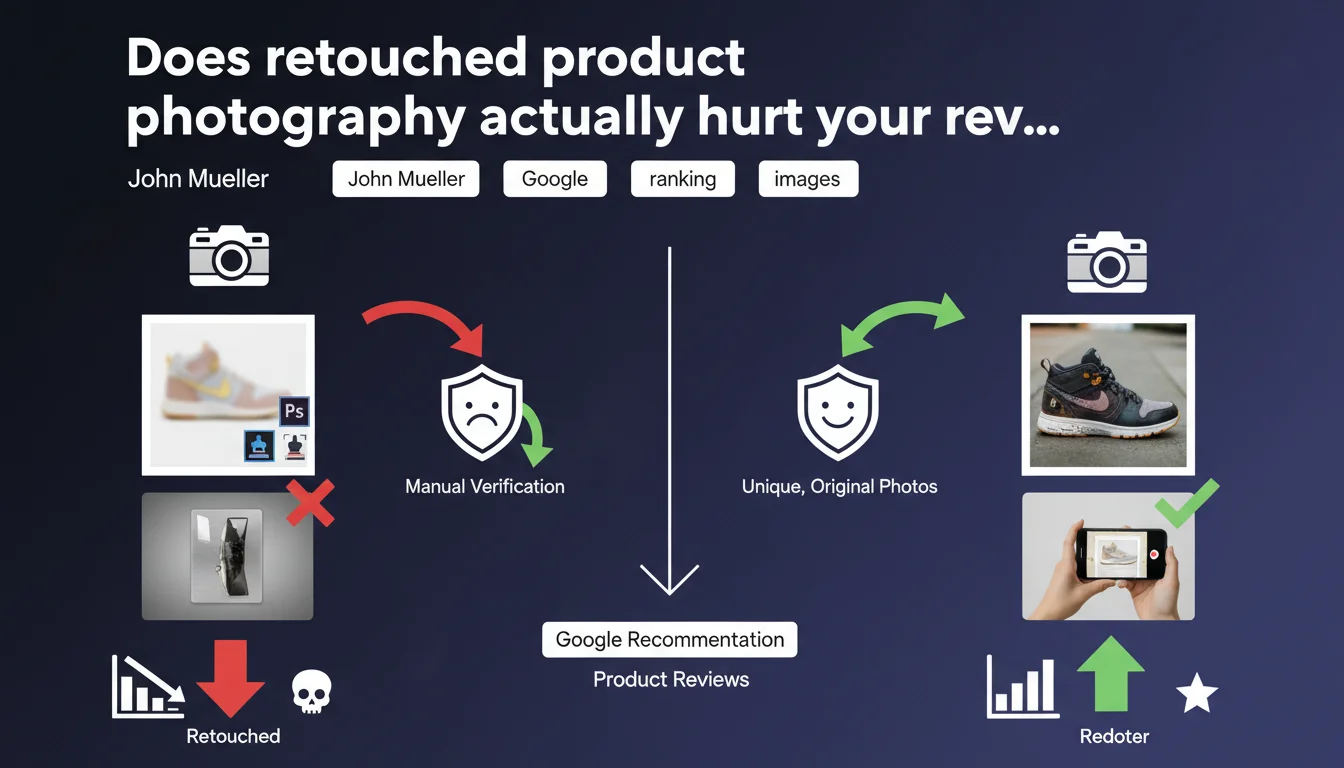
Google demands original and authentic photos for product reviews — no retouched visuals or borrowed images from elsewhere. While no automated system detects artificial images, sporadic manual reviews are conducted. Visual authenticity has become an editorial quality criterion for this type of content.
What you need to understand
Why does Google insist on authentic photos for product reviews?
The logic is straightforward: a credible review is built on genuine product experience. If you recycle official manufacturer visuals or retouched stock images, your content loses legitimacy. Google wants to ensure you've actually tested the item, and original photos are the tangible proof.
This requirement aligns with the Product Reviews updates, which favor first-hand content. The search engine aims to differentiate real tests from shallow compilations that merely aggregate information found elsewhere.
Does Google automatically detect fake photos?
No, and this is crucial: no automated system scans your images to verify whether they're retouched or borrowed. Mueller is transparent about this — checks are manual and sporadic.
In practice? You might slip under the radar for a while, but if a Quality Rater encounters your content during an evaluation, using generic or artificial visuals will work against you. It's not a direct algorithmic penalty, but rather a degraded editorial quality signal that can influence the overall perception of your site.
What does "no Photoshop" mean in this context?
Google doesn't ban light retouching — adjusting brightness or cropping remains acceptable. The problem arises when you manipulate the image to the point of misrepresenting the product, or worse, when you use 3D renders or artificial compositions that don't show the real product you've actually tested.
The idea: your visuals must reflect your personal testing, not a studio setup borrowed from a retailer's website. If you've never touched the product, your photo shouldn't exist.
- Mandatory authenticity: every photo must prove you tested the product yourself.
- No automatic detection: only sporadic manual verifications identify problematic content.
- Light retouching tolerated: basic adjustments OK, artificial manipulations not OK.
- Quality signal: generic images degrade the site's overall editorial perception.
SEO Expert opinion
Does this statement really change the game for review sites?
Honestly, no — if you were already producing serious content. Sites publishing genuine tests with their own photos aren't affected. However, if you were recycling official brand visuals or marketplace images, you're in the crosshairs.
The problem is Mueller stays intentionally vague about the scale of manual audits. How many sites are actually reviewed? How often? No data. [To verify]: real impact likely depends on your industry and visibility. A small affiliate blog has less chance of being scrutinized than a large comparison tool.
Is the absence of automatic detection a sign of weakness?
Yes and no. On one hand, it's consistent with Google's current philosophy: favoring human evaluation for subjective editorial criteria. An algorithm can barely judge whether a photo "feels" authentic or not.
On the other hand, it leaves a door open to questionable practices. As long as you're not audited, you can technically continue cheating. That's frustrating for those playing by the rules, but it's reality. Google relies on a deterrent effect: knowing you could be checked, you should comply. In practice? Many sites won't change anything until they see traffic drops.
What nuances should be applied to this recommendation?
Let's be honest: not all review types lend themselves to personal photos. If you're comparing online SaaS services, showing your computer screen isn't necessarily more valuable than official screenshots. Google doesn't clarify these edge cases.
Another point — and this is where it gets tricky: some products can't be easily photographed by an average tester (industrial equipment, complex software, embargoed products). In these situations, prioritize transparency: explain why you're using manufacturer-supplied visuals, and compensate with detailed field analysis.
Practical impact and recommendations
What should you do concretely to comply?
Start with a visual audit of your existing review content. Identify articles that use only official or stock visuals, and schedule updates with original photos. If you no longer have the product, that's a signal your content is outdated — consider unpublishing it or marking it as obsolete.
For new content, adopt a simple routine: each tested product should generate at least 3-4 original photos taken in your testing environment. No professional gear needed — a recent smartphone suffices if lighting and framing are correct. Authenticity trumps aesthetic perfection.
What mistakes should you absolutely avoid?
Don't just mix a few personal photos with official visuals to "look polished." Google evaluates overall content authenticity — if 80% of your images feel like stock photos, your signal remains weak. Better to have 3 genuine albeit rough photos than 10 polished images borrowed from elsewhere.
Also avoid 3D renders or artificial composites, even well-executed ones. If your visual doesn't show the actual physical product you tested, it fails the authenticity test. And don't even think about watermarking found images to pass them off as yours — that's exactly the type of manipulation that will be caught during manual review.
How do you verify your site is compliant?
Review your top 10-20 highest-performing review articles. For each visual, ask yourself: "Does this photo prove I actually tested this product?" If the answer is no or uncertain, replace the image.
Next, check your Search Console data on review-related queries. If you notice stagnation or visibility decline on this segment despite regular publishing, your content may be degraded by lack of visual authenticity — though it's just one factor among many.
- Audit existing review content and identify non-original visuals
- Produce 3-4 authentic photos minimum for each new tested product
- Prioritize authenticity over aesthetic polish in visuals
- Avoid mixing personal photos with official images
- Ban 3D renders, artificial composites, and watermarked borrowed visuals
- Verify coherence between test narrative and visual proof
- Monitor Search Console performance on product review queries
❓ Frequently Asked Questions
Les captures d'écran de logiciels comptent-elles comme photos originales ?
Puis-je utiliser les photos fournies par les marques en complément ?
Un site e-commerce est-il concerné par cette directive ?
Quelle est la sanction si je ne me conforme pas ?
La retouche photo est-elle totalement interdite ?
🎥 From the same video 17
Other SEO insights extracted from this same Google Search Central video · published on 04/02/2022
🎥 Watch the full video on YouTube →
💬 Comments (0)
Be the first to comment.