
Official statement
Other statements from this video 17 ▾
- □ Faut-il éviter de modifier fréquemment les balises title pour préserver son référencement ?
- □ Peut-on vraiment effacer le passé SEO d'un domaine racheté ?
- □ Faut-il désavouer les liens qui ne correspondent plus à votre thématique ?
- □ Faut-il vraiment supprimer les backlinks pointant vers l'ancien contenu de votre domaine ?
- □ Les erreurs serveur tuent-elles vraiment votre classement Google ?
- □ Faut-il inclure le nom de marque dans les titres des sites d'actualités ?
- □ Pourquoi modifier uniquement le titre d'un contenu copié ne trompe-t-il personne ?
- □ Les catégories dans les URL influencent-elles vraiment le référencement ?
- □ Pourquoi Google crawle-t-il des pages sans jamais les indexer ?
- □ Comment faciliter l'indexation de vos contenus selon Google ?
- □ Les liens vers vos pages non indexées sont-ils vraiment perdus pour votre SEO ?
- □ Pourquoi Google réduit-il drastiquement son crawl après une migration CDN ?
- □ Le temps de réponse serveur influence-t-il vraiment le classement Google ?
- □ Faut-il vraiment mettre à jour les backlinks après une migration de domaine ?
- □ Faut-il vraiment bloquer des pages par robots.txt si elles peuvent être indexées sans contenu ?
- □ Le texte alternatif d'une image dans un lien a-t-il la même valeur SEO que le texte d'ancrage visible ?
- □ Les photos de produits retouchées nuisent-elles au classement des avis produits ?
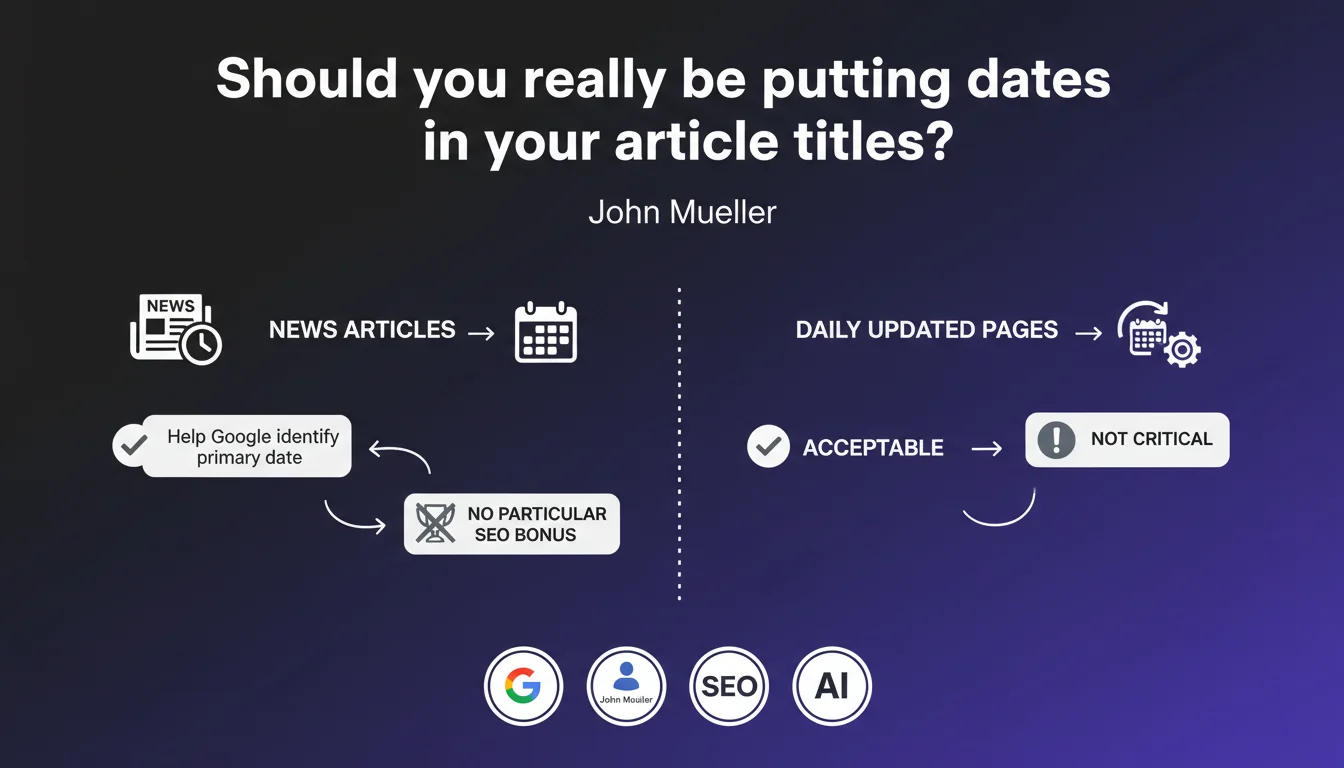
Google uses the date in the title to more easily identify the primary date of a news article, but it provides no direct SEO advantage. For regularly updated content, it's acceptable without being strategic.
What you need to understand
Why does Google care about the date in the title?
Google seeks to identify the primary date of a page to display relevant results in news contexts. When the date appears in the title, this simplifies the extraction process for the search engine.
Important — this only concerns news articles. For other types of content, Google has many other signals available: structured HTML tags, schema.org, metadata. The title is just one indicator among many.
What does this mean concretely for ranking?
No SEO bonus. No ranking boost. The date in the title does not push your page higher in the SERPs.
It simply facilitates interpretation by Google — which can have an indirect impact on display in Google News or in the "Top Stories" sections, but not on classic organic ranking.
What about pages updated daily?
Mueller clarifies that it's acceptable but not critical. Translation: if you manually update the date every day, Google won't hold it against you, but you shouldn't expect any particular advantage either.
The real problem with this approach? You risk creating user confusion if the date displayed in the title doesn't match the one in the main content or the one Google extracts elsewhere.
- The date in the title helps Google identify the primary date for news articles only
- No direct impact on organic ranking
- Acceptable for pages with daily updates, but not strategic
- Risk of confusion if multiple dates exist on the page
SEO Expert opinion
Is this statement consistent with real-world observations?
Yes, broadly speaking. We've never observed a direct correlation between the presence of a date in the title and better positioning. High-performing news sites rely mainly on structured tags (schema.org Article, datePublished) rather than depending on the title.
Where it gets murky: Mueller remains vague about what constitutes a "news article" in Google's eyes. Does a corporate blog that publishes weekly fall into this category? [Needs verification]
What are the real risks of a date in the title?
The main danger is CTR. A title with an aging date (even just a few months old) can discourage users from clicking, especially if the content remains relevant.
And let's be honest — many sites artificially update the date without actually modifying the content. Google isn't fooled. If your strategy relies on "freshness gaming," you risk losing credibility in the long run.
In what cases doesn't this rule apply?
For evergreen content, it's even counterproductive. A how-to guide, a tutorial, a reference resource — anything that remains valid over time — gains nothing from displaying a date in the title.
Worse: you create a perception of artificial obsolescence. The reader sees "2022" and thinks it might be outdated, when the content is still relevant.
<time> tag in the HTML. Any discrepancy can muddy the signals sent to Google.Practical impact and recommendations
What should you do concretely with your titles?
For pure news sites: include the date if it's part of your editorial format, but prioritize structured tags (schema.org NewsArticle, datePublished, dateModified) to ensure reliable extraction by Google.
For blogs and semi-evergreen content: avoid the date in the title. It won't gain you anything and can harm CTR over time. Focus on a title optimized for relevance and engagement.
What mistakes must you absolutely avoid?
Never put a date in the title if you don't keep it updated. Nothing is more damaging than a "dated" article that still displays an old date even though you've revised it.
Also avoid multiple dates on the same page — one in the title, another in the body, a third in schema.org. Google must be able to identify the primary date without ambiguity.
How do you verify your site is properly configured?
Use Google's Rich Results Test tool to validate your schema.org tags. Verify that datePublished and dateModified are correctly extracted.
Also review your titles in Search Console: if you notice abnormally low CTR on recent content with a date in the title, it might be a signal that this format isn't working for your audience.
- Verify that datePublished and dateModified are present in schema.org
- Ensure the date displayed in the title (if present) matches the structured tags
- Monitor CTR for pages with dates vs. without dates in Search Console
- Remove dates from titles for evergreen content
- Implement a consistent update process if you use dates
❓ Frequently Asked Questions
La date dans le title impacte-t-elle le positionnement dans Google Actualités ?
Faut-il supprimer les dates des anciens articles pour améliorer le CTR ?
Peut-on mettre à jour uniquement la date sans modifier le contenu ?
Quelle différence entre datePublished et dateModified en schema.org ?
Les sites e-commerce doivent-ils mettre des dates dans les titles produits ?
🎥 From the same video 17
Other SEO insights extracted from this same Google Search Central video · published on 04/02/2022
🎥 Watch the full video on YouTube →
💬 Comments (0)
Be the first to comment.