
Official statement
What you need to understand
Managing publication dates is a recurring topic in SEO, particularly for websites that regularly update their content. Google's official position provides essential insight into this practice.
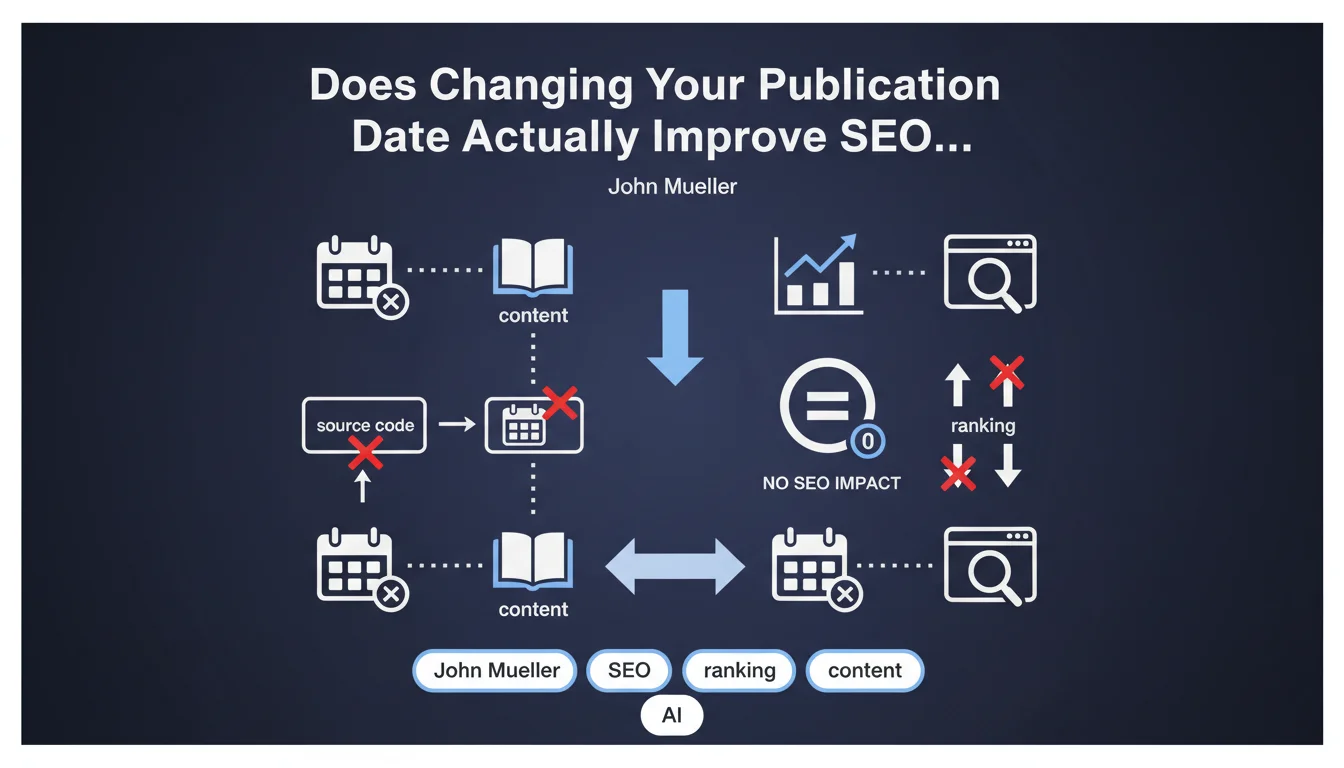
According to John Mueller, modifying the publication date only makes sense if the content has undergone a significant modification. Simply changing the date without touching the content is considered "noise" with no added value.
This statement raises an important question: what constitutes a significant modification? It generally involves a substantial overhaul of the content, adding important sections, updating obsolete data, or significantly enriching existing information.
- Only modify the date when making substantial changes to the content
- Avoid artificially changing dates to simulate freshness
- Consider displaying two distinct dates: initial publication and last modification
- Focus on the real value provided to users rather than on technical manipulations
SEO Expert opinion
This position from Google is perfectly consistent with the quality-focused approach that the search engine has prioritized for several years. In practice, we indeed observe that websites updating their dates without substantially modifying their content don't gain visibility.
An important nuance to note: the notion of "significant modification" remains subjective. For a technical article, correcting 20% of the content with updated information may be considered significant. For a comprehensive guide, a more thorough overhaul might be necessary.
The recommended approach of displaying two distinct dates (publication and modification) is particularly relevant. It offers transparency to users and clear signals to search engines, while preserving the historical authority of the original content.
Practical impact and recommendations
- Audit your existing content to identify pieces that require substantial updating (obsolete information, outdated data, new developments)
- Define a modification threshold: only change the date if at least 25-30% of the content is rewritten or significantly enriched
- Implement dual date display in your HTML structure: original publication date AND last modified date using appropriate Schema.org tags (datePublished and dateModified)
- Document your updates by adding a visible "Last Updated" section for users, briefly explaining what has changed
- Absolutely avoid changing dates automatically or systematically without actual content modification
- Establish an editorial calendar for content revision based on relevance and performance, not on arbitrary dates
- Monitor the performance of your updated content to validate that modifications bring measurable value (engagement, rankings, conversions)
Implementing these practices requires a structured editorial strategy and a thorough understanding of technical signals sent to search engines. Optimizing dates, Schema.org markup, and consistent management of content updates represent a complex set that demands expertise and rigor. For businesses managing a large volume of content or operating in competitive sectors, guidance from a specialized SEO agency enables structuring this approach optimally, integrating these best practices into a comprehensive, sustainable, and high-performing content strategy.
💬 Comments (0)
Be the first to comment.