
Official statement
What you need to understand
The code-to-text ratio measures the proportion of visible text content relative to the total volume of the page's HTML code. For years, some SEO professionals have considered this ratio as a technical quality indicator.
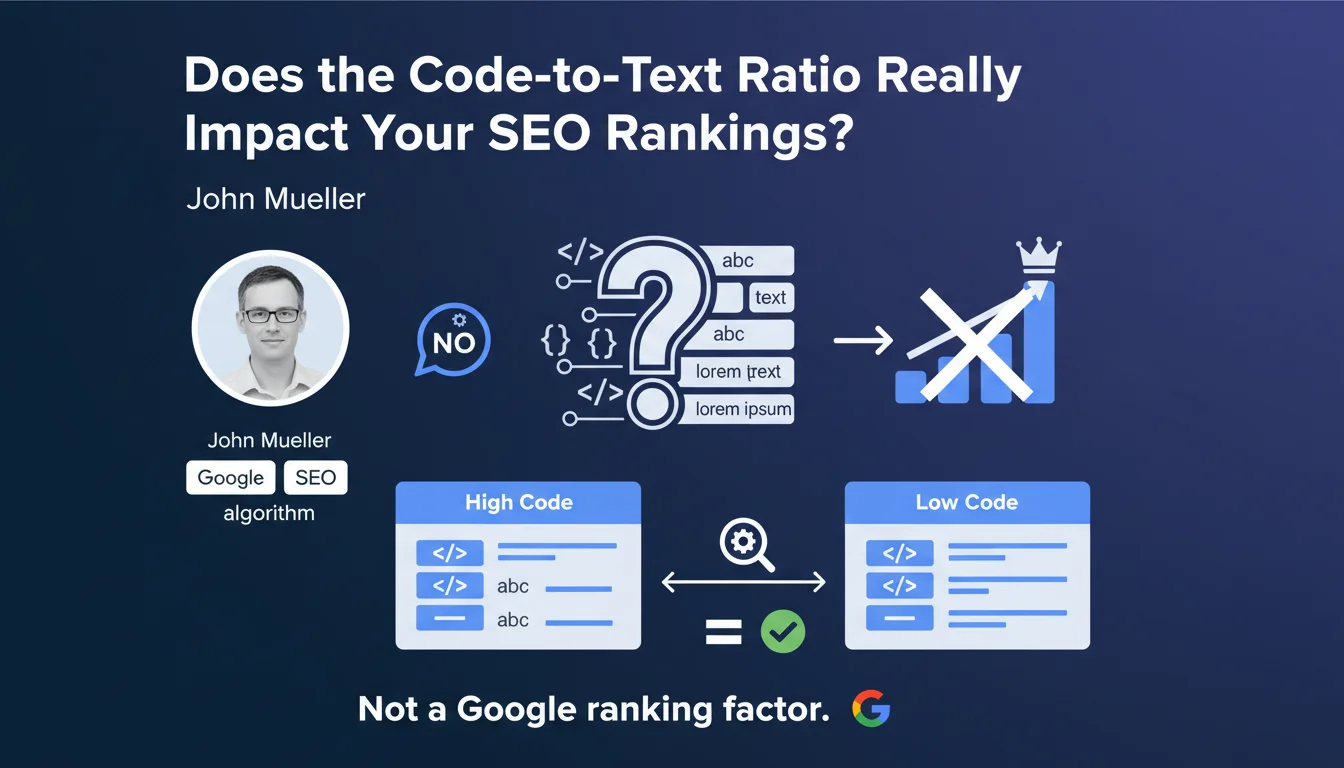
Google officially confirms that this ratio has never been a ranking criterion. Whether your page contains 10% or 90% text relative to code, it does not directly influence your position in search results.
This confusion persists notably because some SEO audit tools continue to display this indicator, giving the impression that it's an element to be optimized. This perpetuates a myth that diverts attention from real priorities.
- The code-to-text ratio is not and has never been a ranking factor
- Google focuses on the quality and relevance of visible content
- Clean code remains important, but not for ratio reasons
- SEO tools can be misleading by mentioning this metric
SEO Expert opinion
This clarification from Google is perfectly consistent with field observations over many years. Sites with very heavy code (JavaScript frameworks, multiple CSS libraries) rank excellently if their content is relevant and meets user expectations.
However, one should not confuse code-to-text ratio with actual technical performance. Excessively heavy code can impact loading speed, user experience, and Core Web Vitals, which are confirmed ranking signals. So it's not the ratio itself that matters, but its potential consequences.
In summary, focus on content quality rather than ratio calculations. A page with 500 relevant words and clean code will always outperform a page with 2000 mediocre words and an "optimal" ratio.
Practical impact and recommendations
- Stop monitoring code-to-text ratio as an SEO metric in your audits and dashboards
- Ignore SEO tool alerts regarding a supposedly insufficient code-to-text ratio
- Focus on visible content quality: relevance, depth, response to search intent
- Optimize Core Web Vitals instead (LCP, FID, CLS), which are actual ranking factors
- Maintain clean code for performance, not for a theoretical ratio with no impact
- Ensure you have enough text content to allow Google to understand your topic, without targeting a specific percentage
- Invest your time in semantic optimization, content structure, and information architecture
These strategic adjustments often require a complete revision of your SEO approach and rigorous prioritization of optimizations with real impact. Faced with the growing complexity of ranking signals and the constant evolution of algorithms, engaging a specialized SEO agency can prove beneficial to receive personalized support and avoid wasting time on optimizations with no added value.
💬 Comments (0)
Be the first to comment.