
Official statement
What you need to understand
What exactly is text-to-HTML ratio and why do SEOs talk about it?
The text-to-HTML ratio represents the proportion of visible text content relative to the total amount of HTML code on a web page. Some SEO audit tools calculate this ratio and recommend a minimum threshold of 10 to 20%.
This metric originates from the idea that search engines would prefer pages rich in content rather than those overloaded with code. Many SEO practitioners have therefore strived to optimize this ratio for years.
What does Google actually say about this?
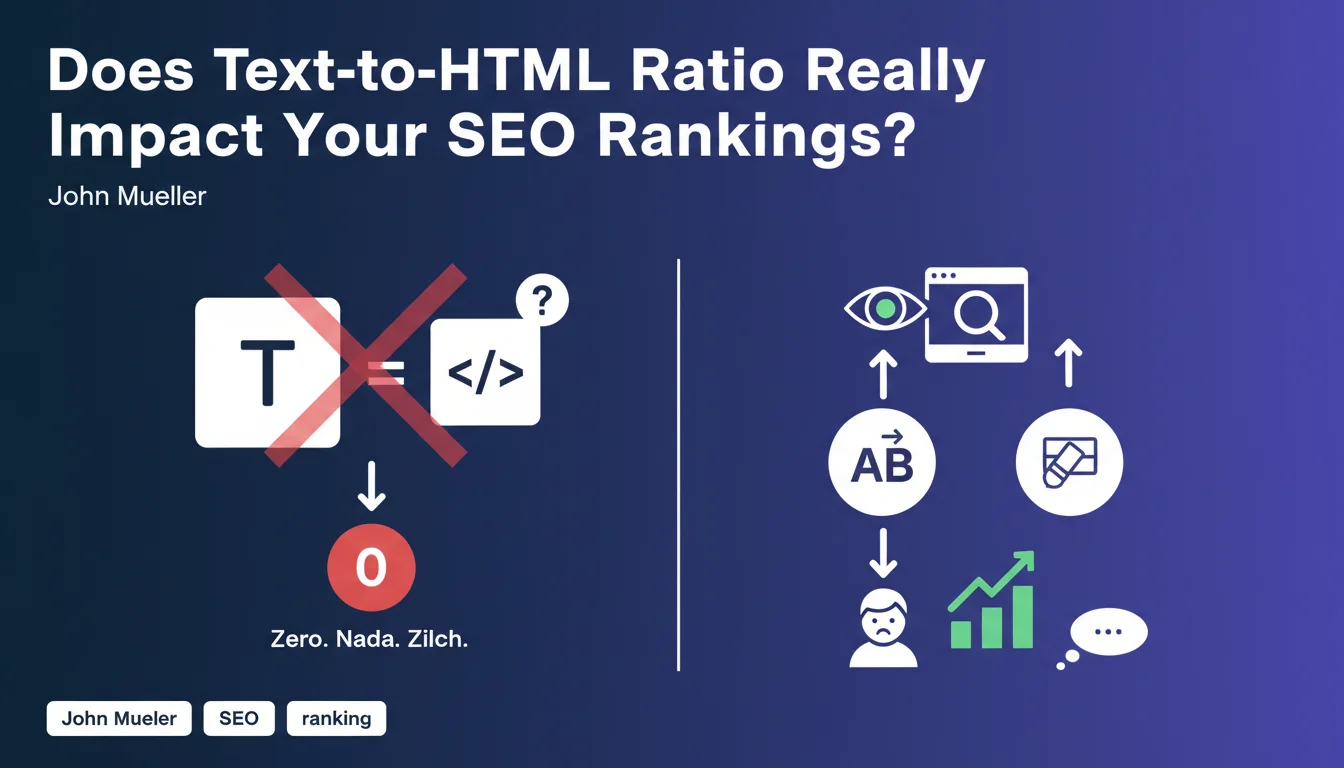
John Mueller, Google spokesperson, stated unambiguously that this ratio has no importance for ranking in search results. He even joked that changing the font or color would have more impact.
This statement directly contradicts a widespread belief in the SEO community. Google does not measure and does not use this ratio as a ranking factor.
Why does this confusion persist throughout the SEO industry?
Many SEO audit tools continue to display this ratio as a quality indicator, which perpetuates the myth. Practitioners often refer to these tools without questioning the actual relevance of the proposed metrics.
The confusion also stems from an indirect correlation: excessively heavy HTML code can slow down loading time, which does impact SEO. But it's the performance that matters, not the ratio itself.
- Text-to-HTML ratio is not a ranking factor used by Google
- This metric persists in many obsolete SEO audit tools
- The confusion comes from an indirect correlation with web performance
- Google prioritizes content quality and user experience
- Heavy code can affect SEO through Core Web Vitals, not through the ratio
SEO Expert opinion
Is this statement consistent with what we observe in practice?
After 15 years of experience, I can confirm that sites with low text-to-HTML ratios can rank perfectly well if their content is relevant and their performance optimal. I've observed sites with 5% ratio on the first page, while others at 25% stagnate.
What really matters is the semantic quality of content, information structure, and overall user experience. Google analyzes visible content and its relevance, independently of the amount of underlying code.
What nuances should we bring to this statement?
While the ratio itself doesn't matter, excessively heavy HTML code can have indirect consequences. Poorly optimized code slows down page loading and degrades Core Web Vitals, which are indeed ranking factors.
Similarly, code overloaded with unnecessary tags, redundant scripts, or inline CSS can complicate Googlebot crawling. But it's the code's efficiency that's problematic, not the mathematical ratio.
In what cases does HTML code optimization remain relevant?
HTML code optimization retains full importance for technical performance. Reducing DOM weight, minimizing CSS and JavaScript, and cleaning up unnecessary code directly improve loading speed.
Clean code also facilitates crawler work and improves accessibility. These optimizations have a real SEO impact, but they aren't measured through a simple text-to-HTML ratio.
Practical impact and recommendations
What should you actually do with this information?
Stop immediately worrying about text-to-HTML ratio as an SEO metric. If your audit tool displays this data in red, ignore it and focus on genuinely relevant indicators.
Redirect your efforts toward optimizing content quality, semantic richness, and search intent. These elements have a measurable impact on your rankings, unlike the ratio.
What mistakes should you avoid following this clarification?
Don't use this statement as an excuse to neglect the technical optimization of your code. The ratio doesn't matter, but code performance and cleanliness remain essential.
Also avoid removing important structural code (structured data, semantic tags) under the pretext of improving a fictitious ratio. Keep all technical elements useful for crawling and indexing.
- Remove text-to-HTML ratio from your SEO KPIs and dashboards
- Focus on Core Web Vitals for technical performance
- Invest in text content quality and depth
- Optimize DOM weight and actual loading speed
- Maintain clean and semantically correct HTML code
- Prioritize user experience over obsolete metrics
- Train your teams on real Google ranking factors
How can you effectively reorient your technical SEO strategy?
Focus your technical audits on elements that genuinely impact SEO: crawlability, indexability, structured data, internal linking, and web performance. These aspects require sharp expertise to be properly optimized.
Transitioning to a modern SEO approach often requires thoroughly reviewing your audit processes and optimization priorities. This strategic overhaul can prove complex to orchestrate alone, particularly for aligning technical and editorial teams.
💬 Comments (0)
Be the first to comment.