
Official statement
What you need to understand
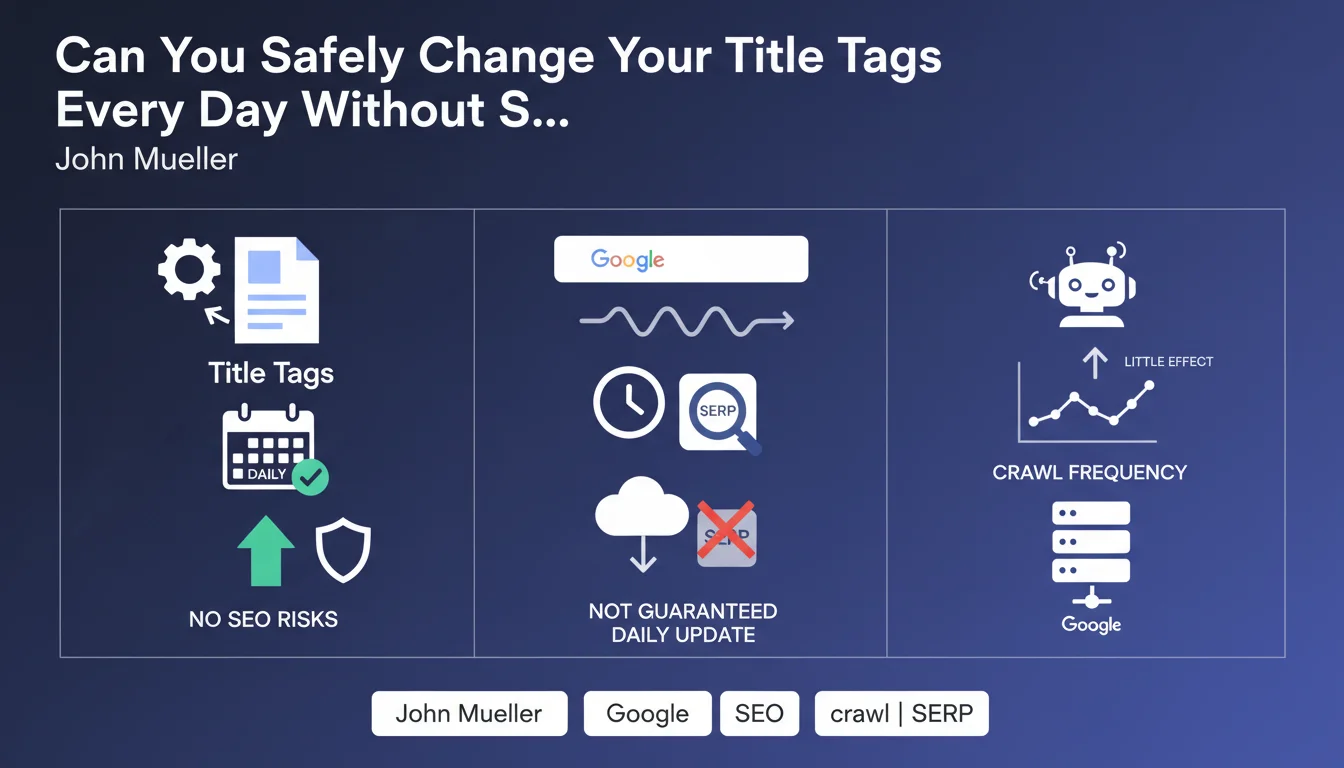
Google explicitly allows frequent Title tag modifications, even daily if the need arises. There is no direct penalty associated with this practice according to official statements.
However, two important technical limitations must be taken into account. First, Google does not guarantee that it will immediately pick up the new version of the Title in search results. Second, these changes do not significantly accelerate the crawl frequency of your pages.
The real challenge lies in semantic analysis and ranking. Each substantial modification to the Title can trigger a reanalysis of the page by the algorithm, with potential consequences on rankings.
- No direct penalty for frequent Title modifications
- No guarantee of rapid updates in SERPs
- Limited impact on crawl frequency
- Risk of ranking fluctuations depending on the extent of modifications
- Possible semantic reevaluation with each significant change
SEO Expert opinion
This official position is consistent with field observations, but deserves to be nuanced. In practice, we indeed observe that Google sometimes takes several days, even weeks, to take a new Title into account, particularly on pages with low crawl frequency.
The crucial point often underestimated concerns the yo-yo effect on rankings. Modifying a Title that contains strategic keywords can trigger a reevaluation phase during which positions fluctuate significantly. This phenomenon is mainly observed on competitive queries where the semantic relevance of the Title carries significant weight.
On the other hand, for event-driven or naturally updating content (product pages with variable stock, events with changing dates, dynamic pricing), this flexibility is valuable and generally does not pose major problems.
Practical impact and recommendations
- Allow frequent modifications only on content that truly justifies it (news, stock levels, dated events)
- Avoid Title changes on your strategic pages that are already well-ranked, unless the optimization is carefully considered
- Document each modification with the date and previous version to trace correlations with any traffic fluctuations
- Favor minor adjustments (adding the year, modifying a qualifier) rather than complete rewrites
- Wait at least 3-4 weeks before evaluating the real impact of a Title change on performance
- Monitor your rankings daily after any modification to quickly detect a problematic yo-yo effect
- Test first on secondary pages before applying a systematic modification strategy
- Maintain semantic consistency between the old and new Title to limit algorithmic reevaluation
The optimal management of Title tags requires continuous monitoring of rankings, detailed impact analysis, and a thorough understanding of algorithmic behavior according to page types. For sites with high commercial stakes or complex SEO strategies involving regular adjustments, support from a specialized SEO agency allows you to manage these optimizations with the necessary methodological rigor, relying on advanced monitoring tools and proven expertise in repositioning dynamics.
💬 Comments (0)
Be the first to comment.