
Official statement
Other statements from this video 17 ▾
- □ Should you worry about changing page titles frequently—or is Google totally fine with it?
- □ Can you really erase the SEO past of a purchased domain?
- □ Should you really disavow links that don't match your current niche anymore?
- □ Should you really remove backlinks pointing to your domain's old content?
- □ Do server errors really kill your Google rankings?
- □ Should you include your brand name in news article titles for better search visibility?
- □ Should you really be putting dates in your article titles?
- □ Does adding categories to your URLs really boost your SEO rankings?
- □ Why does Google crawl pages it never adds to its index?
- □ What's the real secret to getting Google to index all your content?
- □ Are backlinks to your non-indexed pages really wasting your SEO potential?
- □ Why Does Google Drastically Reduce Its Crawl Rate After a CDN Migration?
- □ Does server response time really impact your Google rankings?
- □ Should you really update your backlinks after a domain migration?
- □ Should you really block pages with robots.txt if Google can index them without any content?
- □ Does image alt text in a link carry the same SEO weight as visible anchor text?
- □ Does retouched product photography actually hurt your review rankings?
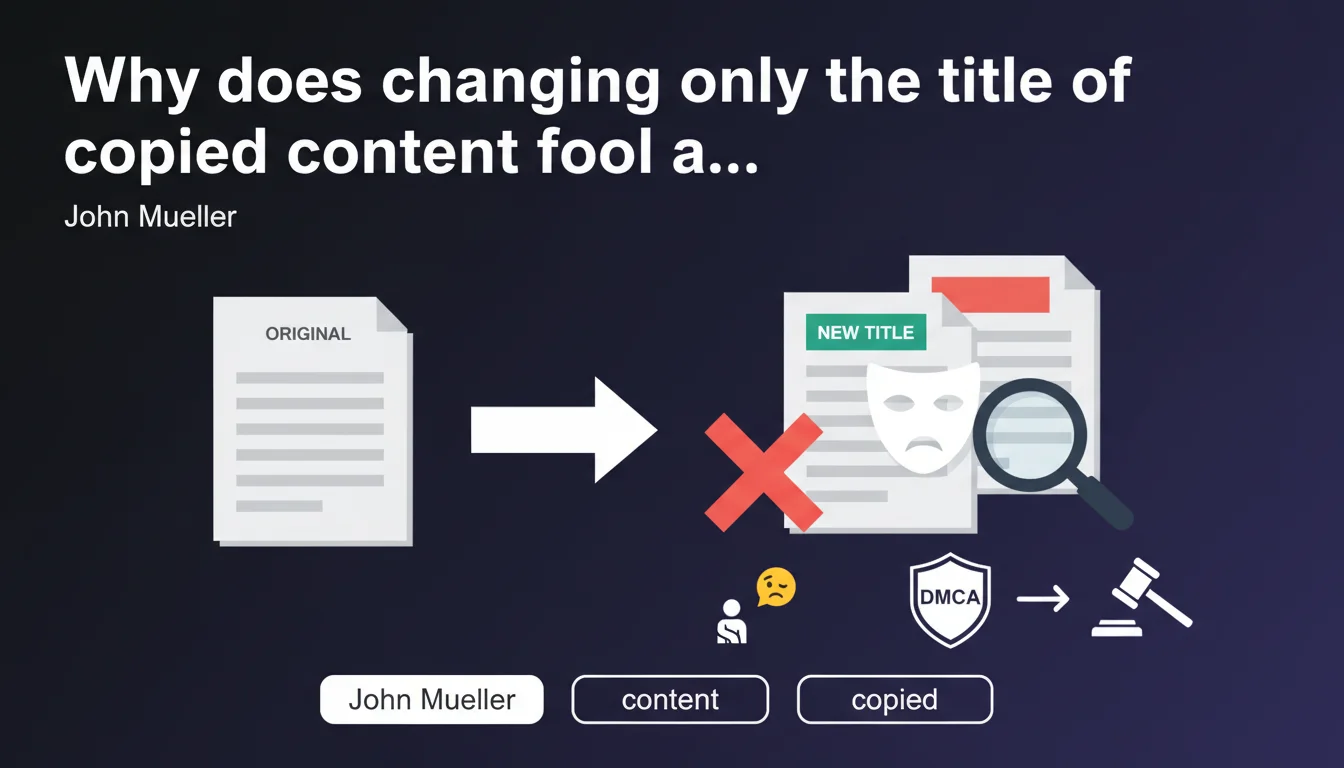
Google considers that copying content and simply changing the title is not a viable strategy. This practice does not transform plagiarized content into original material. For cases of complete duplication, submitting a DMCA takedown notice remains the appropriate option.
What you need to understand
What exactly is the practice being targeted by this statement?
Mueller is targeting a rudimentary but still observable technique: copying entire content from a competitor website and merely changing the title or a few superficial elements. The underlying idea behind this manipulation? Attempting to convince algorithms that this is new content.
This approach reflects a fundamental misunderstanding of how duplicate content detection systems work. Google doesn't limit itself to comparing titles — its algorithms analyze semantic structure, linguistic patterns, and the overall fingerprint of the text.
Why does this practice persist despite its ineffectiveness?
Two main reasons. First, the apparent ease: copy-pasting takes a few minutes compared to several hours to produce original content. Second, some automated tools still promise this type of manipulation at scale.
The problem is that these tactics are from a bygone era. Google's current filters identify duplicate content with such precision that this approach is not only useless but counterproductive.
What's the difference between duplication and legitimate inspiration?
There's a crucial distinction. Drawing inspiration from a competitor's editorial angle to produce your own analysis with your data, your style, and your expertise remains perfectly legitimate. Copying word-for-word 90% of the text while changing just the title crosses the line.
Google distinguishes between these two situations. One enriches the web with a new perspective. The other simply dilutes existing information without adding value.
- Cosmetic modifications (title, a few words) don't change the nature of copied content
- Algorithms analyze the substance of text, not superficial elements
- Filing a DMCA takedown remains the legal tool to protect your original content
- The boundary between inspiration and plagiarism lies in the delivery of original added value
SEO Expert opinion
Does this statement really reflect how filters work in practice?
Yes, but with important nuances. In practice, we observe that certain syndicated content or aggregation websites still manage to rank despite substantially similar content. The difference? They typically add supplementary context, a different interface, or benefit from existing domain authority.
Let's be honest: the « simply rewrite the title » scenario Mueller describes represents the bottom tier. Problematic SEO cases are rarely this crude. Real-world situations more often involve more sophisticated spinning, partial rewrites, or automatically generated content with variations.
In what contexts does this rule not apply strictly?
Several exceptions deserve mention. Official press releases are often republished identically across hundreds of websites — Google doesn't penalize this practice because it understands the nature of these contents. Same logic applies to factual data (hours, pricing, technical specifications) that can only be reformulated marginally.
And here's where it gets tricky: Mueller doesn't specify where exactly the threshold sits between « insufficient modification » and « acceptable rewriting ». [To be verified] in the field, our tests show that a rewrite exceeding 40-50% of content with a different angle can avoid filters, but this limit remains fuzzy and probably variable depending on the sector.
Is DMCA really the recommended solution?
Mueller points toward the DMCA process for « cases of complete copying ». It's the standard legal approach, certainly. But in operational reality, the DMCA procedure requires time, precise documentation, and doesn't guarantee immediate deindexing.
For small publishers facing massive scraping, this recommendation can seem insufficient. DMCA request processing timeframes can stretch across weeks, during which copied content can capture traffic.
Practical impact and recommendations
What should you do if your content gets copied?
First step: systematically document your original publication date through your sitemaps, RSS feeds, and ideally third-party archives (Wayback Machine). This provable precedence becomes crucial in a DMCA process.
Next, assess the scale. One isolated site copying an article? DMCA may suffice. An automated scraping network? You need to combine DMCA, reporting via Google Search Console, and possibly technical barriers (rate limiting, detection of suspicious bots).
How do you protect your content upfront?
Proactive protection remains more effective than reactive response. Integrate unique elements that are difficult to replicate: proprietary data, client case studies, screenshots with your branding, personalized graphics.
Technically, some sites use hidden text snippets or specific linguistic patterns to identify copies. But let's be realistic — these techniques slow down copiers; they don't stop them.
What mistakes should you absolutely avoid?
Don't fall into the inverse trap: copying content yourself thinking superficial rewriting will suffice. Even with an AI paraphrasing tool, if structure and core ideas remain identical, you expose yourself to the same filters.
Another common mistake: republishing your own content across multiple domains you own without proper canonical tags. Google may interpret this as duplication, even if you're the original author.
- Document your original publication dates via sitemap and archives
- Prepare a standardized DMCA process with takedown request templates
- Monitor for copies with tools like Copyscape, Google Alerts on your key phrases
- Integrate proprietary elements difficult to copy in every piece of content
- Use canonical tags for all syndicated or republished content
- Avoid any superficial rewriting of third-party content — either create something new or cite while adding substantial value
❓ Frequently Asked Questions
Quel pourcentage de modification rend un contenu copié acceptable pour Google ?
Le DMCA fonctionne-t-il vraiment pour faire désindexer du contenu copié ?
Un site avec plus d'autorité peut-il outrepasser mon contenu original en le copiant ?
La réécriture par IA change-t-elle la donne pour ce type de manipulation ?
Comment prouver l'antériorité de mon contenu en cas de litige ?
🎥 From the same video 17
Other SEO insights extracted from this same Google Search Central video · published on 04/02/2022
🎥 Watch the full video on YouTube →
💬 Comments (0)
Be the first to comment.