
Official statement
Other statements from this video 17 ▾
- □ Should you worry about changing page titles frequently—or is Google totally fine with it?
- □ Can you really erase the SEO past of a purchased domain?
- □ Should you really disavow links that don't match your current niche anymore?
- □ Should you really remove backlinks pointing to your domain's old content?
- □ Do server errors really kill your Google rankings?
- □ Should you include your brand name in news article titles for better search visibility?
- □ Why does changing only the title of copied content fool absolutely nobody?
- □ Should you really be putting dates in your article titles?
- □ Does adding categories to your URLs really boost your SEO rankings?
- □ Why does Google crawl pages it never adds to its index?
- □ What's the real secret to getting Google to index all your content?
- □ Why Does Google Drastically Reduce Its Crawl Rate After a CDN Migration?
- □ Does server response time really impact your Google rankings?
- □ Should you really update your backlinks after a domain migration?
- □ Should you really block pages with robots.txt if Google can index them without any content?
- □ Does image alt text in a link carry the same SEO weight as visible anchor text?
- □ Does retouched product photography actually hurt your review rankings?
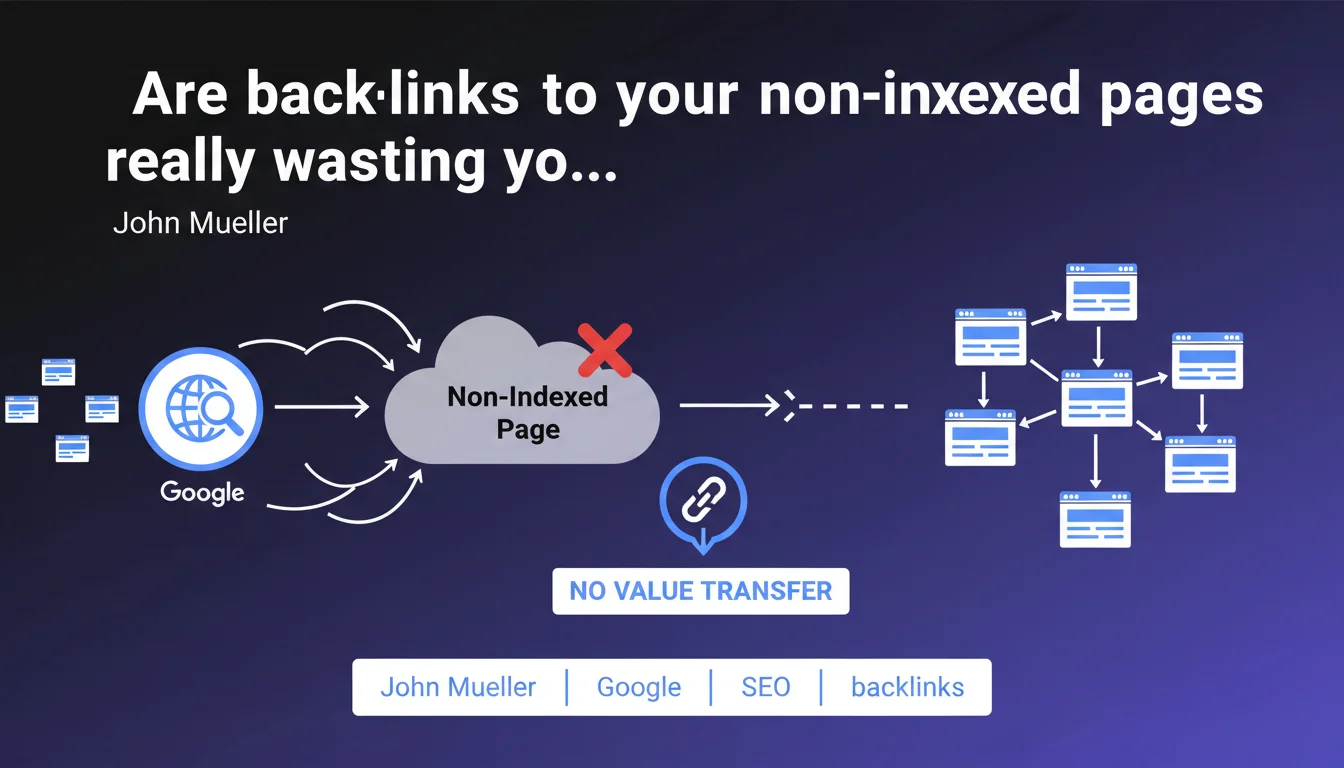
Google transfers no value from links pointing to pages it refuses to index. Without an indexed destination, these backlinks become unusable for the rest of your site. Every non-indexed page with incoming links represents a waste of SEO juice.
What you need to understand
What happens when Google refuses to index a page that receives links?
When Google decides not to index a page, it completely cuts off the transfer of value from the backlinks it receives. These links transmit nothing to the rest of your site — no PageRank, no authority, no relevance signal.
In practical terms? A link from an authoritative site to your excluded page becomes an SEO dead end. Google may crawl that link, but it can do nothing with it since the destination doesn't exist in its index.
Why does Google refuse to index certain pages?
The reasons are varied: duplicate content, insufficient quality judgment, pages blocked by robots.txt then submitted, canonicalization to another URL, or simply an algorithmic decision not to allocate crawl budget.
The problem is that you don't always control this decision. A page you consider strategic can be seen as worthless by Google — and all the backlinks it accumulates become sterile.
Is this loss of value permanent?
Yes, as long as the page remains non-indexed. No indexation = no juice transmission. It's binary.
If you fix the issues and Google eventually accepts indexing the page, the links regain their usefulness. But in the meantime, you've left authority on the table — and backlinks have a limited lifespan.
- Links to non-indexed pages transmit no value to your site
- Google cannot do anything with these links without a destination in its index
- Indexation refusal can be algorithmic or technical
- The loss persists as long as the page remains excluded from the index
- Each backlink to a non-indexed page is a waste of SEO potential
SEO Expert opinion
Does this statement contradict the idea that Google redistributes PageRank?
Not really. PageRank redistribution works within the index — between pages Google knows and values. A page outside the index doesn't exist in this distribution system.
But here's where it gets tricky: Mueller doesn't specify what happens to internal links from a non-indexed page. If it's part of your link structure, do its outgoing links count? [To be verified] — logic would suggest not, but we have no explicit confirmation.
Is Google transparent about its non-indexation criteria?
No. And that's where this statement becomes frustrating for practitioners. Google tells you your links are lost, but doesn't always explain why it refuses to index certain pages.
Search Console sometimes displays "Crawled, currently not indexed" without actionable reason. You improve content, enhance structure, strengthen internal linking — and the page stays excluded. This opacity makes recovering lost juice difficult.
Should you systematically redirect non-indexed pages with backlinks?
It's tempting, but be careful. A 301 redirect to a relevant page can save link value — provided the destination is thematically coherent.
Blindly redirecting to the homepage or a generic category dilutes the signal. Google can interpret that as manipulation and devalue the link. Let's be honest: in some cases, it's better to let a zombie page die than force a clunky redirect.
Practical impact and recommendations
How do you identify non-indexed pages receiving backlinks?
Cross-reference Google Search Console data (excluded pages) with a backlink tool like Ahrefs, Majestic, or Semrush. Pages marked "Crawled, currently not indexed" or "Discovered, currently not indexed" that have referring domains are your priorities.
Export the list and sort by number of referring domains. A page with 5+ quality backlinks that isn't indexed represents an SEO juice hemorrhage.
What should you concretely do with these pages?
First step: understand why Google refuses to index them. Poor content? Duplication? Aggressive canonicalization? Insufficient crawl budget on a deep site section?
If the page has real editorial value and solid backlinks, improve it until it deserves indexation. Otherwise, redirect it to the most relevant page thematically to recover link juice.
What critical mistakes should you avoid?
Don't let non-indexed pages with backlinks sit around — it's pure waste. Don't systematically redirect to the homepage: it's a quick fix that kills signal relevance.
And above all, don't assume Google will eventually index the page "someday". If it stays excluded after several weeks despite proper linking, it's an algorithmic decision — take action rather than wait.
- Audit non-indexed pages in Search Console monthly
- Cross-reference with backlink data to identify juice losses
- Prioritize pages with 3+ referring domains or authoritative backlinks
- Analyze the reason for indexation refusal (content, technical, crawl budget)
- Improve content and internal linking if the page has potential
- Redirect to a thematically coherent page otherwise
- Check after 2-3 weeks if Google has reindexed or followed the redirect
- Document recurring cases to refine your content strategy
❓ Frequently Asked Questions
Une page bloquée par robots.txt mais avec des backlinks transmet-elle du jus ?
Les liens internes vers une page non indexée comptent-ils pour le maillage ?
Peut-on forcer l'indexation d'une page avec des backlinks de qualité ?
Une redirection 301 récupère-t-elle 100% de la valeur des backlinks perdus ?
Les outils SEO surestiment-ils l'autorité de mon site à cause de ces liens perdus ?
🎥 From the same video 17
Other SEO insights extracted from this same Google Search Central video · published on 04/02/2022
🎥 Watch the full video on YouTube →
💬 Comments (0)
Be the first to comment.