
Official statement
Other statements from this video 11 ▾
- □ Is old content really killing your search rankings?
- □ Can old content still rank well despite its age?
- □ Should you really fix broken links in your older content?
- □ Should you really add warning banners to your older content pieces?
- □ Should you really update all your old content for SEO?
- □ Should you really delete outdated content instead of simply marking it as deprecated?
- □ Is using the canonical tag as a hidden redirect costing you your SEO rankings?
- □ Why does Google discourage crypto-redirects for your site migrations?
- □ Should you really stop adding dates to your titles just to make them look fresh?
- □ Should you redirect or create an explanatory page when discontinuing a tool?
- □ Is auditing your documentation regularly really essential to maintain strong SEO performance?
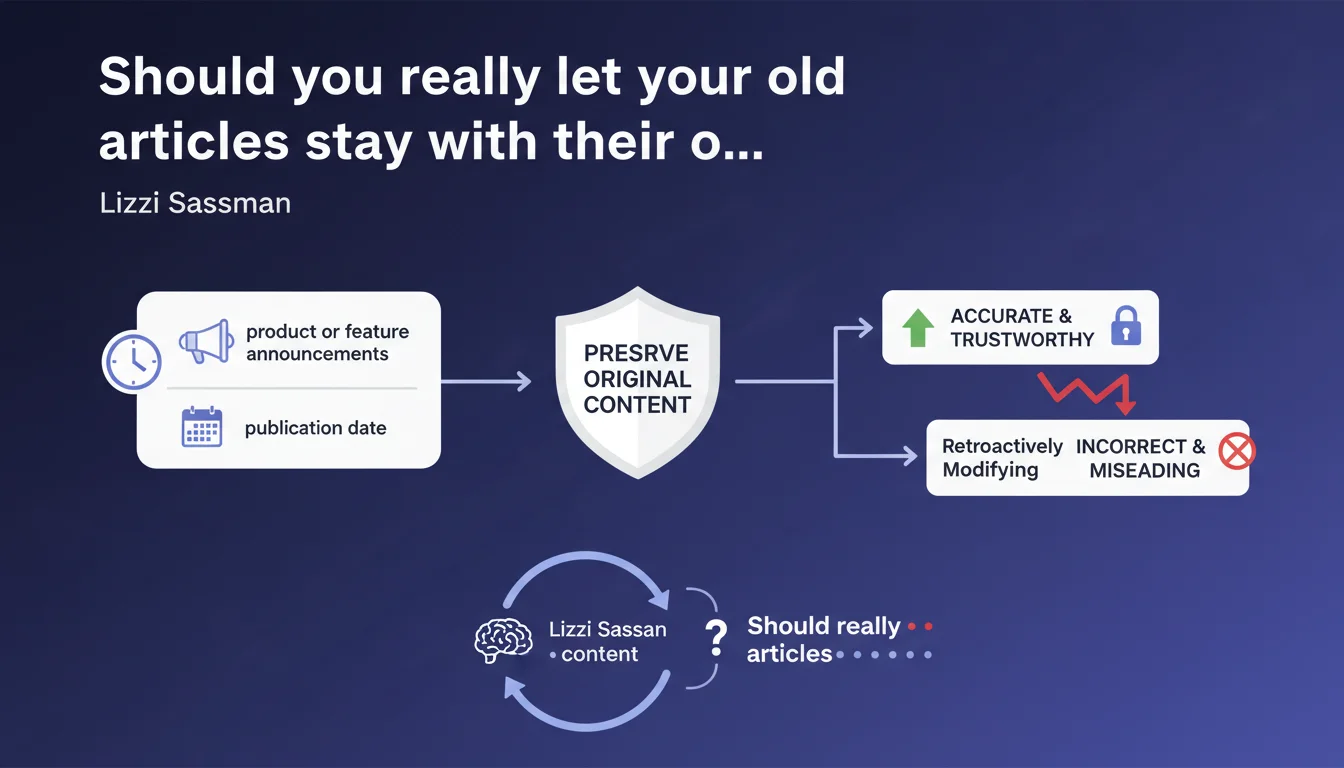
Google requires preserving the original content of product or feature announcements intact, including the publication date. Retroactively modifying these contents would be considered misleading. This directive targets historical accuracy, not standard editorial updates.
What you need to understand
Why is Google clarifying this point now?
This stance responds to an observed practice: some sites quietly modify their old announcements to erase failed predictions or broken promises. Google is making a firm statement — history matters.
The stakes go beyond simple technical SEO. This is about preserving the informational integrity of the web. When you announce in March that a feature will launch in June and it finally arrives in November, leaving the original article as-is documents that evolution. Modifying it to say "launch planned for November" turns your archive into a lie.
Are all dated contents subject to this rule?
No, and that's where it gets subtle. Google explicitly targets product and feature announcements. A standard blog post, a pillar page, a how-to guide — all of that remains modifiable without issue. The logic? These contents naturally evolve with knowledge and practices.
Announcements, on the other hand, freeze a precise moment: "Here's what we're launching, here's when, here's how." They document an intention at a specific point in time. Transforming them afterward blurs the chronology of facts.
What should you do if the original content contains outdated or incorrect information?
Google isn't saying to let your errors rot without context. The solution: add clearly dated update notes, at the top or bottom of the article. "Updated on [date]: This feature ultimately launched with the following characteristics..."
You preserve the original archive while properly informing your readers. Double benefit: you respect historical accuracy AND you serve updated content. The reader sees the evolution, Google validates the transparency.
- Product/feature announcements: original content untouchable, publication dates mandatory
- Update notes: dated additions authorized and recommended to correct/update
- Other content: free modification according to your standard editorial needs
- Google's objective: prevent rewriting history to hide unfulfilled promises
- Transparency: valued as a signal of editorial reliability
SEO Expert opinion
Is this directive truly new or just a reminder?
Let's be honest — Google has never said otherwise. But until now, no documentation has been quite this explicit. This clarification probably comes after observing drift: sites modifying their roadmaps retroactively, tech media revising failed predictions.
In the field, we've already observed for years that sites with transparent editorial history perform better in EEAT. Acknowledged corrections, clearly marked updates — that reassures. Google is simply formalizing what it already valued in its algorithms.
What nuances should be applied to this rule?
First point: [To verify] how Google technically detects these retroactive modifications. Archive.org? Crawl history? The statement remains vague on the control mechanism. We assume a mix of signals: cached versions, timestamps, comparisons over time.
Second nuance — and it's massive: this rule concerns factual accuracy, not SEO optimization. You can perfectly well improve HTML markup, fix typos, optimize meta descriptions on an old press release. What you cannot do: change "Q2 launch" to "Q4 launch" without explicit mention.
Third point: what about mixed content? An article that announces a product BUT also contains general usage advice? The announcement part stays frozen, the advice part can evolve. Mentally segment your contents into distinct blocks.
In what cases could this rule create problems?
Imagine: you announced an API with certain endpoints. Six months later, you pivot the entire architecture. Keeping the original announcement intact might create confusion among developers who stumble across it via Google. What to do?
The clean solution: clearly archive the old content (canonical tag to the new version, or dedicated "Archive" section) AND publish a new updated announcement. You document both states without mixing eras. And most importantly, explicitly link between versions to show the connection.
Practical impact and recommendations
What do you need to do concretely on your old content?
First, audit your historical announcements. Identify all articles of the "Launch of..." type, "New feature...", "Available starting...". Create an Excel list with URL, publication date, promises made, current state of those promises.
For each content where reality diverged from the announcement: add an update banner at the top of the page. Typical format: "[Update — date]: This product is now available with the following characteristics, different from the initial announcement. Here's why..." Maximum transparency.
If you've already retroactively modified certain announcements, restore the original versions from your backups or Archive.org. Then add your update notes. Yes, it might sting to re-display failed predictions. But Google (and your readers) prefer honesty to revisionism.
What mistakes should you absolutely avoid?
Mistake number one: outright deleting announcements that didn't materialize. That screams "we're hiding our failures". Keep the content, contextualize it, own it. Documented failure beats suspicious emptiness.
Mistake two: modifying publication dates to make an announcement seem more recent. Google detects these manipulations through its caches and crawl history. You risk far more than a simple ranking drop — editorial trust is lost once, rebuilt over months.
Mistake three: confusing standard editorial updates with retroactive modification. Improving the readability of a 2020 how-to guide? No problem. Changing the roadmap announced in that same guide? Forbidden without explicit mention. The boundary is clear once you understand it.
How do you verify your site's compliance?
- List all your announcement/launch type content from at least the last 3 years
- Verify that each announcement displays its original publication date clearly
- Compare initial promises vs current reality for each announcement
- Add dated update notes everywhere necessary
- Create a standardized "Update" banner template for consistency
- Document your editorial process: who can modify what, under what rules
- Train your content teams on the distinction between announcement and evolving content
- Set up a quarterly alert to audit new announcements
This Google directive reinforces the importance of editorial traceability. Sites that properly document their evolution, own their mistakes, and contextualize their pivots gain EEAT credibility. Conversely, historical revisionism becomes an algorithmic warning signal.
Concretely: stop touching the body text of your past announcements. Add dated updates. Be transparent about what changed and why. This documentary rigor requires overhauling editorial workflows, raising team awareness, and sometimes conducting significant historical audits. If this project seems complex to pilot internally, specialized support can help you structure this compliance effort without burning resources for weeks.
❓ Frequently Asked Questions
Puis-je corriger une faute de frappe dans une vieille annonce de produit ?
Que faire si une annonce contient des informations devenues fausses ou dangereuses ?
Cette règle s'applique-t-elle aux communiqués de presse ?
Comment Google détecte-t-il les modifications rétroactives ?
Les articles de blog classiques sont-ils concernés par cette directive ?
🎥 From the same video 11
Other SEO insights extracted from this same Google Search Central video · published on 09/05/2024
🎥 Watch the full video on YouTube →
💬 Comments (0)
Be the first to comment.