
Official statement
Other statements from this video 11 ▾
- □ Le contenu ancien pénalise-t-il vraiment votre référencement ?
- □ Le contenu ancien peut-il encore se classer malgré son âge ?
- □ Faut-il vraiment corriger les liens cassés dans vos contenus anciens ?
- □ Faut-il vraiment ajouter des bannières d'avertissement sur vos contenus anciens ?
- □ Faut-il vraiment laisser vos vieux articles avec leurs erreurs d'origine ?
- □ Faut-il vraiment supprimer le contenu obsolète plutôt que de le marquer comme déprécié ?
- □ Pourquoi utiliser la balise canonical comme redirection est-il une erreur SEO majeure ?
- □ Pourquoi Google déconseille-t-il les crypto-redirects pour vos migrations de sites ?
- □ Faut-il vraiment arrêter d'ajouter des dates dans les titres pour paraître frais ?
- □ Faut-il rediriger ou créer une page explicative quand on supprime un outil ?
- □ Faut-il vraiment auditer régulièrement sa documentation pour rester performant en SEO ?
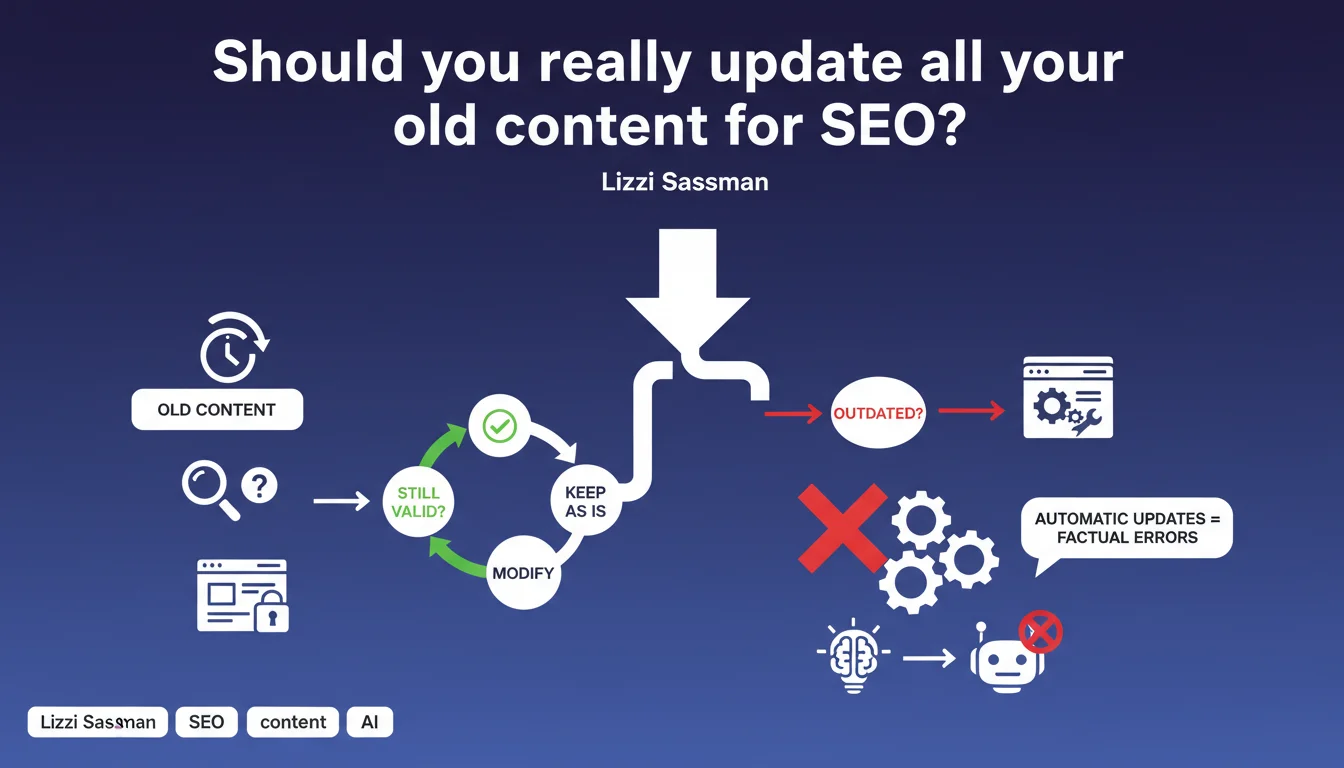
Google advises against systematically updating all old content. Some historical pages contain information that remains valid, and modifying them could introduce factual errors. A selective approach takes priority over automatic refresh.
What you need to understand
Why does Google discourage massive content updates?
The statement targets the automated content refreshing practices that have become common. Many SEO teams massively update their archives to signal freshness to Google, often without verifying actual relevance.
The problem? This approach can corrupt historically accurate information. A technical blog article written 5 years ago may remain relevant — modifying it just to add a recent date or rephrase without proper expertise can introduce factual errors.
What does this change for editorial strategy?
Google reminds us that freshness isn't always a positive signal. For certain search queries, well-documented older content outperforms recent superficial versions. Factual quality trumps publication date.
This position aligns with E-E-A-T logic: old content can demonstrate a site's historical experience on a topic. Destroying it to artificially rejuvenate it erases this expertise capital.
- Don't confuse cosmetic freshness (changing the date) with substantive improvement
- Some historical content has documentary value that must be preserved
- Updates should be editorial and selective, not automated
- Google detects surface-level modifications with no real added value
In what cases does updating remain necessary?
The statement doesn't say you should freeze everything. Content that's factually obsolete, outdated technical guides, or pages with broken links require intervention. The challenge is identifying what truly deserves a refresh.
Evergreen content that's well-written can remain intact for years. Conversely, pages covering evolving topics (algorithms, tools, regulations) demand regular follow-up — but targeted, not systematic.
SEO Expert opinion
Does this recommendation contradict observed practices?
Yes and no. Tests show that freshness can boost CTR in SERPs, especially on recent informational queries. But Google clearly distinguishes between factual freshness and artificial freshness. Simply changing a date without modifying the content adds nothing.
The real debate: some SEOs have observed ranking gains after massive refresh. But do these gains come from the date or from editorial improvements made in parallel? Hard to isolate the variable. [To verify]: Google has never provided clear data on how much weight freshness carries as an isolated ranking signal.
What nuances should be considered?
The statement remains vague on one crucial point: how does Google evaluate the quality of an update? If you republish an article with 20% of relevant new content, is that considered substantive improvement or cosmetic refresh?
Another gray area: statistics or data-heavy pages. An article "50 SEO Stats" from 3 years ago is objectively obsolete. Updating it with new data is editorial common sense, not manipulation.
In what cases does this rule not apply?
On news or media sites, freshness remains a fundamental criterion. A media outlet that doesn't publish regularly loses visibility on QDF queries (Query Deserves Freshness). The statement mainly targets corporate blogs, technical sites, and educational content.
Transactional pages (product sheets, comparisons) follow different logic. If your competitor updates their SaaS tools comparison and yours is from 2 years ago, you'll mechanically lose traffic — regardless of what Google says about old content.
Practical impact and recommendations
What should you actually do with your old content?
Implement a selective editorial audit rather than an automatic refresh calendar. Review your content based on factual criteria: technical obsolescence, declining traffic, high bounce rate, comments flagging errors.
Prioritize pages that still generate traffic but whose engagement metrics are degrading. These will benefit most from substantive updates. Pages dead for 3 years can remain untouched if their content stays accurate.
What mistakes should you absolutely avoid?
Never change just the publication date without touching the content. Google can detect these manipulations through DOM analysis and cached versions. If you modify, bring real added value: new examples, updated data, enriched sections.
Avoid cosmetic rewording generated by AI without human validation. Many tools promise to "refresh" your content automatically — but they often introduce inconsistencies or dilute original expertise.
- Identify content that's factually obsolete vs still valid
- Prioritize based on current traffic and search potential
- Document every modification to justify editorial value
- Don't touch historical content that serves as documentary reference
- Test impact on a sample before rolling out massively
- Monitor engagement metrics post-update to validate relevance
How do you validate whether an update is worthwhile?
Ask yourself three questions: Is the content factually wrong today? Are users flagging issues? Are competitors offering noticeably more complete versions?
If the answer is no to all three, leave the content alone. A solid technical article from 2018 can outperform a mediocre 2024 article. Age even becomes an authority signal on certain non-evolving topics.
❓ Frequently Asked Questions
Google pénalise-t-il les contenus anciens non mis à jour ?
Faut-il supprimer la date de publication sur les articles de blog ?
Comment savoir si un contenu ancien mérite une mise à jour ?
Les outils de content refresh automatisé sont-ils risqués ?
Peut-on republier un ancien article avec une nouvelle date ?
🎥 From the same video 11
Other SEO insights extracted from this same Google Search Central video · published on 09/05/2024
🎥 Watch the full video on YouTube →
💬 Comments (0)
Be the first to comment.