
Official statement
Other statements from this video 11 ▾
- □ Can old content still rank well despite its age?
- □ Should you really fix broken links in your older content?
- □ Should you really add warning banners to your older content pieces?
- □ Should you really update all your old content for SEO?
- □ Should you really let your old articles stay with their original mistakes?
- □ Should you really delete outdated content instead of simply marking it as deprecated?
- □ Is using the canonical tag as a hidden redirect costing you your SEO rankings?
- □ Why does Google discourage crypto-redirects for your site migrations?
- □ Should you really stop adding dates to your titles just to make them look fresh?
- □ Should you redirect or create an explanatory page when discontinuing a tool?
- □ Is auditing your documentation regularly really essential to maintain strong SEO performance?
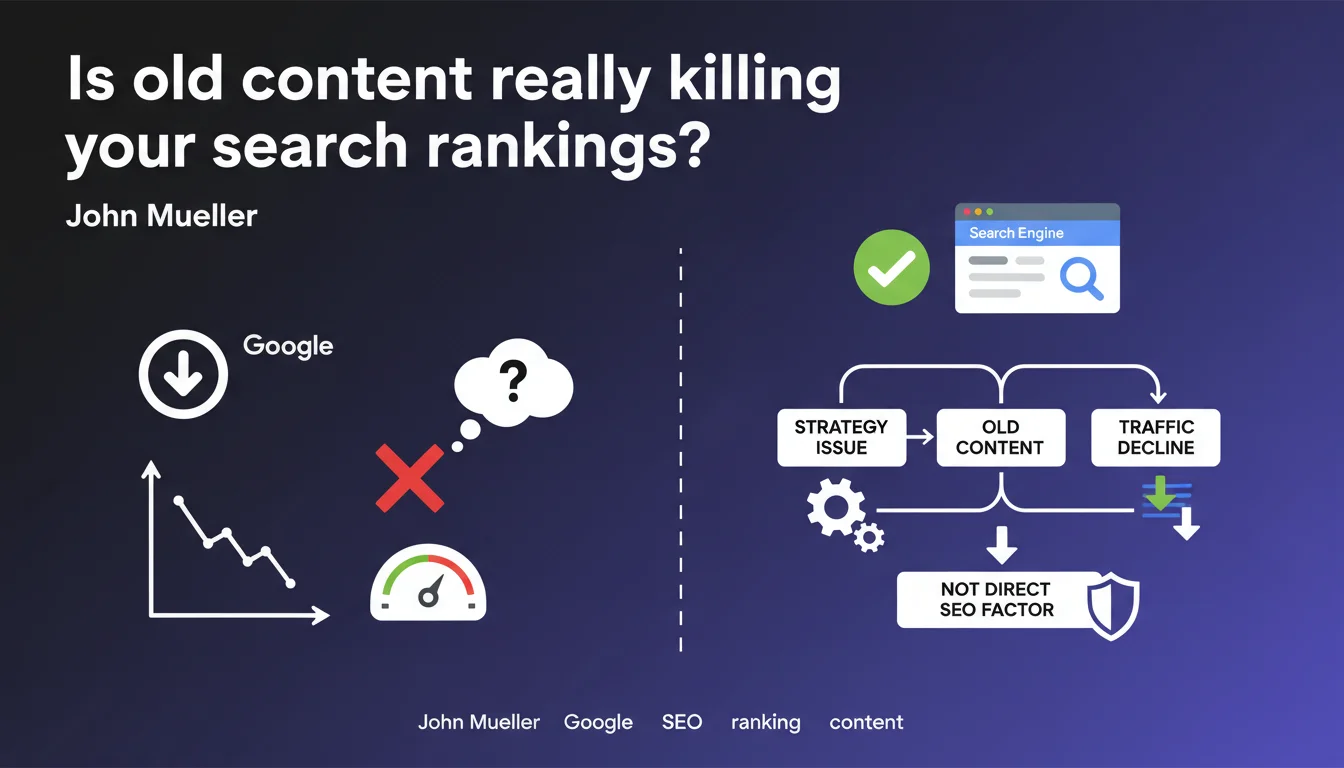
Google states it does not directly penalize old content. The drop in traffic on older pages is more about strategic factors (relevance, evolving user intent) than an algorithmic penalty tied to publication date. In other words: it's the lack of relevance that kills, not the age.
What you need to understand
Does Google apply a time-based filter to content?
No, according to Mueller. No algorithm demotes content simply because it was published 5 or 10 years ago. The idea that an aging article mechanically loses its rankings solely due to its publication date is a myth.
That said, Google does favor perceived freshness when it's relevant to the query. If a user searches "iPhone 15 review," a 2020 article about the iPhone 11 simply won't match their intent — but that's a relevance problem, not an age problem.
Why are my old pages losing traffic then?
The reasons are multiple, and rarely tied to a direct algorithmic penalty. Search intent evolves: what was searched yesterday isn't searched the same way today. Queries shift, competitors publish better content, algorithms refine themselves.
Old content can also suffer from a lack of indirect freshness signals: fewer backlinks, lower click-through rates (CTR declining), reduced user engagement. These behavioral signals impact rankings, even if the publication date itself doesn't matter.
What's the difference between "old" and "obsolete"?
Old = published a long time ago. Obsolete = no longer answers current intent. Google doesn't punish the old, it ignores the obsolete. An evergreen guide on a stable concept (e.g., "How to Calculate Bounce Rate") can rank for 10 years without major updates.
Conversely, an article on "SEO Strategies 2018" is obsolete by 2019 — not because it's old, but because the information is outdated and nobody searches for it in that form.
- Google doesn't automatically demote old content
- Traffic decline often reflects an evolution in user intent
- Relevance > Publication date
- Indirect signals (backlinks, CTR, engagement) matter more than date
- Critical distinction: old ≠ obsolete
SEO Expert opinion
Is this statement consistent with real-world observations?
Yes and no. On the purely technical side, the statement holds: there's no "publication date" variable found being used as a direct demotion factor in patents or documented case studies. A/B tests show that simply changing a date without substantive updates doesn't change rankings.
But — and this is where it gets thorny — Google clearly prioritizes freshness on QDF queries (Query Deserves Freshness): news, recent products, regulatory changes. On these verticals, old content mechanically loses ground, even if it remains factually correct. So "no penalty" technically, but functional loss of visibility all the same.
What nuances should be added to this position?
Mueller speaks of a "direct SEO factor," which is careful wording. Indirect factors linked to age are legion: CTR degradation (snippets less appealing against refreshed competitors), erosion of link profile (backlinks age, some disappear), loss of semantic co-occurrences with new entities.
Another blind spot: Google says nothing about the relative weight of freshness in all ranking signals. Granted, it's not "a direct ranking factor," but that doesn't mean freshness doesn't count — it does, especially on evolving topics. [To verify]: what is the exact weighting of freshness in the overall algorithm? Google obviously won't disclose that.
In what cases does this rule not apply?
On YMYL verticals (finance, health, legal), freshness becomes critical even if the substance barely changes. A 2015 article on mortgage rates will be ignored, even if it remains mathematically correct, because the user is explicitly seeking recent information.
Same applies to anything touching products, software, regulations. A tutorial on Photoshop CS5? Dead. An unfunded tax guide from 3 years ago? Invisible. Not because Google penalizes it, but because nobody clicks it, and Google learns quickly not to surface it.
Practical impact and recommendations
Do I absolutely need to refresh all my old content?
No, it's a waste of resources. Prioritize based on business potential and measured degradation. An article still generating stable, qualified traffic doesn't need to be touched just to display a recent date. That's wasted effort.
However, if you spot traffic erosion on historically high-performing pages, that's a signal. First, analyze intent: has the query evolved? Are competitor results now more comprehensive, better structured, or simply newer on an evolving topic?
What mistakes should you avoid when refreshing content?
The classic mistake: updating only the publication date without touching the substance. Google sees through this, and more importantly, it adds nothing for the user. If you're updating, do it properly: add recent data, fill gaps, improve structure, enrich visuals.
Another trap: trying to update everything at once. Better to identify the 20% of pages generating 80% of old traffic, and treat those in depth. The rest can wait, or even be deprioritized or consolidated.
How do you verify that an update actually had an impact?
Use Search Console to compare impressions and clicks before/after the update, isolating the post-crawl period (wait at least 2-3 weeks). If CTR rises, it's often because the snippet became more appealing or Google is repositioning you on query variants.
Also monitor session duration and bounce rate via GA4. Refreshed content should engage more. If it doesn't, either the update was cosmetic, or user intent has fundamentally shifted and you need to pivot the content, not just refresh it.
- Audit old pages with >30% traffic drop over 12 months
- Check if search intent has evolved (analyze current SERP)
- Prioritize pages with strong business potential or historical performance
- Update in depth: recent data, improved structure, factual enrichment
- Never change only the date without updating content
- Measure post-crawl impact: impressions, CTR, user engagement
- Consider consolidating similar/obsolete pages rather than individual updates
❓ Frequently Asked Questions
Dois-je systématiquement afficher la date de dernière mise à jour sur mes articles ?
Modifier la date de publication sans toucher au contenu a-t-il un effet SEO ?
Un contenu ancien bien positionné doit-il quand même être mis à jour ?
Les pages sans trafic depuis 2 ans doivent-elles être supprimées ?
Google favorise-t-il les sites qui publient régulièrement du contenu neuf ?
🎥 From the same video 11
Other SEO insights extracted from this same Google Search Central video · published on 09/05/2024
🎥 Watch the full video on YouTube →
💬 Comments (0)
Be the first to comment.