
Official statement
Other statements from this video 11 ▾
- □ Le contenu ancien pénalise-t-il vraiment votre référencement ?
- □ Le contenu ancien peut-il encore se classer malgré son âge ?
- □ Faut-il vraiment corriger les liens cassés dans vos contenus anciens ?
- □ Faut-il vraiment ajouter des bannières d'avertissement sur vos contenus anciens ?
- □ Faut-il vraiment mettre à jour tous vos anciens contenus pour le SEO ?
- □ Faut-il vraiment laisser vos vieux articles avec leurs erreurs d'origine ?
- □ Faut-il vraiment supprimer le contenu obsolète plutôt que de le marquer comme déprécié ?
- □ Pourquoi utiliser la balise canonical comme redirection est-il une erreur SEO majeure ?
- □ Pourquoi Google déconseille-t-il les crypto-redirects pour vos migrations de sites ?
- □ Faut-il vraiment arrêter d'ajouter des dates dans les titres pour paraître frais ?
- □ Faut-il rediriger ou créer une page explicative quand on supprime un outil ?
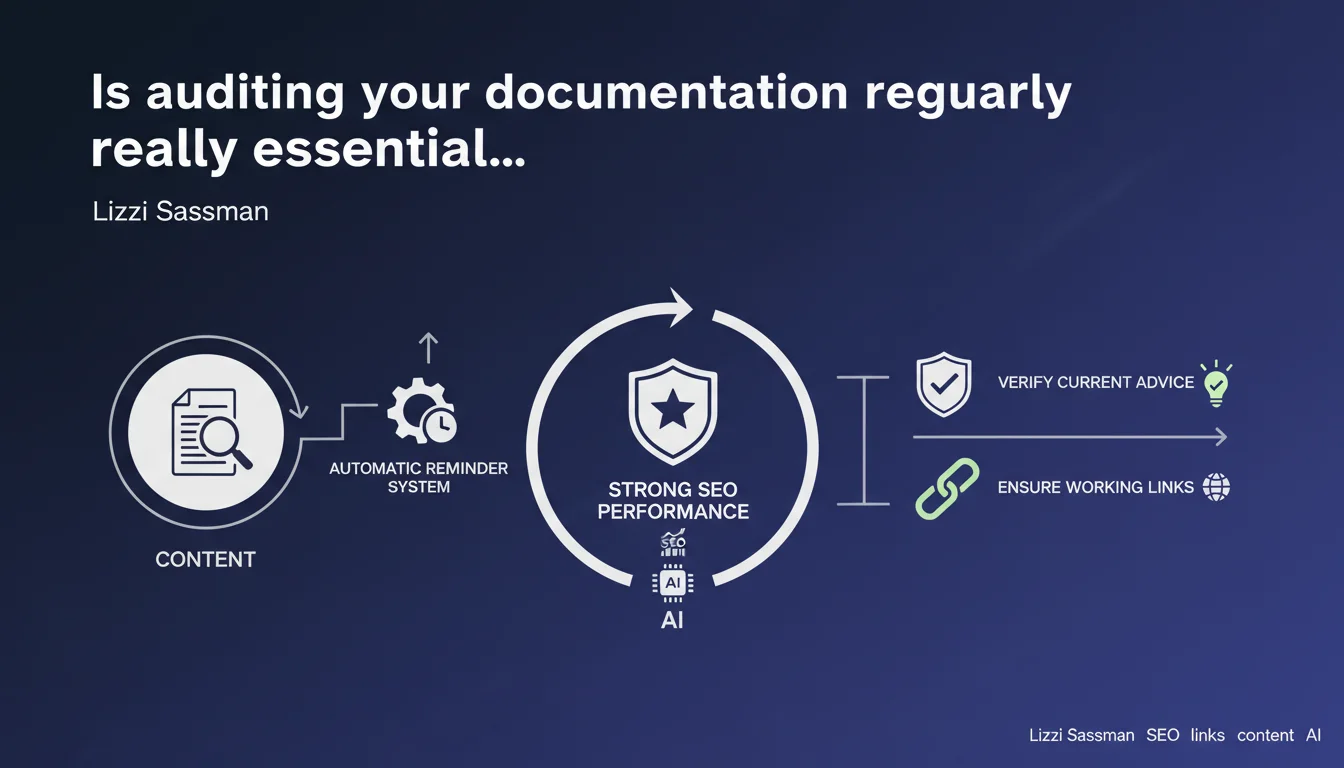
Google recommends implementing automated audit systems to periodically verify that existing content remains relevant and that links function correctly. The goal: maintain content freshness, a quality signal that the algorithm closely monitors.
What you need to understand
Why does Google insist on regular content auditing?
Content freshness isn't an SEO myth. Google evaluates the temporal relevance of pages, particularly on evolving topics or technical documentation. Obsolete content, broken links, outdated advice — all of this degrades user experience and, mechanically, the quality signals that Google picks up on.
Lizzi Sassman is talking about an automated reminder system here. Not sporadic manual reviews when you think about it, but an industrial logic: fixed schedule, documented process, dedicated tools. That's the difference between maintaining 50 pages and managing 5,000.
What sets an effective content audit apart from a simple review?
An audit is structured and measurable. You don't review randomly: you verify specific criteria (data timeliness, validity of internal/external links, consistency with product updates, alignment with current search queries).
Automated systems allow you to trigger these verifications based on a frequency suited to the type of content. A page about a product feature evolving every quarter requires a different audit cycle than a stable methodological guide.
What concrete signals does Google monitor on aging content?
The bounce rate, time spent on page, organic CTR that plummets — all indicators that the content no longer meets expectations. Broken links send a signal of editorial neglect. Outdated information generates negative user feedback or community corrections.
Google doesn't read the publication date alone. It analyzes user behaviors and signals of active editorial maintenance. Content regularly updated with substantial modifications stays competitive.
- Content freshness is a measurable quality criterion for Google via user behaviors
- An automated audit system structures editorial maintenance at scale
- Broken links and obsolete information directly degrade user experience signals
- Effective auditing relies on precise criteria and frequency suited to content type
SEO Expert opinion
Is this recommendation truly a priority in an SEO strategy?
Let's be honest: auditing existing documentation often comes after producing new content. Yet, this is an allocation error. A well-ranked page that loses 30% of traffic due to obsolescence costs more than it generates.
The real issue is about trade-offs. On a 10,000-page site, auditing everything every quarter is unrealistic. You need to segment by criticality: pages generating revenue, pillar content, areas with high product obsolescence. Everything else can wait.
What tools allow you to concretely automate these audits?
Google deliberately stays vague on the "how." [To verify] but in practice, it involves CMS with editorial workflow (automatic reminders based on last modification date), crawlers like Screaming Frog or OnCrawl configured for recurring monitoring, custom scripts that match URLs with Analytics data to detect performance drops.
The problem — and Google doesn't say this — is that these systems require mature technical and editorial infrastructure. For many sites, the barrier isn't the idea but the operational capacity to execute it.
In what cases is this regular audit logic counterproductive?
On stable evergreen content (timeless methodological guides, conceptual definitions), quarterly audits are wasted time. Worse: modifying for the sake of modifying risks breaking stability signals that Google values on certain topics.
Audits should be triggered by a signal — traffic drop, product update, evolution of user queries — not by a blind schedule. Regularity shouldn't become dogma.
Practical impact and recommendations
How do you structure an operational content audit system?
First step: map content by criticality. Segment 1 (revenue/conversion pages): monthly audit. Segment 2 (high organic traffic pages): quarterly. Segment 3 (everything else): semi-annual or trigger-based (performance alert).
Next, define audit criteria — not a generic checklist but KPIs suited to page type. For a product sheet: price, availability, technical specs. For a guide: relevance of examples, validity of external links, alignment with current search queries.
What technical pitfalls should you avoid when implementing?
Don't confuse auditing with automatic republishing. Some CMS republish content without substantial modification just to "refresh" the date — Google sees through this. Modifications must be real and add value.
Another pitfall: auditing without prioritizing corrections. A report of 500 broken links is useless if nobody has time to fix them. Better to automate detection AND correction workflows (automatic assignment, criticality-based SLA).
What should you measure to evaluate audit effectiveness?
The only KPI that matters: the traffic/conversion impact of audited pages. Compare performance before/after corrections on a cohort of pages. If the audit doesn't generate measurable recovery, the process needs rethinking.
Also monitor the rate of obsolete pages detected vs corrected. A large gap signals an operational capacity problem, not a detection problem.
- Segment content by criticality and define appropriate audit frequencies
- Establish precise audit criteria by page type (no generic checklist)
- Automate both detection AND correction workflows (assignment, SLA)
- Modify only if the correction adds real user value
- Measure traffic/conversion impact of audited pages to validate process effectiveness
- Monitor detection vs correction rate to identify operational bottlenecks
❓ Frequently Asked Questions
Quelle fréquence d'audit est recommandée pour du contenu technique ou produit ?
Un simple changement de date de publication suffit-il à signaler de la fraîcheur à Google ?
Faut-il auditer les pages qui ne génèrent plus de trafic organique ?
Quels outils permettent de détecter automatiquement les contenus obsolètes ?
Comment prioriser les corrections après un audit de plusieurs centaines de pages ?
🎥 From the same video 11
Other SEO insights extracted from this same Google Search Central video · published on 09/05/2024
🎥 Watch the full video on YouTube →
💬 Comments (0)
Be the first to comment.