
Official statement
Other statements from this video 11 ▾
- □ Le contenu ancien pénalise-t-il vraiment votre référencement ?
- □ Faut-il vraiment corriger les liens cassés dans vos contenus anciens ?
- □ Faut-il vraiment ajouter des bannières d'avertissement sur vos contenus anciens ?
- □ Faut-il vraiment mettre à jour tous vos anciens contenus pour le SEO ?
- □ Faut-il vraiment laisser vos vieux articles avec leurs erreurs d'origine ?
- □ Faut-il vraiment supprimer le contenu obsolète plutôt que de le marquer comme déprécié ?
- □ Pourquoi utiliser la balise canonical comme redirection est-il une erreur SEO majeure ?
- □ Pourquoi Google déconseille-t-il les crypto-redirects pour vos migrations de sites ?
- □ Faut-il vraiment arrêter d'ajouter des dates dans les titres pour paraître frais ?
- □ Faut-il rediriger ou créer une page explicative quand on supprime un outil ?
- □ Faut-il vraiment auditer régulièrement sa documentation pour rester performant en SEO ?
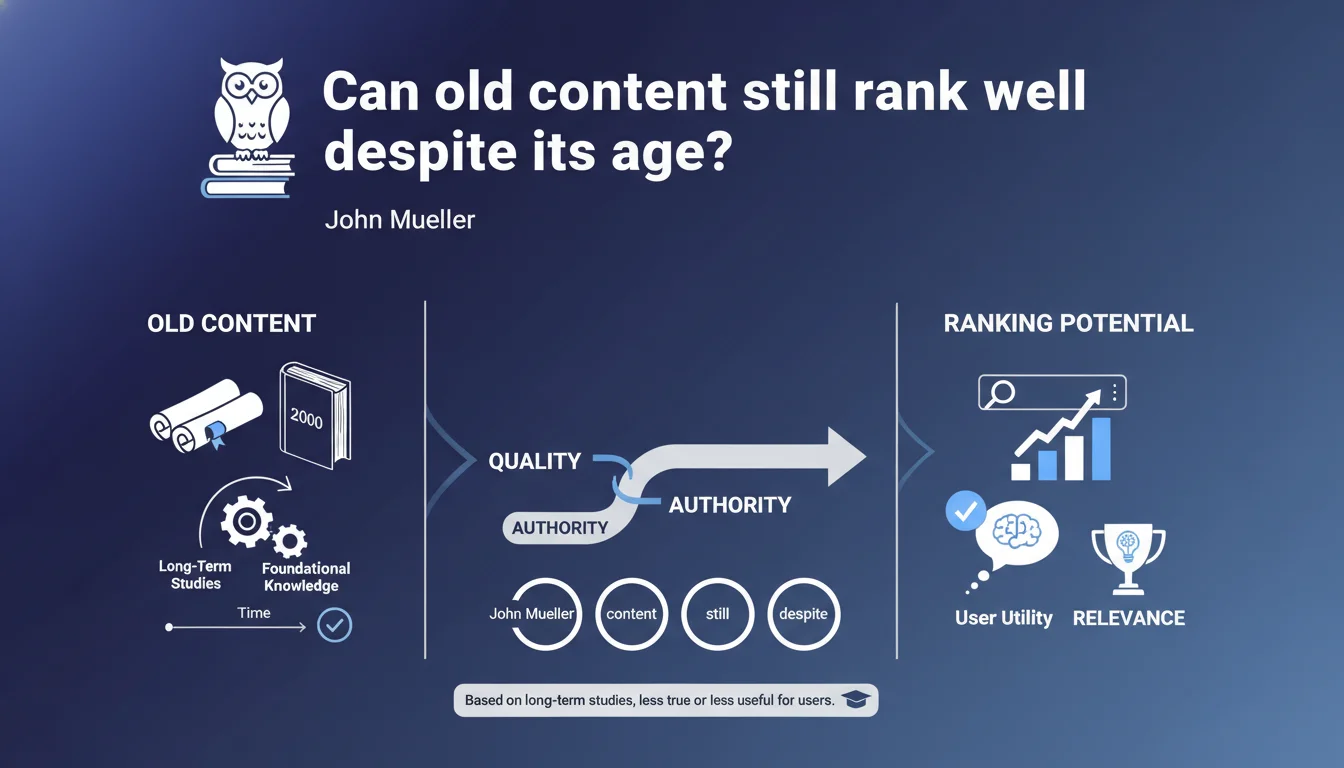
Google confirms that the age of content is not in itself a delisting criterion. Reference or academic content, often based on long-term studies, retains its relevance despite its publication date. Freshness is therefore not a universal signal of quality.
What you need to understand
Why does Google clarify that old isn't necessarily bad?
This statement comes in a context where many SEOs worry about seeing their dated content lose visibility. The shortcut "old content = obsolete content" has become entrenched in people's minds, particularly since algorithmic updates that favor freshness for certain queries.
Mueller clarifies here a reality often forgotten: certain types of content — academic, scientific, reference — derive their value precisely from their temporal stability. A study published ten years ago does not become false because it is ten years old. It remains true if the method and conclusions remain valid.
What is "reference content" according to Google?
Google does not provide a strict definition, but the term refers to resources that hold authority in a field: academic publications, methodological guides, specialized encyclopedias, longitudinal studies. These contents have a claim to timelessness or longevity.
The nuance is important: not all old content is reference content. A blog post on "SEO trends 2018" does not receive the same treatment as research published on the fundamentals of the PageRank algorithm.
How does Google distinguish between necessary freshness and acceptable permanence?
Google analyzes the type of query and user intent. For "election results," freshness is critical. For "theory of relativity," it is not. The algorithm likely evaluates the lexical field, click history, and the nature of indexed content.
But it remains unclear on the precise signals that qualify content as "reference." No specific metadata is mentioned, no recommended data structure. The criterion appears contextual and likely based on E-E-A-T signals and the editorial consistency of the site.
- The age of content is not an automatic delisting criterion
- Google differentiates content based on its nature: news vs. reference
- Academic and scientific content escape the freshness imperative
- The relevance of content depends on search intent, not solely on its date
- No clear technical signal is communicated to "mark" content as permanent
SEO Expert opinion
Is this statement consistent with what we observe in the field?
Yes and no. On one hand, we do see old content ranking well on stable informational queries: technical guides, definitions, methodological resources. Wikipedia is the perfect example — pages dating from 2005 continue to dominate certain SERPs.
On the other hand, many sites experience a gradual decline in positions for content that is not updated, including on topics not subject to news cycles. Freshness appears to function as an implicit trust signal, even when it is not strictly necessary. [To verify]: does Google really penalize the old, or do competitors simply produce better and more recently?
What nuances should be added to this statement?
Let's be honest: Mueller talks about "reference" or "academic" content. But how many SEO sites actually produce this type of content? The majority of web content does not fall into this category. It is informative but not permanent, factual but not scientific.
The risk is interpreting this statement as a blank check to let your content age without intervention. Yet even "reference" content can become partially obsolete if standards evolve, if new research emerges, if examples become dated. The line is fine between "timeless" and "frozen."
And that's where it gets tricky: Google does not say how it differentiates old content that is still valid from old content that has become hollow. No metrics, no signals. We remain in the dark.
In what cases does this rule not apply?
Any content linked to strong temporality is excluded. News, events, trends, emerging technologies, regulations, evolving numerical data. On these subjects, freshness is a direct relevance criterion, not a bonus.
But even on "stable" content, competition plays a role. If three competitors update their technical guide and you don't, you lose in comparative engagement signals — and likely in positions. Age may be tolerated by Google, but it is rarely rewarded.
Practical impact and recommendations
What should you concretely do with your old content?
Start by auditing your existing corpus. Segment your content by nature: news, technical tutorial, in-depth study, definition, case analysis. Identify those with a claim to permanence and those that are necessarily perishable.
For "reference" content, verify it remains factually accurate. A study remains valid, but if cited examples or tools are obsolete, the reader perceives a gap. Update the contextualizations without touching the substance if it remains solid.
For standard informative content, test a strategic refreshment logic: add a recent section, update numerical data, enrich with new sources. Even a minor addition can reactivate freshness signals without rewriting entirely.
What mistakes should you avoid at all costs?
Do not change the publication date to simulate freshness without real updating. Google detects these manipulations through content analysis and indexing history. You lose in editorial credibility — and potentially in ranking if the algorithm detects an inconsistency.
Also avoid rewriting everything reflexively. Old content that ranks well and still performs does not need a complete overhaul. Sometimes, simple consolidation or targeted enrichment is enough. Rewriting can break established signals — internal anchors, contextual backlinks, click history.
And above all, do not rely on this statement to justify inaction. "Google says old can be good" does not mean "I can leave my content unwatched." Competitive monitoring remains decisive.
How can you verify that your site is correctly positioned on this subject?
Analyze the traffic curves of your old content. A gradual decline without loss of SERP positions can indicate a CTR or engagement problem — the content is aging poorly even if Google still tolerates it. A sharp drop in positions on stable queries signals a competitiveness or perceived quality issue.
Compare your old content with what currently ranks in the top 3. If competitors systematically add updated sections, recent examples, fresh data, it is a signal that the algorithm values this freshness — even on a "stable" topic.
- Segment content by temporality and nature
- Verify the factual validity of old content classified as "reference"
- Update contextualizations and examples without rewriting the substance if it remains valid
- Test strategic refreshment on standard informative content
- Never manipulate publication date without real updating
- Monitor traffic and position evolution on old content
- Compare with competitor content to detect freshness gaps being valued
❓ Frequently Asked Questions
Google pénalise-t-il les contenus datés de plusieurs années ?
Faut-il systématiquement mettre à jour la date de publication d'un article remanié ?
Un contenu académique ou scientifique bénéficie-t-il d'un traitement spécifique par l'algorithme ?
Comment savoir si mon contenu ancien est encore compétitif ?
La fraîcheur du contenu est-elle toujours un signal de ranking ?
🎥 From the same video 11
Other SEO insights extracted from this same Google Search Central video · published on 09/05/2024
🎥 Watch the full video on YouTube →
💬 Comments (0)
Be the first to comment.