
Official statement
Other statements from this video 8 ▾
- □ Do you really need to optimize your site differently for AI Overviews and AI Mode?
- □ Do you really need to overhaul your SEO strategy for Google's AI features?
- □ Do clicks from AI Overviews actually convert better?
- □ Do AI Overviews really drive traffic to a wider range of websites?
- □ Why does Google really obsess over 'unique value' in content?
- □ Will Search Console's Core Web Vitals recommendations finally make a real difference?
- □ Is the robots.txt file really still useful for controlling AI crawler access in 2024?
- □ Is log analysis really the SEO skill that will outlast everything else?
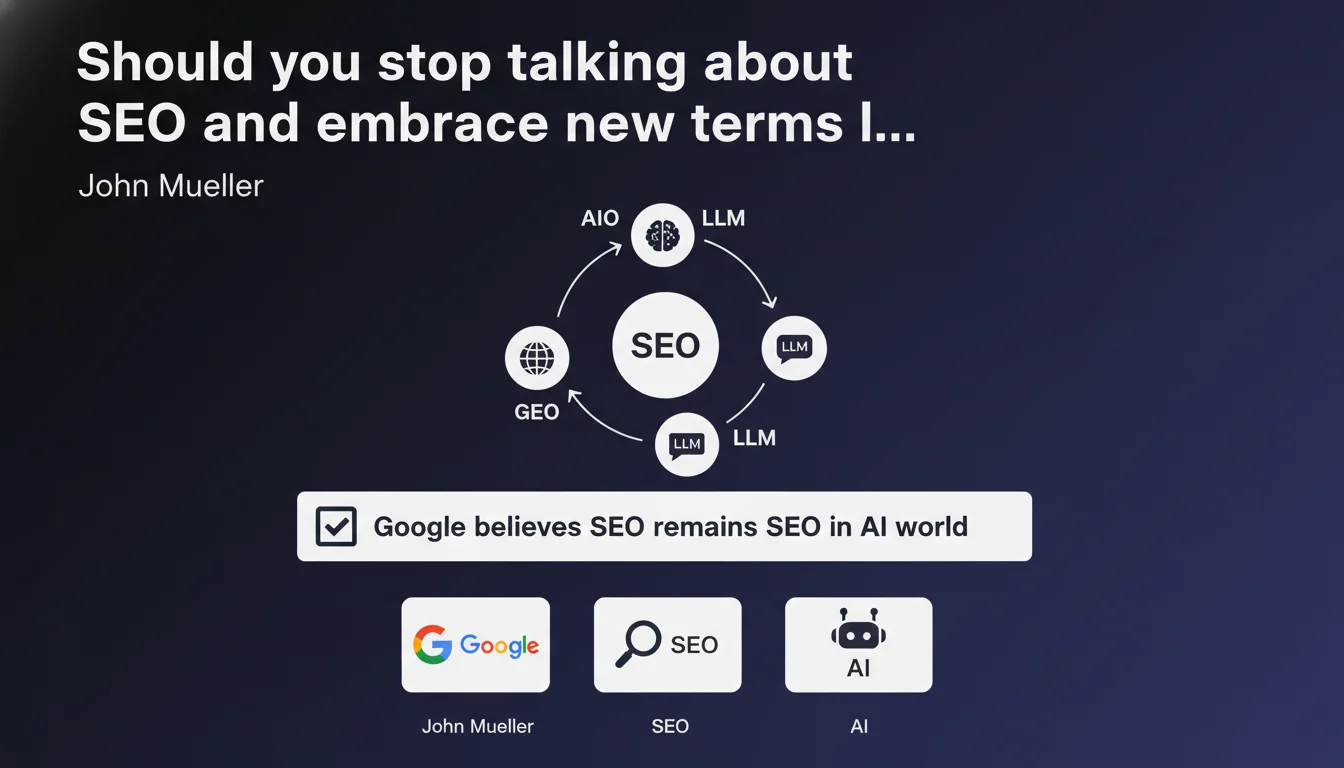
Google refuses the idea of rebranding SEO despite the arrival of generative AI. John Mueller confirms that the term "SEO" remains relevant and there is no strategic reason to switch to acronyms like AIO (AI Optimization), GEO (Generative Engine Optimization), or LLM optimization. Search engine optimization is still search engine optimization, even if techniques continue to evolve.
What you need to understand
Why is Google insisting on keeping the term "SEO"?
The proliferation of new terms — AIO, GEO, LLM optimization — reflects collective anxiety about generative AI arriving in search results. Some consultants and agencies have tried to create a new market by inventing separate disciplines, believing that optimizing for AI Overviews or generative engines required new vocabulary.
Google sweeps away this fragmentation. The message is clear: search engine optimization remains a single discipline, regardless of whether displayed results are classic blue links, featured snippets, or AI-generated answers. The fundamental objective — making your content visible and relevant in search results — doesn't change.
Does this mean no new skills are required?
No. Google's position doesn't mean techniques remain frozen. The arrival of AI Overviews and generative systems does effectively change how content must be structured: increased clarity, strong semantic structuring, relevant schema.org markup.
But these evolutions fit within the continuity of classic SEO. Optimizing for AI is essentially pushing further the principles already established: answering search intent precisely, structuring information logically, providing verifiable factual answers.
What are the risks of this terminological fragmentation?
Multiplying terms creates unnecessary confusion. Companies start wondering if their current SEO strategy is obsolete, whether they need to hire distinct "AIO" profiles, whether their budget should be redistributed across multiple disciplines.
This fragmentation primarily benefits those selling consulting services. For practitioners, it blurs priorities. A site well optimized for users and classic engines will also be well positioned to be cited in AI-generated answers — because the underlying criteria remain identical.
- SEO doesn't change its name despite generative AI's arrival in search results.
- Fundamental principles remain valid: relevance, clarity, structure.
- New terms like AIO or GEO create unnecessary fragmentation that primarily benefits agency marketing.
- No separate discipline is necessary — it's a continuous evolution of search engine optimization.
SEO Expert opinion
Is this statement consistent with what we observe in the field?
Yes and no. Google is right on substance: sites that perform well in AI Overviews are generally those that already performed well in classic SEO. Structured content, topical authority, clean markup — nothing revolutionary.
But minimizing the impact of changes is somewhat convenient. AI Overviews radically change traffic distribution: a generated answer might cite three sources instead of directing users to ten organic results. The CTR of classic positions mechanically drops when an AI answer appears at the top of the page. Saying that "nothing changes" obscures this economic upheaval for publishers.
What nuances should be added to this position?
Mueller's statement is technically correct but strategically incomplete. Yes, SEO remains SEO. But certain specific tactics are emerging to maximize the chances of being cited in a generated answer: explicit question-answer format, short factual definitions at the beginning of sections, structured data tables.
These adjustments may not deserve a new acronym, but they require particular attention. [To verify]: Google has never publicly detailed the exact criteria for selecting sources cited in AI Overviews — we're still working largely through empirical observation.
In what cases does this unified vision of SEO pose problems?
For sites heavily dependent on informational traffic, believing that "nothing changes" is dangerous. If your business model relies on articles like "How to do X?" or "What is Y?", you're on the front lines of disruption caused by generative AI.
In these cases, a defensive approach is necessary: diversify content types, strengthen content with high human added value (analyses, testimonials, detailed comparisons), focus on conversion on-site rather than relying solely on click volume. SEO remains SEO, certainly — but your editorial strategy must evolve faster than ever.
Practical impact and recommendations
What should you do concretely in response to this statement?
Don't change your internal processes just to follow a terminological trend. If an agency proposes a separate "AIO" audit from your classic SEO audit, ask how the recommendations concretely differ. Often, they're the same optimizations rebranded.
Focus on fundamentals that work in all cases: structured content, relevant schema.org markup, clear answers to user intent. These optimizations benefit both classic search optimization and visibility in AI-generated answers.
What mistakes should you avoid in this context?
First mistake: panic and overhaul your entire strategy thinking traditional SEO is dead. It's not. Organic links continue to generate massive traffic, and Google itself confirms that principles remain valid.
Second mistake: completely ignore the evolution under the guise that "SEO remains SEO". AI Overviews change the game on certain queries. Monitor your metrics, identify queries where you're losing clicks to AI answers, adjust your content accordingly.
How can you verify your site is well positioned for the generative AI era?
First check whether your pages appear as sources in AI Overviews when they're displayed. Search for your target keywords in private browsing, see if Google cites your content in its generated answers.
Next, analyze your content structure: favor inverted pyramid formats (direct answer first, details after), use descriptive headings, integrate clear definitions and easily extractable factual data.
- Maintain your classic SEO efforts: technical, content, link building.
- Strengthen your content structure with logical heading tags and adapted schema.org.
- Adopt explicit question-answer formats for informational content.
- Monitor your impressions and CTR in Search Console, especially on queries where AI Overviews appear.
- Diversify your content types so you're not relying solely on simple informational queries.
- Regularly test your target keywords to observe whether you're cited in AI answers.
❓ Frequently Asked Questions
Le terme « AIO » (AI Optimization) a-t-il un sens distinct du SEO ?
Faut-il adapter son contenu spécifiquement pour les AI Overviews ?
Les AI Overviews vont-ils tuer le trafic organique traditionnel ?
Google donne-t-il des critères précis pour être cité dans les AI Overviews ?
Dois-je recruter un profil « AIO specialist » distinct de mon SEO actuel ?
🎥 From the same video 8
Other SEO insights extracted from this same Google Search Central video · published on 01/07/2025
🎥 Watch the full video on YouTube →
💬 Comments (0)
Be the first to comment.