
Official statement
What you need to understand
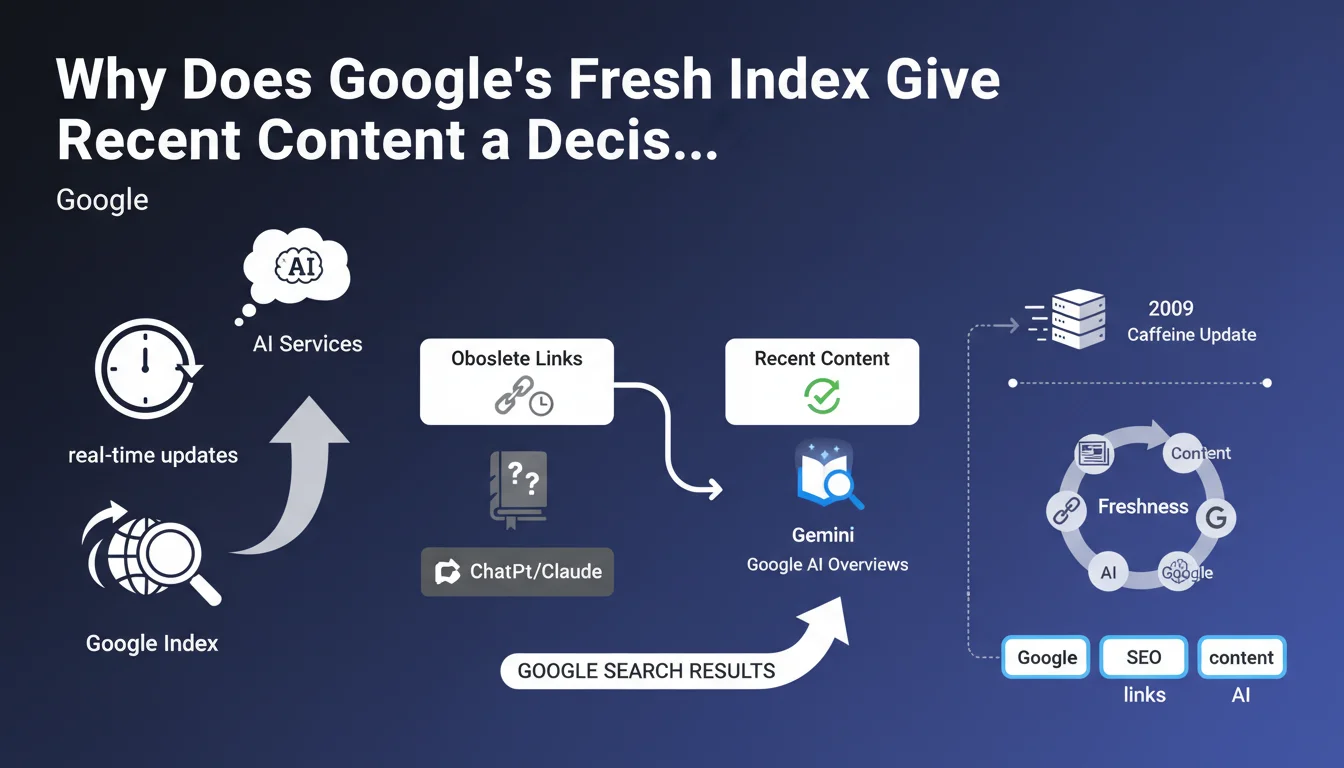
Google asserts that the freshness of its index constitutes a major asset for its artificial intelligence services, particularly Gemini and AI Overviews. Unlike closed language models that operate with static data, Google updates its index in real time.
This ability to index and exploit fresh content is not new: it dates back to the Caffeine update of 2009, but takes on a strategic dimension with the rise of generative AI. Google can thus provide answers based on up-to-date information rather than on obsolete data.
For SEO practitioners, this statement confirms that content freshness remains a quality signal taken into account by the algorithm, particularly in sectors where current events and temporal relevance are essential.
- Google's index is updated in real time, unlike closed LLMs
- This freshness directly feeds AI Overviews and Gemini
- The Caffeine update (2009) laid the foundation for this infrastructure
- Recent and updated content benefits from a competitive advantage in results
- This dimension takes on increased importance with the integration of AI into SERPs
SEO Expert opinion
This statement is perfectly consistent with the field observations of SEO practitioners for years. Freshness has always been a ranking factor, particularly for QDF (Query Deserves Freshness) queries related to current events, trends, or time-sensitive information.
However, it must be nuanced: not all content requires constant freshness. Evergreen pages (comprehensive guides, definitions, fundamental tutorials) can perform sustainably without frequent updates if their intrinsic quality is high. Over-optimization for freshness can even dilute relevance.
Caution: Artificially modifying publication dates or making cosmetic updates without real added value can be counterproductive. Google evaluates the substance of changes, not just the timestamp.
The emergence of AI Overviews changes the game: fresh content now has two visibility opportunities (classic results + AI snippets). This reinforces the value of a dynamic editorial strategy for current events sectors.
Practical impact and recommendations
- Identify your time-sensitive content: news, trends, statistical data, regulations, evolving technologies
- Establish an update calendar to regularly refresh your strategic content with new information, examples, or statistics
- Use publication and modification dates in your structured data (schema.org) to signal freshness
- Create a visible "Last Updated" section for users and search engines
- Develop industry monitoring to quickly integrate new relevant information into your existing content
- Prioritize substance: add genuinely useful content, not just superficial modifications
- Monitor AI Overviews on your target queries to identify positioning opportunities
- Avoid date manipulation without substantial content modification
- Maintain your evergreen content without forcing artificial freshness if it remains relevant
Google's index freshness represents a real competitive advantage, particularly with the rise of AI Overviews. A balanced strategy combines quality evergreen content and regular updates of time-sensitive pages.
Implementing a dynamic content strategy requires resources, rigorous methodology, and a fine understanding of freshness signals. For companies wanting to optimize this dimension without mobilizing their internal teams, support from a specialized SEO agency can prove judicious for structuring a personalized and sustainable approach.
💬 Comments (0)
Be the first to comment.