
Official statement
Other statements from this video 8 ▾
- □ Faut-il optimiser son site différemment pour AI Overviews et AI Mode ?
- □ Faut-il adapter sa stratégie SEO pour les fonctionnalités IA de Google ?
- □ Les AI Overviews favorisent-elles vraiment une plus grande diversité de sites ?
- □ Pourquoi Google insiste-t-il autant sur la « valeur unique » du contenu ?
- □ Les recommandations Search Console sur Core Web Vitals vont-elles enfin servir à quelque chose ?
- □ Le fichier robots.txt reste-t-il vraiment utile pour contrôler le crawl des IA ?
- □ L'analyse des logs est-elle vraiment la compétence SEO qui survivra à tout ?
- □ Faut-il arrêter de parler de SEO et adopter les nouveaux termes AIO, GEO ou optimisation pour LLM ?
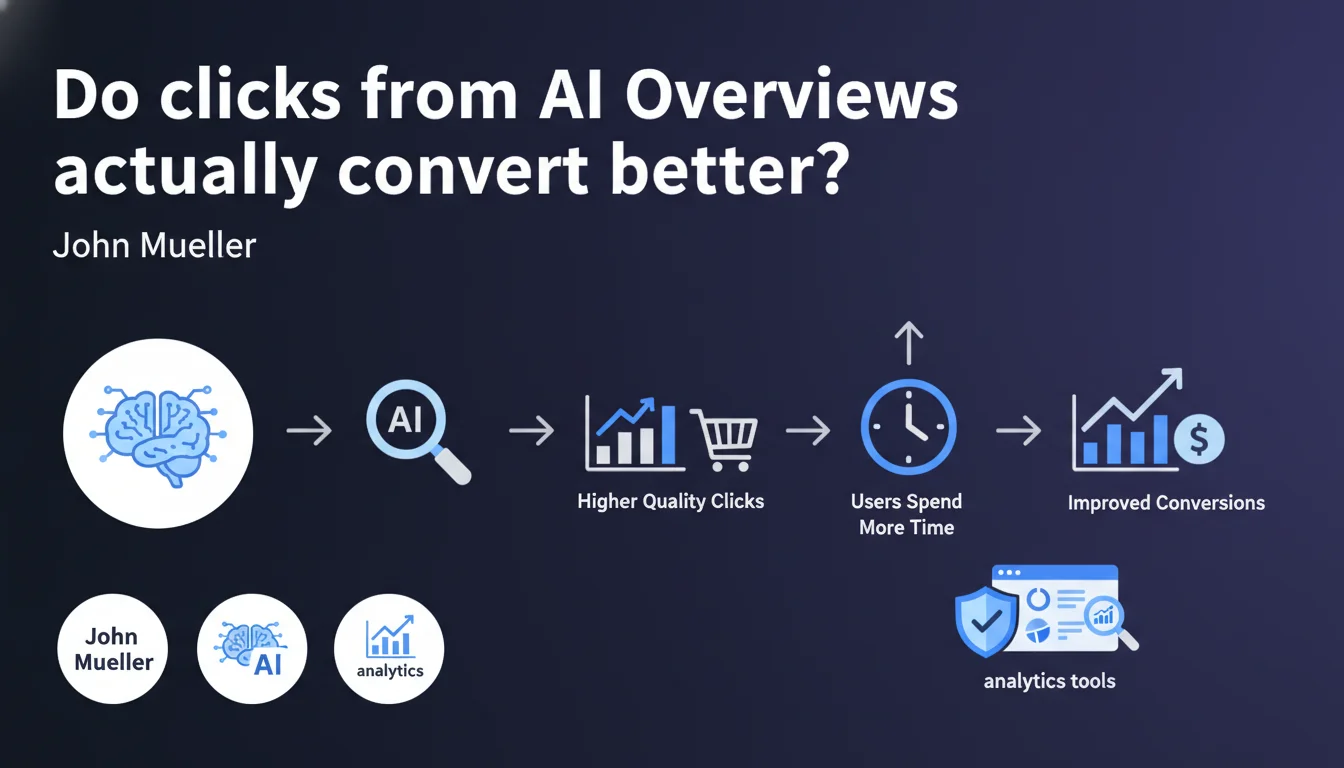
Google claims that users who click from AI Overviews spend more time on sites and generate better conversions. A strong signal that these clicks are qualified — but one that deserves verification in your own analytics before celebrating.
What you need to understand
Why does Google emphasize quality over volume?
Because since the rollout of AI Overviews, the main complaint from publishers has been straightforward: fewer organic clicks. Google responds by shifting the debate toward quality rather than quantity.
The argument is appealing — one click that converts is worth more than ten bounce visits. But there's a subtext: if volume drops but quality rises, Google can argue that the net impact is neutral, even positive. Let's be honest, this rhetoric looks like preemptive defense.
What is a higher-quality click according to Google?
Google cites two metrics: time spent on site and conversion rate. The underlying idea is that the user arrives with better-qualified intent — the AI Overview having filtered or clarified their query upstream.
Concretely? A user who clicks after reading an AI summary would theoretically be better informed about what they'll find, thus less likely to bounce immediately. It's a hypothesis that holds water — but one that requires field validation.
What are the implications for overall organic traffic?
If clicks drop in volume but rise in quality, revenue per visitor should mechanically increase. The question remains whether the gain compensates for the drop. For a site monetized through display advertising, it's a disaster. For an e-commerce or SaaS business, it's potentially neutral or positive.
The problem is that this qualitative improvement isn't uniform. Some sectors see their clicks evaporate without measurable compensation. Others actually observe funnel improvements. It all depends on the query type and position occupied in the AI Overview.
- Click volume: can drop significantly depending on sectors
- Time on site: Google claims measurable increase
- Conversion rate: improvement observed on some sites, not all
- Net impact: highly variable depending on the site's business model
- Source visibility: depends on attribution in the AI Overview
SEO Expert opinion
Is this claim verifiable through real-world data?
Yes and no. Several sites have indeed reported an improvement in conversion rate and engagement on sessions from SERPs with AI Overviews. But — and this is crucial — these gains are far from universal.
The sites that benefit most are those appearing in direct attribution within the AI Overview. For others, stuck in positions 4-10 under a big AI block, the finding is opposite: fewer clicks, no perceptible qualitative improvement. [To verify] in your own analytics by segmenting traffic by SERP type.
What are the weaknesses of this claim?
Google provides no precise figures. No benchmarks, no sector averages, no detailed measurement methodology. "Some sites may observe" is a prudently evasive formulation.
Another issue: Google doesn't distinguish between query types. A navigational query already ultra-qualified has little to gain from an AI Overview. A complex informational query, perhaps. But again, everything depends on your positioning within the generated answer.
Finally, there's an obvious selection bias: sites that report gains are those that maintained or gained visibility in AI Overviews. The losers see no qualitative improvement — they've simply lost traffic. Period.
What strategy should you adopt facing this shift?
If you're already well-positioned in AI Overviews, leverage this lever. Optimize to be cited: clear structure, verifiable facts, FAQ format, appropriate Schema.org.
If you're invisible in these AI blocks, don't expect miraculous qualitative compensation. You're losing traffic, that's it. You then need to rethink your editorial strategy to appear in cited sources — or pivot toward queries less affected by AI Overviews.
Practical impact and recommendations
How do you concretely measure the impact of AI Overviews on your traffic?
First step: segment your data. Google Search Console doesn't yet explicitly distinguish clicks from AI Overviews, but you can cross multiple signals in Google Analytics.
Create a user segment based on landing pages associated with generic queries where you know an AI Overview displays. Compare bounce rate, session duration, and conversion rate versus the rest of organic traffic. If Google is right, these metrics should be superior.
Which optimizations should you prioritize to appear in AI citations?
Target informational queries where Google generates an AI Overview. Structure your content with clear, factual, sourced answers. Use appropriate Schema.org tags: FAQ, HowTo, Article with claimReviewed if relevant.
Avoid long vague introductions — get straight to the point. AI Overviews favor content that directly answers the posed question, with verifiable data. Think Wikipedia format rather than lengthy blog posts.
What do you do if your clicks drop without quality compensation?
If your analytics show traffic decline without conversion improvement, two options. Either you pivot toward long-tail queries less impacted by AI Overviews. Or you invest heavily in editorial overhaul to become a cited source.
In any case, don't stay passive. Sites that endure AI Overviews without reacting lose ground permanently. Those that adapt their editorial and technical strategy can recover — even gain — visibility.
- Segment organic traffic by SERP type in Google Analytics
- Compare conversion rate, session duration, bounce between segments
- Identify queries where an AI Overview displays
- Restructure content to be citable: direct, factual answers
- Implement appropriate Schema.org tags (FAQ, HowTo, Article)
- Monitor positioning evolution within AI citations
- Pivot to long-tail if necessary
❓ Frequently Asked Questions
Google Analytics peut-il différencier les clics issus d'AI Overviews ?
Tous les sites bénéficient-ils de cette amélioration qualitative ?
Faut-il optimiser spécifiquement pour les AI Overviews ?
Le temps passé sur site est-il une métrique fiable pour mesurer la qualité ?
Les AI Overviews impactent-ils tous les secteurs de la même manière ?
🎥 From the same video 8
Other SEO insights extracted from this same Google Search Central video · published on 01/07/2025
🎥 Watch the full video on YouTube →
💬 Comments (0)
Be the first to comment.