
Official statement
Other statements from this video 8 ▾
- □ Faut-il optimiser son site différemment pour AI Overviews et AI Mode ?
- □ Les clics depuis AI Overviews convertissent-ils vraiment mieux ?
- □ Les AI Overviews favorisent-elles vraiment une plus grande diversité de sites ?
- □ Pourquoi Google insiste-t-il autant sur la « valeur unique » du contenu ?
- □ Les recommandations Search Console sur Core Web Vitals vont-elles enfin servir à quelque chose ?
- □ Le fichier robots.txt reste-t-il vraiment utile pour contrôler le crawl des IA ?
- □ L'analyse des logs est-elle vraiment la compétence SEO qui survivra à tout ?
- □ Faut-il arrêter de parler de SEO et adopter les nouveaux termes AIO, GEO ou optimisation pour LLM ?
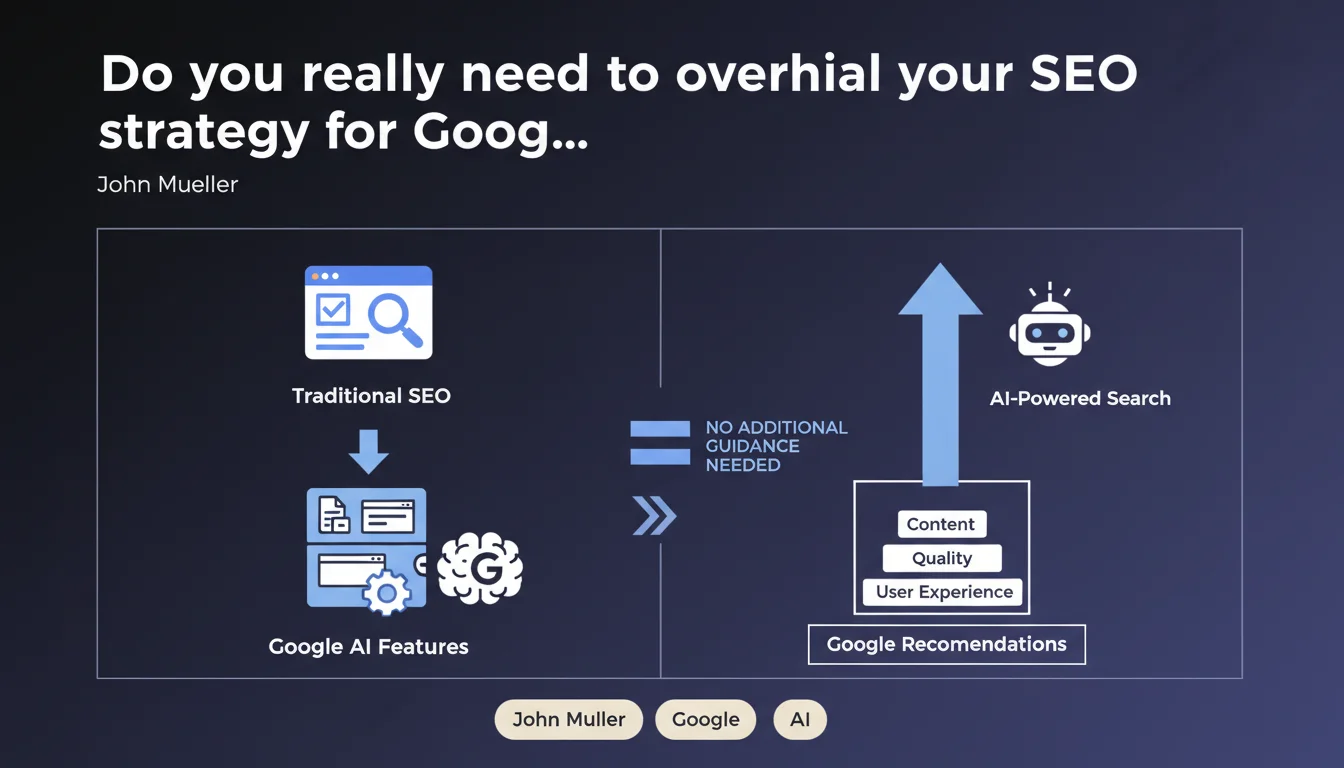
Google claims that classic SEO recommendations remain fully valid for new AI features like AI Overviews. No specific optimization is necessary — existing best practices are enough. A position that simplifies the narrative but may hide important nuances.
What you need to understand
Why does Google insist on the continuity of SEO practices?
John Mueller reminds us that SEO fundamentals established years ago apply without modification to new AI-powered interfaces. Google wants to prevent professionals from over-investing in hypothetical optimizations for features still in evolution.
This statement aims to reassure the SEO ecosystem: no methodological revolution ahead, no new language to master. The relevance signals, authority, and user experience that mattered yesterday still matter today.
What are these traditional recommendations that remain valid?
We're talking about the classic pillars: quality content, solid technical architecture, E-E-A-T signals, optimal user experience. Nothing revolutionary — Mueller reaffirms that Google evaluates pages by the same criteria, regardless of the display surface.
Core Web Vitals, internal linking, semantic relevance, topical authority: all these factors continue to play their role. AI doesn't change the fundamental equation — it just modifies how answers are presented.
Are all AI-powered features identical in how they work?
Google groups diverse surfaces under this term: AI Overviews (formerly SGE), dynamically generated rich snippets, conversational responses. Each uses AI differently, but according to Mueller, the principle remains uniform.
This generalization may seem convenient, but it masks a more nuanced reality. Certain queries trigger specific formats that value content differently depending on their structure, freshness, or format (FAQ, tables, lists).
- Methodological continuity: no break from established SEO practices
- Same evaluation framework: relevance, authority, user experience still matter
- No additional guidance: Google publishes no documentation specific to AI
- Focus on fundamentals: content quality and E-E-A-T signals take priority
SEO Expert opinion
Does this statement really reflect the complexity on the ground?
Let's be honest: Mueller's claim oversimplifies things. On paper, yes, fundamentals remain identical. In practice, certain types of content perform better in AI Overviews — notably those using structured FAQ format, fresh data, and direct answers.
Observations show that Google favors content that answers precisely and quickly, with clear structuring. It's not a revolution, but it is an accentuation of already observed trends. Saying there's no adaptation to prepare for ignores these nuances. [To verify]
What are the limits of this uniform approach?
Mueller presents a monolithic vision where reality is segmented. Short informational queries trigger AI Overviews that capture zero clicks — traffic never reaches the site. Classic recommendations optimize visibility, but not necessarily traffic.
For transactional queries or in-depth content, the impact differs. Google continues to display traditional organic results. The uniformity of the message masks the fact that certain strategies will need to evolve depending on the types of queries you target.
Is this position consistent with observed signals?
Partially. Sites that rank well in traditional organic results often appear in AI Overviews — that confirms continuity of criteria. But we also observe cases where content ranking lower organically is selected for AI because it answers a specific question better.
The fact that Google publishes no specific documentation is telling. Either the criteria are truly identical and no supplement is needed, or — more likely — the mechanisms are still too unstable to be formalized publicly. [To verify]
Practical impact and recommendations
What concretely should you do or avoid?
First rule: don't panic. No need to turn everything upside down to prepare for AI features. If your site already follows SEO best practices, you're on the right track. Keep producing quality content, optimized for user intent.
Second rule: refine your semantic structuring. Use relevant Schema.org tags (FAQPage, HowTo, Article), segment your content with clear subheadings, answer questions directly. It's not a revolution, it's a natural evolution of your current practices.
What common mistakes must you absolutely avoid?
Avoid over-optimizing for features still unstable. Some SEO professionals start creating ultra-short content calibrated solely for AI Overviews — that's a strategic dead end. Google can change its selection criteria overnight.
Don't neglect long-form and in-depth content either under the pretext that AI favors short answers. Both coexist. Expert and detailed content remains valued for complex queries where AI isn't sufficient.
How can you verify your site is correctly positioned?
Audit your content based on E-E-A-T criteria: experience, expertise, authority, trustworthiness. Google Search Console remains your best ally for identifying pages that perform and those that stagnate. Monitor organic CTR evolution — a marked drop may indicate your results are being cannibalized by AI Overviews.
Analyze queries that trigger AI Overviews in your field. Observe which content gets selected and why. Adjust your editorial strategy accordingly, without revolutionizing everything.
- Maintain your SEO fundamentals: technical, content, authority
- Structure your content with relevant Schema.org tags (FAQ, HowTo, Article)
- Answer user questions in a direct and precise manner
- Monitor your organic CTR in Search Console to detect AI impacts
- Continue producing expert and in-depth content for complex queries
- Don't over-optimize for features still experimental
- Analyze AI Overviews in your sector to identify selection patterns
❓ Frequently Asked Questions
Les AI Overviews remplacent-elles les résultats organiques classiques ?
Dois-je créer des contenus spécifiques pour être cité dans les AI Overviews ?
Les signaux E-E-A-T comptent-ils autant pour les fonctionnalités IA ?
Comment savoir si mes pages apparaissent dans les AI Overviews ?
Le trafic organique risque-t-il de chuter avec les AI Overviews ?
🎥 From the same video 8
Other SEO insights extracted from this same Google Search Central video · published on 01/07/2025
🎥 Watch the full video on YouTube →
💬 Comments (0)
Be the first to comment.