
Official statement
Other statements from this video 8 ▾
- □ Do you really need to optimize your site differently for AI Overviews and AI Mode?
- □ Do you really need to overhaul your SEO strategy for Google's AI features?
- □ Do clicks from AI Overviews actually convert better?
- □ Do AI Overviews really drive traffic to a wider range of websites?
- □ Will Search Console's Core Web Vitals recommendations finally make a real difference?
- □ Is the robots.txt file really still useful for controlling AI crawler access in 2024?
- □ Is log analysis really the SEO skill that will outlast everything else?
- □ Should you stop talking about SEO and embrace new terms like AIO, GEO, or LLM optimization instead?
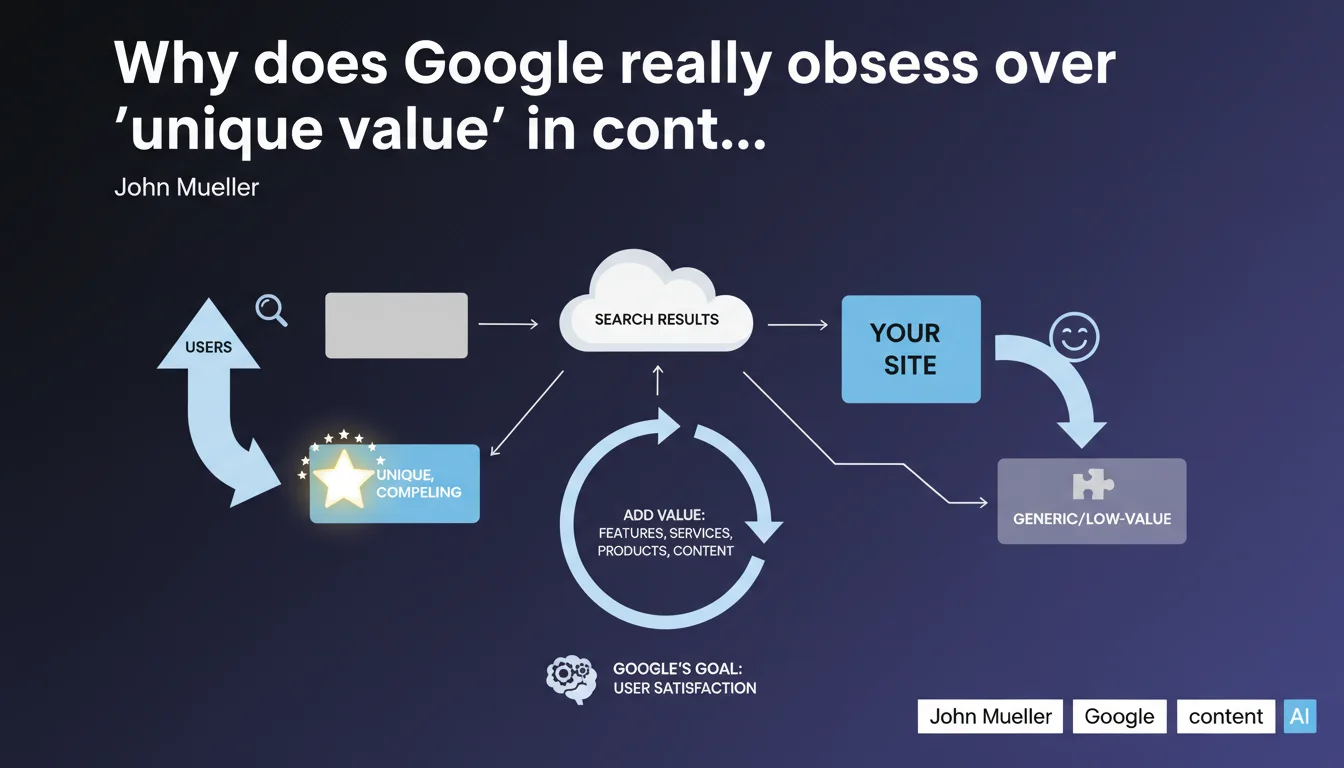
Google is refocusing its messaging on creating unique, high-value content. Mueller recommends analyzing SERPs to identify uncovered angles and delivering distinctive answers. The message is straightforward: stop copying, stand out.
What you need to understand
What does Google really mean by 'unique value'?
Unique value doesn't simply mean rewording what already exists. Google seeks content that brings a different angle, on-the-ground expertise, exclusive data, or superior user experience.
In practice? If ten sites answer the same question with identical structure and information, the one offering a concrete use case, original visuals, or an interactive tool stands out. The algorithm rewards what competitors cannot simply duplicate.
Why this emphasis on content quality in 2025?
With the explosion of AI-generated content, Google faces massive inflation of mediocre pages. The search engine must therefore refine its quality filtering criteria to avoid serving recycled material.
Mueller doesn't say it outright, but this statement aligns with the Helpful Content Updates rollout. If your content resembles what a standard LLM would produce without specific inputs — it risks stagnating.
How do you identify this added value?
The recommended approach is simple: analyze the top 10 for your target query. Spot gaps, unanswered questions, superficially treated angles. That's where you should intervene.
This means not limiting yourself to observing H2 titles. Actually read what competitors offer, measure the depth of their coverage, identify user frustrations in comments or forums.
- Unique value ≠ artificial originality — it's about answering better, not differently for the sake of it
- Google prioritizes distinctive features: calculators, comparators, structured databases
- "High-quality" content combines expertise, depth, and practical utility
- SERP analysis should become a reflex before any content production
SEO Expert opinion
Is this statement consistent with real-world observations?
Yes — and no. Sites relying on generic content are indeed losing ground since recent core updates. But we also see cases where very "standard" content still performs thanks to high domain authority or solid internal linking.
The problem is Mueller doesn't specify the threshold for necessary differentiation. Between "adding two original sentences" and "producing a 15,000-word guide with proprietary data," where's the bar? [Needs verification] — Google provides no numerical metrics.
When doesn't this rule really apply?
Let's be honest: if you're a news site, you can't always deliver "unique value" on every story. Responsiveness sometimes trumps originality.
Similarly, for purely basic informational queries ("capital of Spain"), unique value doesn't really exist. It's the speed of information display and source trust that matter. Mueller's advice applies mainly to moderately competitive content, not the extremes.
What nuances should we add to this recommendation?
Mueller mentions "features, services, products, or content" — and that's crucial. Unique value doesn't always come through text. An interactive comparison table, advanced search filter, or simulation tool can make all the difference.
Be careful not to confuse originality with relevance. Ultra-original content that doesn't directly answer search intent is worthless. Real differentiation is what improves user experience — not what flatters the writer's ego.
Practical impact and recommendations
What should you do concretely to deliver this unique value?
First step: audit your existing content. Identify pages that don't distinguish themselves from competitors — those are prime candidates for overhaul or deindexing.
Next, for each new piece, integrate a phase of systematic SERP analysis. List what competitors do, then identify at least three angles or pieces of information they don't cover. That's your editorial roadmap.
What mistakes must you avoid?
Don't fall into the volume-for-volume trap. Better ten truly distinctive pages than a hundred mediocre ones. UX signals (time on page, bounce rate) quickly reveal hollow content.
Also avoid confusing "unique value" with gratuitous technical jargon. Adding complex terms without real utility won't help. Google measures engagement, not language level.
How do you verify your content is truly differentiated?
Try the blind test method: strip your logo and mix an excerpt of your content with competitors'. If a savvy reader can't identify yours, it lacks editorial signature.
Also track engagement metrics (scroll depth, reading time, clicks on interactive elements). Truly useful content generates measurable behaviors — not just phantom views.
- Conduct a differentiation audit on your strategic pages
- Integrate a SERP analysis phase before any content production
- Prioritize interactive features (tables, calculators, filters)
- Enrich with proprietary data (case studies, internal benchmarks)
- Measure actual engagement beyond rankings alone
- Avoid unqualified volume in favor of depth
❓ Frequently Asked Questions
La valeur unique concerne-t-elle uniquement le contenu textuel ?
Comment Google mesure-t-il concrètement cette valeur unique ?
Faut-il retravailler toutes mes pages existantes ou prioriser ?
Un contenu unique mais peu utile peut-il quand même bien ranker ?
Les sites d'actualité peuvent-ils vraiment apporter une valeur unique sur chaque article ?
🎥 From the same video 8
Other SEO insights extracted from this same Google Search Central video · published on 01/07/2025
🎥 Watch the full video on YouTube →
💬 Comments (0)
Be the first to comment.